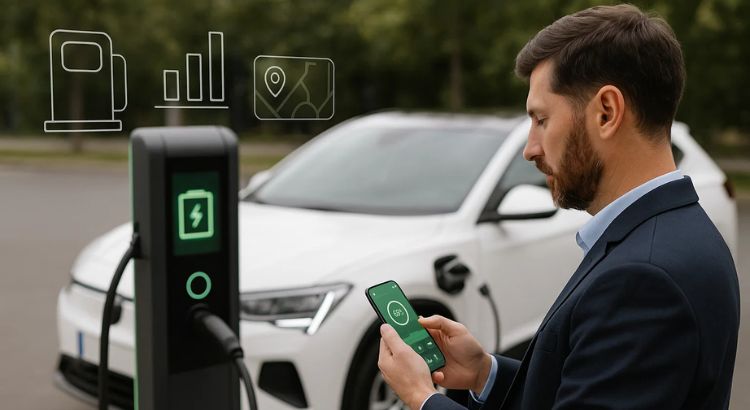
The EV market is not just growing, it is exploding. In 2025 electric vehicle adoption is expected to surpass 20% globally, with charging infrastructure scrambling to keep pace. But here’s the catch: chargers are hardware. Smart charging? That’s all software.
Whether you’re managing a network of public charging stations, building a private fleet, or rolling out EV support in commercial buildings, EV charging management software is no longer a “nice-to-have.” It’s mission-critical.
The real challenge in 2025 isn’t just charging EVs. It’s doing it at scale without chaos, without downtime, and without turning your support team into firefighters.
And that’s exactly where software like Stellen Infotech EV Charging Management Software Solutions fits in.
1. The Real-World Problems EV Charging Software Solves in 2025
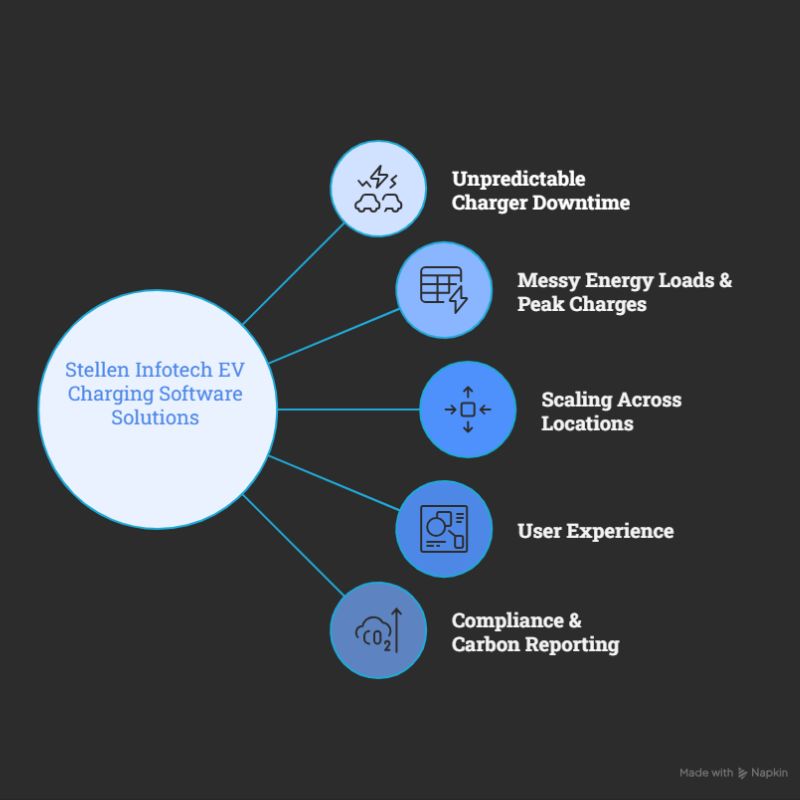
Let’s stop pretending this is just about plugging in a car.
In 2025, the logistics behind that plug-in are where most businesses bleed time, money, and customer trust. That’s why EV charging management software isn’t just a dashboard, it’s your operational backbone.
Here’s what real businesses are dealing with:
1. Unpredictable Charger Downtime
You’ve got hardware installed across multiple sites. Now imagine one charger at a popular location goes down and no one notices for hours. Lost revenue. Frustrated users. One-star reviews.
A good EV charging software:
- Sends real-time alerts on faults
- Automatically flags offline units
- Helps your ops team fix issues fast before Twitter hears about it
2. Messy Energy Loads & Peak Charges
As EV demand spikes, so does your power bill especially during peak hours. Without smart load management, you’re either:
- Overpaying for electricity
- Or overloading the grid (which regulators won’t love)
The right software helps balance energy usage with:
- Load balancing across stations
- Demand response support
- Dynamic pricing models that don’t kill your margins
3. Scaling Across Locations? Say Hello to Chaos
Managing 5 chargers? You can maybe wing it with spreadsheets. Managing 500? You need automation.
A scalable platform gives you:
- A single control center for all stations
- Unified reporting and analytics
- Role-based access so teams don’t step on each other
Whether it’s a corporate fleet or a growing public network, you need control without micromanagement.
4. User Experience That Actually Feels Human
Here’s where many operators drop the ball. You can have the fastest charger in town, but if users can’t:
- Find your station
- Book a slot
- Pay easily
- Or get support when something breaks…
…then your charging network isn’t working.
Modern EV charging software fixes that with:
- Intuitive mobile apps
- Real-time station visibility
- Wallets, QR scanning, subscription plans, and more
Basically, a smooth UX that makes people come back.
5. Compliance & Carbon Reporting
Whether you’re running a fleet or operating stations in the EU or U.S., regulators are turning up the heat. Emissions tracking, energy source reporting, uptime SLAs it’s all on the table now.
Solid software doesn’t just collect data it organizes it in a way that’s:
- Auditor-friendly
- Compliant with ISO/IEC 15118 or OCPP
- Ready for any government or investor report
Where Stellen Infotech Comes In
While most platforms throw in a dashboard and call it a day, Stellen Infotech EV Charging Software tackles all of the above without the bloated interfaces or outdated architecture.
It’s built for 2025, not 2015. And it’s designed with scalability and real-world operations in mind.
No fluff. No patchwork tools. Just one platform that handles it all.
2. Must-Have Features in 2025 (and Why Half the Platforms Miss the Mark)
There’s no shortage of EV charging software in the market. But most of them are either stuck in 2018 or built like Frankenstein too many moving parts, nothing fully connected.
What you need now is deep functionality that doesn’t just tick a box but actually works together. Let’s break it down.
1. Centralized Dashboard for Multi-Station Oversight
Not just a fancy graph. We’re talking about:
- Live status of each charger
- Health diagnostics, usage trends
- Control commands (reset, shutdown, firmware updates)
This is mission control. You need to know what’s happening without logging into 10 portals or calling tech support.
Stellen Infotech unified dashboard doesn’t just show data it gives you actionable control. You can monitor, manage, and maintain your entire charging infrastructure from a single place. Even if you’ve got 5 locations or 500.
2. Load Balancing & Energy Optimization Tools
Electricity isn’t getting cheaper. And in many countries, the grid’s capacity is under serious pressure.
Modern EV software should:
- Auto-distribute charging load to avoid overdraw
- Schedule charging during off-peak hours
- Integrate with solar and on-site storage systems
Their platform offers real-time load distribution with AI-based forecasting. You don’t just reduce bills, you get to play nice with regulators and go greener in the process.
3. Payment Flexibility + Monetization Tools
Users expect the same ease they get from Uber or Netflix. If your payment flow looks like a government form from 2004, you’re out.
Key features:
- Support for wallets, cards, UPI, and contactless payments
- Custom pricing (by hour, kWh, user tier)
- Subscription packages and loyalty points
Full-stack billing engine with API support. Set your own pricing rules, automate invoicing, and plug into existing CRMs or accounting systems. It’s built for scale and profit, not just transactions.
4. Smart Reservation & Queue Management
We’re way past “first come, first serve.” In 2025, time is money. And so is predictability.
Must-haves:
- Slot booking via app or web
- Waiting lists with live updates
- Instant notifications when a charger frees up
With dynamic booking and live sync across platforms, the software ensures clients don’t bounce and station utilization goes up. Good for your wallet, great for user experience.
5. OTA Firmware & Remote Maintenance
If your technician needs to visit a site for every minor update, you’ve already lost.
What you should expect:
- Push firmware updates remotely
- Trigger health diagnostics without being on-site
- Schedule maintenance with downtime impact reports
Stellen Infotech includes remote diagnostics and automated firmware deployment across all charger models. It saves ops teams hours and ensures you’re always compliant and running the latest patch.
6. User Access Controls & Multi-Tiered Roles
Not everyone needs admin power. And not every team member should see financials.
You need:
- Role-based permissions
- Audit logs
- Secure login protocols (2FA, SSO, etc.)
They offer granular access controls that work across enterprise setups so whether it’s a station manager, IT guy, or a third-party vendor, they see only what they need to.
7. OCPP & Open Standards Compliance
This isn’t a nice-to-have. It’s table stakes.
Your software must:
- Support OCPP (Open Charge Point Protocol)
- Integrate with different hardware brands
- Ensure long-term hardware flexibility
They’re not just compliant, they build with open architecture in mind. That means future-proofing and vendor independence, which is gold for long-term strategies.
Bonus Feature: Carbon Footprint & ESG Tracking
Yeah, investors care. Governments care. Even your customers care.
Smart platforms now offer:
- Emissions tracking per charge
- Green energy usage reports
- ESG dashboards for internal and public reports
Stellen bakes this directly into the analytics dashboard. Whether it’s internal ESG goals or prepping for a pitch deck, you’ve got data that backs your sustainability claims.
That wraps up Part 3.
If this all sounds like a lot good. It should be. Because in 2025, basic EV charging software doesn’t cut it. You need something built for scale, built for change, and built for business, not just cables and plugs.
3 How Businesses Are Actually Using EV Charging Management Software to Grow
Forget generic “solutions for everyone.” Let’s look at specific players in the EV ecosystem and how they actually benefit from modern, scalable EV charging software like Stellen Infotech.
1. Fleet Operators: Charging at Scale Without the Headache
Fleets (delivery vans, taxis, corporate cars) are under pressure to go electric. But managing dozens or hundreds of EVs is chaos without the right software.
Real Problems:
- Drivers competing for chargers
- Overdraw penalties from utilities
- Zero visibility into charging costs
How Stellen Helps:
- Scheduled smart charging: Different time slots for different vehicles
- Fleet analytics: Cost per charge, driver-wise efficiency, idle time
- Load optimization: Prevents spikes, spreads load during night hours
“We saved 18% on our monthly electricity bill after switching to Stellen’s platform. And no more 3 AM support calls from drivers who couldn’t charge.” — Operations Lead, Logistics Fleet (Singapore)
2. Commercial Property Owners: From Utility Sinkhole to Profit Center
Whether it’s malls, coworking hubs, or apartment complexes charging stations add value. But only if they’re managed smartly.
Real Problems:
- Chargers being hogged or left idle
- Complaints from tenants
- No way to recoup electricity costs
How Stellen Helps:
- Custom pricing: Charge guests more, offer discounts to tenants
- Live availability via QR/app: Reduces “charger rage”
- Revenue tracking: Know exactly what each station earns
“After 6 months on Stellen, our chargers went from a dead asset to making us $2,300/month. It’s like a vending machine, but smarter.” — Property Manager, Urban Realty Group
3. Charge Point Operators (CPOs): Managing 100s of Locations Without a Bottleneck
This is where scale matters most. CPOs often struggle with multiple hardware vendors, disconnected systems, and messy reporting.
Real Problems:
- Manual reporting to regulators
- Poor customer experience at kiosks
- Lack of real-time oversight
How Stellen Helps:
- OCPP compliance: Works with multiple charger brands
- White-labeling options: Build your brand on top of their infrastructure
- Real-time monitoring + auto alerts: If a charger fails, the system lets you know instantly
“Before Stellen, we were managing 20 platforms. Now we just use one and finally sleep better.” — CTO, Mid-size CPO, Europe
4. Utility Companies & Energy Providers: Partnering With Infra, Not Fighting It
Many utilities are moving from energy providers to energy platforms and EV charging fits right in. But managing demand and integration is not for the faint-hearted.
Real Problems:
- Grid overload
- No real control over user behavior
- Clumsy integration with billing systems
How Stellen Helps:
- Demand response tools: Reduce load during grid stress events
- Smart pricing integration: Change rates in real-time
- Custom API access: Plug into internal systems with minimal friction
“We needed a system that played nice with our energy marketplace—and Stellen delivered. Our dev team didn’t hate it. That’s rare.” — Head of Digital Transformation, Major Utility Firm
5. Franchise Models (Gyms, Restaurants, Hospitality): EV as a Service Differentiator
Offering EV charging doesn’t just help the planet it brings in foot traffic.
Real Problems:
- Guests leave when chargers are full
- No way to track ROI
- Complicated setup for multiple franchisees
How Stellen Helps:
- Reservation and queue system: Keeps guests engaged instead of annoyed
- Data on usage vs. time of day: Optimize your offers and store hours
- Franchisee dashboards: Let each location control their piece without central IT chaos
“EV charging is now one of our top 3 amenities and the only one that literally pays for itself.” — Brand Manager, Hospitality Chain (India)
6. Government & Municipal Projects: Transparent, Trackable, Tamper-Proof
Govt. EV projects are heavily audited, grant-based, and politically sensitive. Mismanaging a charger rollout can cost your job.
Real Problems:
- No real-time visibility
- Expensive custom software tenders
- Reporting nightmares
How Stellen Helps:
- Grant-ready reporting: Instant access to usage, uptime, and maintenance logs
- Public dashboards: Transparency builds trust
- Custom integrations: With traffic, utility, and urban planning systems
“The audits used to take 3 weeks. Now? A few clicks. That’s not just helpful—it’s self-preservation.” — Smart City Program Director, U.S. Midwest
The Common Thread? It’s All About Connected Control
What all these use cases share is the need for:
- Real-time visibility
- Automation that doesn’t feel like rocket science
- Scalability without dev bottlenecks
And that’s what Stellen Infotech EV Charging Management Software delivers.
4 Integration-Ready or Dead on Arrival: Why Open Ecosystems Matter in 2025
The EV ecosystem isn’t one software. It’s a network of hardware, payment systems, utility databases, fleet ERPs, city APIs, and even mobile apps for end users.
So if your charging software doesn’t connect with:
- Your energy supplier’s smart pricing API
- Your billing and accounting tool
- Your fleet telematics
- Or your customer mobile app…
…it becomes the bottleneck. Not the backbone.
Why Closed Systems Don’t Cut It Anymore
Let’s break the illusion: No company in 2025 wants a platform that’s married to one hardware brand or needs a dev team for every tiny integration.
EV software in 2025 has to be:
- Hardware-agnostic
- Protocol-compliant (OCPP 2.0.1, ISO 15118, OCPI, etc.)
- API-rich and modular
If it can’t plug and play, it’s done.
Stellen Infotech’s Integration Philosophy: Build Once, Connect Forever
Unlike vendors who lock you in, Stellen builds their EV charging software with open frameworks from Day
1. That means:
- OCPP compliance (for charger interoperability)
- Open API access (for third-party integrations)
- Custom webhooks (so real-time data flows wherever you want)
Need to push charging logs to SAP?
Sync maintenance status with Jira?
Link your RFID-based access with your HR tool?
It’s already possible.
“We integrated Stellen with our fleet, HR, billing, and energy dashboards in under 10 days. Their docs were cleaner than some code I’ve written.” — Lead Developer, Fleet-as-a-Service Startup
The Mobile User Experience: Connected for the End Customer Too
It’s not just about the backend.
End-users expect:
- Charger availability on Google Maps
- QR-based instant booking
- Loyalty rewards for using your charger network
Stellen’s mobile-friendly stack integrates directly into:
- Custom branded mobile apps
- Wallets like Apple Pay / Google Pay
- EV routing platforms (like PlugShare, A Better Routeplanner)
“Customers don’t even ask ‘Do you have EV charging?’ anymore. They just see us on the map and drive in.” — Franchise Owner, QSR Chain (US East Coast)
Developer-Friendly Without the Drama
Your dev team shouldn’t have to fight your EV software.
Stellen offers:
- RESTful APIs
- Webhooks for real-time triggers
- Sandbox environments for testing integrations
- Postman collections and Swagger docs for faster builds
That means faster go-lives and fewer WTF moments in sprint reviews.
It’s Not “Optional.” It’s the Standard.
In 2025, clients expect that your EV charging software will:
- Sync with energy management systems
- Integrate with EV navigation tools
- Connect with CRMs, billing systems, ERPs, or city infrastructure
Stellen doesn’t treat this as a “premium add-on.”
They’ve built it into the core DNA of the platform.
TL;DR of Integration Must-Haves
| Feature | Why It Matters |
| OCPP 2.0.1 Compliance | Hardware interoperability |
| Public + Private APIs | Endless customization possibilities |
| OCPI Support | Roaming and third-party access |
| Mobile UX Ready | Real-time updates and QR-based booking |
| Developer Sandbox | Faster, cleaner integration |
5. Security, Privacy, and Uptime — The Real Enterprise-Grade Test in 2025
Let’s face it EV software isn’t just a “tech tool” anymore. It’s part of national infrastructure, fleet lifelines, and even city energy grids. That means security, compliance, and reliability aren’t buzzwords—they’re non-negotiables.
And in 2025, clients are asking tougher questions:
- Who has access to the charging data?
- Can the system survive a cyberattack?
Is uptime actually 99.9% or just a marketing number?
Common Risks EV Software Faces Today
If you think hackers don’t care about EV stations, think again. Here’s what’s happening on the ground:
| Risk | What It Can Lead To |
| Poor API security | Exposed customer data or payment leaks |
| Weak charger authentication | Unauthorized usage or manipulation of charging sessions |
| No DDoS protection | Network outages during peak usage |
| No role-based access | Employees snooping or misconfiguring systems |
And in industries like fleet or public infrastructure, these risks can bring legal and financial blowback.
Stellen’s Approach: Military-Grade Without the Military Attitude
Let’s not get dramatic, but Stellen doesn’t mess around with security. Their EV Charging Management Software brings enterprise-grade protection with:
- End-to-End Encryption (TLS 1.3) across all communications
- Role-Based Access Control (RBAC) so teams only see what they’re meant to
- SOC 2 & GDPR Compliance baked into the platform
- Two-Factor Authentication for all admin panels
And it doesn’t stop there.
They also run:
- Regular Penetration Testing
- Audit Logging for All Critical Actions
- Geo-redundant backups and auto failover servers
In short: If something goes wrong, they know it before you do and have the backups ready.
Uptime That Speaks for Itself
Everyone loves to say “99.99% uptime,” but Stellen backs it with:
- Multi-region hosting (AWS + Azure fallback)
- 24/7 uptime monitoring
- Status pages and real-time alerts
- Self-healing auto-scaling architecture
“We’ve processed over 3 million charging sessions in 14 months no downtime, no data loss, no drama.” — CTO, European Charge Point Operator (CPO)
Compliance You Don’t Have to Lose Sleep Over
Depending on your geography, you might need to comply with:
- GDPR
- CCPA
- ISO 27001
- SOC 2
- Or local energy regulatory frameworks
Stellen builds region-aware compliance modules so you’re never caught off guard. Logs, audit trails, consent management it’s already in place.
Data Privacy That’s Actually Private
Unlike platforms that quietly monetize usage data, Stellen gives full data ownership to the business. That means:
- No resale to third parties
- No cookie-tracking nonsense
- Full control over retention and deletion
TL;DR: What Makes Stellen Enterprise-Grade
| Feature | Why It Matters |
| TLS Encryption + 2FA | Bulletproof data transmission |
| SOC 2, GDPR, ISO Compliance | Ready for global enterprise deployment |
| RBAC + Audit Trails | Secure internal governance |
| 99.99% Monitored Uptime | Works when you need it most |
| Region-Specific Data Controls | Stay compliant, stay safe |
6. Fleet Management Tools That Don’t Crack Under Pressure
Managing one EV is easy. Managing 50, 500, or 5,000? That’s a whole different game.
If your charging software wasn’t built with fleets in mind, it shows slow dashboards, confused driver access, lack of reports, and chaos when something breaks. That’s why in 2025, fleet-first EV management features aren’t optional they’re make or break.
Let’s look at what really matters when you’re running EV operations at scale.
What Fleets Actually Need (Not What Most Software Thinks)
Forget the fluff here’s what fleet operators actually ask for:
| Need | Why It Matters |
| Multi-vehicle scheduling | Avoid queues and downtime across 100+ units |
| Driver access control | Make sure only authorized drivers charge and at the right locations |
| Centralized energy insights | Know which depots are power hogs, which vehicles are underutilized |
| Maintenance alerts | Spot issues before they turn into stranded vehicles |
| Billing that makes sense | Split by driver, vehicle, or department without needing Excel nightmares |
| Route-based charge planning | Don’t just charge charge smart, based on where the vehicle is headed next |
How Stellen Infotech Built Fleet-Grade Into the DNA
Here’s where Stellen doesn’t just “offer fleet support” they bake it into every layer of the EV Charging Management Software:
Smart Scheduling
- Bulk assign charge windows by vehicle group, priority, or shift
- Auto-adjust schedules based on battery %, route, or weather disruptions
- Real-time alerts if a scheduled charge didn’t happen
Role-Based Driver Access
- Assign drivers to specific vehicle IDs
- Control access based on day, time, location
- GPS + RFID integration supported
Load Management That Thinks at Scale
- Set charge caps across sites to prevent overload
- Dynamic energy pricing integration to cut peak hour costs
- Integration-ready with building energy management systems
Centralized Billing + Reporting
- Generate line-item billing per driver, vehicle, team, or client
- Custom export templates for accounting software (QuickBooks, Zoho, SAP etc.)
- Filterable reports by kWh, charge time, location, or fleet subgroup
Case Study: Logistics Giant That Scaled from 80 to 600 EVs
A real example a logistics firm in California started with just 80 EVs using generic charger software. Within 3 months of scaling to 250+ vehicles, chaos broke out:
- Drivers couldn’t find chargers
- Invoices were inaccurate
- Uptime reports made no sense
They switched to Stellen.
What changed:
- Maintenance cost dropped by 19% due to early fault alerts
- 96% charging success rate (up from 72%)
- 30+ hours saved weekly by ops team through auto-scheduling
“Stellen didn’t just fix our charging problem — they fixed our workflow.” — Logistics Manager, LA-Based Fleet Ops
Built for Fleets. Not Bent for Fleets.
Let’s be honest: most software companies build for public chargers, then later say “oh yeah, we do fleets too.”
Stellen flipped that. From day one, it was designed to handle complexity, with:
- Tiered access control
- Depot-level energy analytics
- Bulk onboarding tools
- Vehicle ID-based performance insights
This isn’t add-on territory it’s core feature architecture.
TL;DR: Why Fleets Choose Stellen
| Feature | Fleet Benefit |
| Smart bulk scheduling | Stops charge congestion at scale |
| Driver access control | Keeps systems clean and secure |
| Intelligent load balancing | Cuts energy bills and overload risks |
| Multi-layer billing + reports | No more reconciling spreadsheets from 5 departments |
| Enterprise integrations (ERP, CRM) | Fits into your existing fleet stack |
7. APIs and Integrations That Actually Work (And Don’t Suck)
Here’s the harsh truth: EV charging doesn’t happen in a vacuum. Your system needs to talk to your billing platform, your fleet management software, your CRM, your ERP, your mobile app… and maybe even your client’s dashboard.
If your EV charging software can’t integrate cleanly, it turns into a walled garden and nobody has time for that in 2025.
Why Integrations Make or Break EV Software
Let’s not get lost in jargon. You need integrations because:
- Your finance team needs accurate usage data for invoices
- Your fleet team wants to sync vehicle status with the main dashboard
- Your support team needs logs tied to customer accounts
- Your end-users expect real-time updates inside your own app
No integrations double data entry, wrong reports, missed alerts, and a frustrated ops team.
Stellen Infotech Integration Stack: Built for Real-World Ops
Stellen didn’t wait for enterprise clients to beg for integrations they built their software open from day one, so it plays nice with other systems out of the box.
Here’s what’s in the stack:
Open API (REST + Webhooks)
- Push/pull real-time charging data
- Trigger events on charge start, complete, or error
- Connect third-party billing or access tools
- Fully documented with SDKs in Python, JavaScript
Pre-Built Integrations
- Accounting: QuickBooks, Xero, Zoho Books
- Fleet Management: Samsara, Geotab, Fleetio
- CRMs: Salesforce, HubSpot
- ERP: SAP, Oracle NetSuite
- IoT/EMS: Schneider, Siemens, ABB
Secure Authentication
- OAuth2 + API key-based roles
- Rate-limiting and IP whitelisting
- Audit trails on every call
Real Integration, Real Results
One public transport operator in Europe synced Stellen with their legacy depot software using the open API. The outcome?
- 100% real-time charging visibility across 12 cities
- Maintenance logs auto-synced to internal CMMS
- Reports auto-fed into central finance without human input
“Before Stellen, we were manually updating spreadsheets at midnight. Now, the data just flows.” — Head of Fleet Ops, European Transit Co.
Dev-Friendly Documentation (No Stack Overflow Panic)
Most companies throw out a 100-page PDF and call it “API documentation.” Stellen actually supports developers like they matter (because they do).
- Swagger-based interactive docs
- Live testing sandbox
- GitHub examples
- 24/7 Slack dev channel for enterprise clients
Even if you’re not a dev, this matters because faster integrations mean faster deployments, happier clients, and lower dev costs.
Future-Proofing With Modular Architecture
Because tech changes, right?
Stellen’s architecture is modular and service-based, which means:
- New integrations can be added without downtime
- APIs evolve without breaking old workflows
- You’re not locked into “their way” of doing things
TL;DR: Why Integration-First Matters
| Feature | Real-World Benefit |
| Open, well-documented APIs | Faster rollouts, no vendor lock-in |
| Pre-built enterprise syncs | Saves weeks of custom dev work |
| Modular architecture | Adapts with your tech stack as it grows |
| Dev-friendly experience | Makes in-house teams actually want to use it |
8. Security & Compliance – You Either Have It or You’re a Liability
Charging infrastructure is no joke. It’s not just about plugging in cars you’re handling:
- Energy consumption data
- Customer payment details
- Driver access logs
- Enterprise credentials
- And sometimes even government integrations
Now imagine one data breach… one rogue API call… one vulnerability exposed. Your software isn’t just down your client’s fleet, their trust, and maybe their contract are gone.
So no, security isn’t some backend afterthought. It’s mission-critical, and in 2025, it better be bulletproof.
The Real Security Risks in EV Charging Platforms
Let’s stop pretending it’s just about SSL certificates. Here’s where the cracks usually show:
| Weak Spot | What Can Go Wrong |
| Poor access control | Unauthorized users accessing charger controls |
| Unencrypted data streams | Leaked energy logs, user data, or location trails |
| Weak APIs | Bot attacks, rate floods, fake transactions |
| Non-compliant storage | GDPR, ISO, or NIST violations hello, lawsuits |
| Firmware gaps | Chargers becoming attack vectors especially public ones |
So if your EV charging software doesn’t address these from Day 1, it’s not “enterprise-grade” it’s just a ticking time bomb.
How Stellen Infotech Locks It All Down
Security is not a feature it’s a culture. And Stellen has layered it from core to cloud.
End-to-End Encryption
- TLS 1.3 for all data in transit
- AES-256 for data at rest
- Encrypted local storage for offline charger syncing
Role-Based Access (RBAC)
- Granular control for admins, drivers, partners
- Time-based and event-based access expiry
- Audit logs on every action taken in the system
Compliance Built-In
- GDPR (EU privacy)
- SOC 2 Type II (Enterprise SaaS standard)
- ISO 27001 (Global info security framework)
- OCPP 2.0.1 Secure Profile (For charger communication protocols)
Continuous Monitoring + Pen Testing
- 24/7 threat detection
- Quarterly third-party pen testing
- Incident response plans with rollback protocols
Secure Doesn’t Mean Slow (Or Annoying)
Stellen keeps the platform snappy and intuitive without cutting corners. How?
- Single Sign-On (SSO) support with SAML 2.0
- 2FA that actually works across devices (not just marketing speak)
- API security keys that rotate on policy not when someone remembers
And yes they notify you before something becomes a threat.
Data Privacy for the Global Market
If your clients span countries, you’re juggling privacy laws from:
- GDPR (EU)
- CCPA (California)
- LGPD (Brazil)
- PDPA (Singapore)
- and more…
Stellen’s system lets you localize:
- Data storage region
- Consent management flows
- Anonymization protocols
That means you can go global without turning into a legal mess.
TL;DR: Security That Speaks Enterprise
| Security Layer | Stellen’s Edge |
| Encryption | End-to-end + AES-256 at rest |
| Role-based access | Full control, audit trail, expiry settings |
| Global compliance | GDPR, ISO 27001, SOC2, and more |
| Real-time threat detection | Stops breaches before they start |
| Enterprise features | SSO, 2FA, policy-based API key rotation |
Real-Time Monitoring & Analytics – Because Gut Feeling Won’t Scale
Your chargers are live 24/7. So should your insights.
It’s not enough to log events or download CSVs. In 2025, operators need real-time dashboards, proactive alerts, and predictive analytics all baked into the EV charging management software, not added on later.
You want to know what’s happening now, not what broke yesterday.
Why Real-Time Monitoring Matters (More Than You Think)
Here’s what a solid monitoring system should track in real time:
| Metric | Why It Matters |
| Charger status (online/offline) | Instant downtime detection → No lost revenue |
| Energy throughput | Track usage patterns, optimize grid load |
| Session success rate | Identify hardware/software failure trends |
| Queue & reservation insights | Reduce customer friction during peak times |
| Driver behavior analytics | Reward good usage, flag abuse |
| Fault codes & alerts | Catch issues before they turn into PR disasters |
If your system isn’t surfacing these without refreshing the page… that’s not management, that’s guesswork.
What Stellen Infotech’s Platform Offers
Stellen didn’t build a dashboard just to tick a box. They built it so operators, technicians, and even marketing teams can all get value instantly.
Live Dashboard View
- See the status of every charger on the map, in real time
- Color-coded health indicators for quick troubleshooting
- Toggle between location, station, or fleet-level views
Predictive Maintenance Alerts
- Detects abnormal charger behavior before it breaks
- Sends alerts based on thresholds (e.g. overheating, voltage drop)
- Integrates with technician scheduling for faster fixes
Usage Heatmaps & Peak Forecasting
- Visualize when and where traffic is surging
- Plan load balancing and maintenance without disrupting users
- Forecast usage to prep for holidays, seasons, or rollout spikes
Session Analytics
- Time spent per session
- Energy delivered
- Plug-in vs actual charging time (a key driver frustration)
- Drop-off points (where drivers quit mid-process)
Bonus: Data That Actually Does Something
Lots of software give you data. Stellen gives you actionable insights.
- Financial reports tied directly to energy sold
- Energy insights segmented by power levels and charger types
- API integrations with fleet management tools & CRMs
- Custom KPIs for operators running multi-location networks
Whether you’re running 10 stations or 1,000 this stuff saves time, money, and support headaches.
TL;DR: Monitoring That’s Actually Usefull
| Feature | What Stellen Offers |
| Live charger view | Real-time map with status and color indicators |
| Predictive fault alerts | Stops problems before they cost you money |
| Analytics for ops & strategy | From usage to revenue to driver behavior |
| Peak time forecasting | Stay ahead of traffic, don’t react to it |
| Integration-ready | Plug into your CRM, fleet, or energy tools easily |
9. Integrations & API Power — Plug Into the Tools You Already Use
The truth? EV charging software isn’t your only tool it’s part of a tech stack.
You’ve got CRM systems. You’ve got billing platforms. You’ve got fleet dashboards, energy monitoring tools, ERP systems, maybe even legacy hardware still in the field. The last thing you need is software that forces you to use its way of doing everything.
This is where integration-first design separates scalable platforms from short-term hacks.
Why Integrations Make or Break Scalability
The more you grow, the more tools you need to talk to each other. Manual workarounds are fine when you’re testing. But at scale? They’re slow, expensive, and error-prone.
Here’s what a scalable EV charging software should integrate with:
| System Type | Use Case |
| CRM (like Salesforce) | Know your customers better, track usage trends |
| Billing systems (Stripe, Razorpay) | Automate collections, refunds, invoices |
| Fleet management platforms | Real-time sync of charging sessions and driver data |
| ERP tools (SAP, Zoho, etc.) | Tie energy and maintenance costs to budgets |
| IoT Platforms | Sync charger telemetry with third-party analytics |
| Grid management APIs | Coordinate charging with local energy demands |
What Stellen Brings to the Table
This isn’t just a “we-have-an-API” situation. Stellen’s platform was designed with developers in mind from Day 1.
API-First Architecture
- Full REST API access for charger control, user data, sessions, and payments
- Webhooks for real-time event notifications
- Built-in docs and sandbox environment for easy onboarding
Plug-and-Play Integrations
- CRM: Connect with Salesforce, HubSpot, Zoho
- Billing: Stripe, PayPal, Razorpay native support
- Fleet: Easily map charging sessions to vehicles and drivers
- Custom? Stellen supports private APIs and internal tools
Developer Support (That Actually Replies)
- Slack channels for integration teams
- Dedicated solution engineers for enterprise setups
- No runarounds, no red tape
How This Helps Real Businesses
Let’s say you run a 50-charger network across 4 cities. You’ve got:
- A customer portal on WordPress
- Payments via Razorpay
- Vehicle data from your fleet dashboard
- Load balancing set by your grid utility
Instead of juggling 4 dashboards, Stellen lets you pull all of it into one pane of glass. That’s what “real integration” looks like it saves hours every week and lets you scale without the chaos.
TL;DR: The Platform That Plays Nice
| Feature | Stellen’s Offering |
| REST API | Full control over users, chargers, billing |
| Native integrations | CRM, payments, fleets, and energy tools |
| Developer resources | Docs, sandbox, support all actually useful |
| Custom build flexibility | For enterprise teams and non-standard workflows |
10. AI & Automation — Smarter Charging Without Manual Madness
Look, the EV industry isn’t just about plugging in cars anymore. It’s about plugging into data, predictions, and decisions made before a human even blinks.
AI in EV charging software isn’t a gimmick it’s essential for scaling fast, reducing energy waste, and making operations run without 24/7 hand-holding.
What Does AI Actually Do in Charging Management?
Forget the buzzword. Here’s where AI is actively making an impact:
| Use Case | How AI Helps |
| Load Forecasting | Predicts energy demand per site, per hour, so you don’t overload the grid |
| Driver Behavior Prediction | Knows when and where your users are likely to charge next |
| Dynamic Pricing | Automatically adjusts pricing based on time of day or charger demand |
| Route Optimization (Fleet) | Suggests best charging stops for commercial EVs based on range + wait time |
| Anomaly Detection | Flags faulty chargers before customers notice issues |
| Support Automation (Chatbots) | Handles basic driver queries instantly no human agent needed |
Stellen’s Approach to Intelligent Automation
Here’s the thing a lot of platforms bolt on “AI” like a marketing sticker. Stellen bakes it into the system.
Smart Load Distribution
- The system doesn’t just react it predicts peak demand based on historical usage, weather, and grid load.
- Auto-load balancing kicks in without your ops team lifting a finger.
Dynamic Smart Pricing
- Want to incentivize night-time charging? Or charge more during peak hours?
- Stellen’s pricing engine lets you schedule and automate rates based on:
- Time of day
- Charger type
- Location
- Energy cost forecast
Predictive Maintenance
- AI monitors charger performance metrics in real-time.
- If a unit starts slowing down or heating up?
Instant alerts before it becomes a real failure.
Driver Support on Autopilot
- Integrated chatbot support handles 80% of user queries (session issues, payment status, charger location).
- Live agents only jump in when escalated.
Let’s Be Real: This Isn’t Luxury — It’s Necessary
When you’re managing 10 chargers, you can babysit them.
When you’re managing 100? Or 1,000 across states?
Manual control breaks. AI automation isn’t a bonus feature it’s the thing that stops your support tickets from exploding, your grid from frying, and your drivers from leaving bad reviews.
TL;DR: Set it, Don’t Sweat it
| Function | Automated By Stellen? |
| Load shaping | Yes – based on AI forecasts |
| Pricing management | Yes – time/location-based |
| Charger health monitoring | Yes – predictive failure alerts |
| Support + FAQs | Yes – AI chatbot built-in |
| Fleet routing | In development with partners |
11: Security & Data Privacy — The Non-Negotiables in 2025
If EV software is the engine, data is the fuel. But if that data leaks? You’re looking at compliance fines, pissed-off customers, and a serious hit to brand trust. In 2025, security is not a feature. It’s the baseline.
And with EV charging software collecting everything from user IDs to payment info to real-time location data, the risks are real. Especially for fleet operators and multi-site businesses.
What Kind of Data Are We Talking About?
Let’s break it down. A charging management platform typically handles:
- Location Data: Where charging events happen and where users travel
- Payment Info: Card tokens, wallet balances, invoices
- User Accounts: Phone numbers, emails, EV license plates
- Usage Patterns: Peak hours, personal charging behavior
- Charger Health Logs: Diagnostics, firmware updates, failure reports
Even one leak from any of these can put a business in hot water.
The 2025 Security Checklist — What Modern Software Must Do
Here’s the minimum any serious EV charging management software should offer:
| Security Layer | Why It Matters |
| Data Encryption (at rest + in transit) | So even if intercepted, your data stays unreadable |
| Role-Based Access Controls (RBAC) | No more “everyone sees everything.” Only assigned roles can access specific data |
| Two-Factor Authentication (2FA) | Stops unauthorized logins even if credentials leak |
| Audit Trails & Logs | Keeps record of who did what, when super handy in breach investigations |
| Tokenized Payment Handling | Keeps card data secure via PCI-compliant partners |
| GDPR & CCPA Ready | Essential for legal compliance especially in EU, California, and beyond |
How Stellen Keeps It Clean and Secure
Stellen Infotech treats your backend like Fort Knox. Here’s what sets its software apart:
End-to-End Encryption
All user sessions and payment traffic are encrypted using TLS 1.3 with advanced cipher suites.
Admin Control You Actually Control
Assign different access levels to:
- Station managers
- Regional leads
- Support staff
- Technicians
No accidental exposure. No chaos.
Real-Time Logs & Alerts
Every access attempt, firmware push, or config change is logged and if something looks shady, you get a real-time alert.
Regulatory Compliance = Built-In
Stellen’s platform ships with:
- GDPR-ready consent tools
- Cookie control for public portals
- Easy data deletion/export features
- CCPA opt-outs
Fleet or Public Charging? Don’t Skip Security.
If you’re running:
- Public chargers in cities
- Corporate charging for employee EVs
- A commercial fleet…
You need to take extra care, because:
- Multiple users = higher breach risk
- Physical devices = higher tampering risk
- Public exposure = higher brand damage if something leaks
TL;DR: Security Is Silent… Until It Isn’t
Here’s what you risk by ignoring security in EV software:
- Data breach
- Compliance fine
- Lawsuit
- Brand trust wiped out
Stellen takes all that off your plate. Secure-by-default, not optional.
12: What Sets Stellen Infotech Apart — No Gimmicks, Just Grit
A lot of software out there talks big: “intelligent,” “intuitive,” “end-to-end platform” yeah, we’ve heard it all.
But when rubber meets the road, most of them either:
- Struggle to scale
- Buckle under real-time demand
- Or make you hire 3 extra people just to manage the “automated” software
Stellen doesn’t play that game.
It’s built for operators, owners, and fleet managers who actually care about performance, uptime, and profitability.
Why Stellen’s EV Charging Software Hits Different
Here’s what makes it stand out straight from real implementation scenarios:
1. Built for Multi-Site, Multi-Role, Multi-Scale Ops
- Whether you manage 5 stations or 500, the interface doesn’t get cluttered.
- From HQ dashboards to location-level access everything’s separated, clean, and fast.
2. Designed with Real Operators, Not Just De
- The product wasn’t cooked up by someone who’s never seen a charging port.
- Stellen works closely with actual EV fleet managers and CPOs to build workflows that match real-world chaos not a perfect-world spreadsheet.
3. Seamless Integrations (API Game is Strong)
- CRM?
- Billing & invoicing?
- Vehicle telematics?
- Load management systems?
Whatever tools you’re already using Stellen plugs in and talks to them in real time.
4. Support That Knows More Than Just “Have You Tried Turning It Off?”
- 24/7 tech support with actual product engineers on standby
- No generic replies. No 48-hour email loops. Just fast fixes.
5. Enterprise Flexibility With Startup Speed
You don’t need to wait 6 months and 10 meetings for a minor update.
- The platform’s modular.
- Customizations are actually… customizable.
- And new features roll out faster than your competitors can catch up.
Real Talk — Is This Software for You?
Here’s the type of businesses Stellen actually serves best:
| Ideal Use Case | Why It Works With Stellen |
| EV fleets (logistics, delivery, public transport) | Real-time monitoring + route optimization tools + APIs |
| Charging networks (cities, commercial hubs) | Scalable OCPP support, public portals, dynamic pricing |
| Enterprises with employee charging | User authentication, multi-role permissions, billing by department |
| Property developers / malls | Intuitive public charging, QR payments, usage analytics |
If that’s your category you’ll feel right at home.
Final Thoughts: 2025 is About Control, Not Chaos
EV charging isn’t in its early stage anymore. It’s not a side hustle or a niche product. It’s part of the core utility infrastructure of tomorrow.
And managing that kind of system needs:
- Uptime.
- Intelligence.
- Scale.
- Security.
- And zero BS.
Stellen Infotech gets it.
Their EV charging management software isn’t the flashiest but it’s the most dependable, flexible, and future-ready you’ll find in 2025.
No overcomplicated dashboards. No hype. Just power, performance, and peace of mind.