A custom web application can help a business automate repetitive work, connect different systems, manage information more efficiently, and create digital experiences around its specific processes.
Unlike off-the-shelf software, a custom web application is built around the way your business actually operates. That makes it useful when standard tools do not provide the functionality, integrations, or workflows your team needs.
But building a custom application is not automatically the right choice for every business. The real question is whether a custom solution can solve a problem that existing software cannot solve efficiently.
In this guide, we’ll look at what custom web applications are, how they can improve business operations, what you can build with them, and when investing in one makes sense.
What Is a Custom Web Application?
A custom web application is software developed specifically for a business, its users, and its operational requirements. Unlike a standard website, a web application allows users to interact with data, complete tasks, manage workflows, or use business-specific functionality through a web browser.
Examples include:
- Customer portals
- CRM systems
- Employee portals
- Inventory management systems
- Booking platforms
- Project management tools
- Document management systems
- B2B and B2C portals
- Business process automation platforms
For example, a company that currently manages customer requests through emails and spreadsheets could build a web application where customers submit requests, employees manage them, and managers track progress from a centralized dashboard.
That is where custom web application development becomes valuable. The software is designed around the business process rather than forcing the business to change its process to fit a generic tool.
Website vs Web Application: What’s the Difference?
A website and a web application may both run in a browser, but they serve different purposes.
A website is generally designed to provide information. A company website, blog, service website, or portfolio is a typical example.
A web application is designed for interaction. Users can log in, submit information, manage records, complete tasks, make bookings, access dashboards, or interact with business systems.
For example:
Website:
A customer visits a company’s website to learn about its services.
Web application:
The same customer logs into a portal to place an order, check its status, download an invoice, or submit a support request.
If your business needs users to perform actions rather than simply consume information, a web application may be the more suitable solution.
Custom Web Application vs Off-the-Shelf Software
Before investing in custom development, it is worth asking whether an existing software product can already solve the problem.
| Factor | Custom Web Application | Off-the-Shelf Software |
|---|---|---|
| Business workflows | Built around your processes | You adapt processes to the software |
| Features | Developed according to requirements | Predefined features |
| Integrations | Can be designed around your systems | Depends on available integrations |
| User experience | Fully customizable | Limited to available options |
| Scalability | Can be planned around business requirements | Depends on the provider |
| Initial investment | Usually higher | Usually lower |
| Best suited for | Unique or complex requirements | Standard business needs |
Off-the-shelf software can be the better choice when your requirements are straightforward and an existing product already does what you need.
Custom development becomes more attractive when your workflows are unique, several systems need to work together, or existing software creates more limitations than solutions.
How Can a Custom Web Application Improve Your Business?
The biggest value of a custom web application is not the technology itself. It is what the application allows your business to do more efficiently.
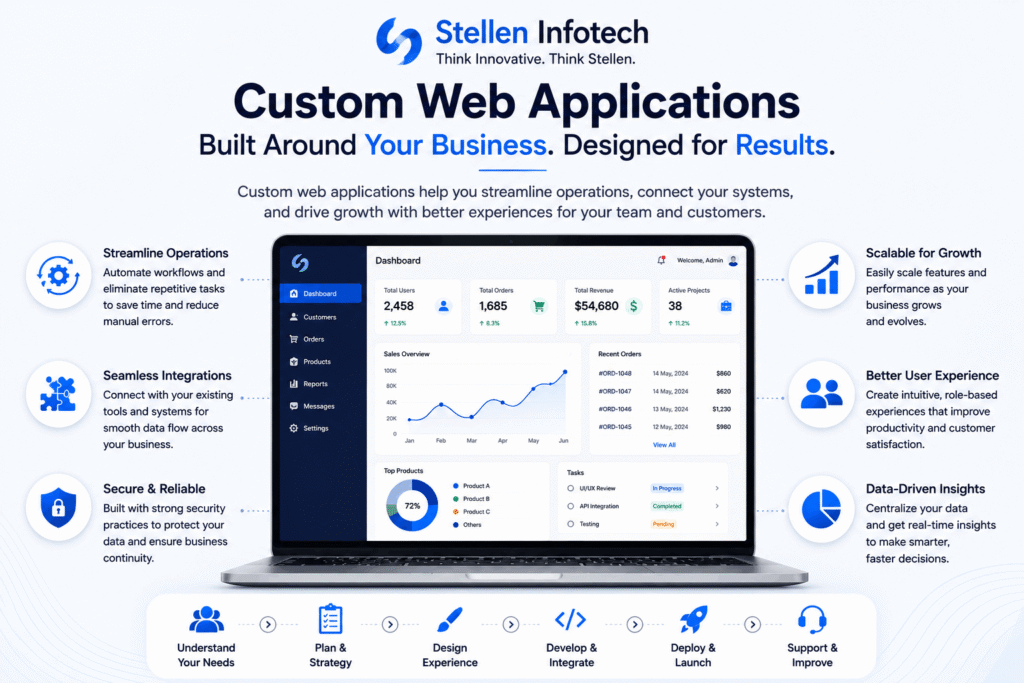
1. Automate Repetitive Business Processes
Many businesses still rely on manual data entry, spreadsheets, emails, and repetitive approval processes.
A custom web application can automate parts of these workflows.
For example, an application could automatically:
- Assign tasks to employees
- Send notifications
- Generate reports
- Update records
- Route approval requests
- Create invoices
- Track customer requests
- Move information between connected systems
Automation can reduce repetitive work and give employees more time to focus on tasks that require human judgment.
The goal is not to automate everything. It is to identify processes where manual work creates unnecessary delays, duplication, or errors.
2. Build Workflows Around Your Business
Every business has its own way of handling customers, employees, orders, approvals, documents, or internal operations.
Off-the-shelf software may not always match those workflows.
A custom application can be designed around the process your business already follows.
For example, a manufacturing company may need a workflow that moves an order through quotation, approval, production, quality checking, dispatch, and delivery. Instead of managing each stage through separate tools, a custom application can bring the workflow into one system.
This can make responsibilities clearer and give teams better visibility into what is happening at each stage.
3. Connect Different Business Systems
Businesses often use multiple tools for different functions, such as CRM, accounting, payments, inventory, marketing, and customer support.
The problem starts when these systems do not communicate properly.
Employees may have to copy information from one system to another, which takes time and creates opportunities for errors.
A custom web application can integrate with existing systems through APIs and other integration methods.
For example, a business could connect its:
Website → CRM → Payment Gateway → Inventory System → Accounting Software
When these systems work together, information can move between them without requiring employees to repeatedly enter the same data.
4. Centralize Business Data
Important information can become difficult to manage when it is spread across spreadsheets, emails, individual software tools, and separate databases.
A custom application can bring relevant information into a centralized environment.
Depending on the application, employees could use dashboards to view:
- Customer information
- Sales activity
- Orders
- Inventory
- Tasks
- Project status
- Financial or operational reports
- Support requests
Having information available in one place can make it easier for teams to find what they need and make decisions using current data.
5. Improve Customer Experience
Custom web applications are not limited to internal business processes.
They can also create better digital experiences for customers.
For example, a customer portal can allow users to:
- Create an account
- View orders
- Track requests
- Download documents
- Update account information
- Make payments
- Submit support tickets
- Communicate with the business
Instead of relying on employees to handle every request manually, customers can complete common tasks themselves.
This can make the experience faster and more convenient while reducing repetitive support work.
6. Support Business Growth
A custom application can be designed with future requirements in mind.
As the business grows, you may need:
- More users
- New workflows
- Additional integrations
- New dashboards
- More automation
- Additional user roles
- New customer-facing features
A well-planned application can be expanded as these requirements emerge.
However, scalability should be considered during architecture and development. Simply building a larger application does not guarantee that it will scale well.
7. Improve Collaboration Between Teams
When different departments work with separate information and processes, communication can become difficult.
A centralized web application can give employees access to the same information based on their roles and permissions.
For example, sales can update customer information, operations can manage fulfillment, and management can view relevant reports without relying on separate spreadsheets or long email threads.
Role-based access also means users can see the information and functions they actually need.
8. Give Your Business More Control Over Functionality
One of the biggest differences between custom and off-the-shelf software is control.
With a custom application, functionality can be developed around your requirements rather than being limited to the features provided by a software vendor.
This can be useful when your business has a process that is difficult to handle with standard software.
However, more control also means more responsibility. A custom application needs proper development, testing, security updates, monitoring, and ongoing maintenance.
What Can You Build With a Custom Web Application?
Custom web applications can support a wide range of business requirements.
Customer Portals
A customer portal can give users a secure place to manage accounts, orders, documents, payments, and support requests.
CRM Systems
A custom CRM can organize customer information, leads, sales activities, follow-ups, and reporting around the company’s sales process.
Inventory Management Systems
Businesses can use custom applications to manage inventory, stock movements, orders, suppliers, and related operational workflows.
Employee Portals
An employee portal can centralize internal resources, requests, documents, communication, approvals, and other HR or operational processes.
Project Management Applications
Teams can manage projects, tasks, deadlines, resources, documents, and progress through a centralized platform.
Booking and Reservation Platforms
Custom booking applications can manage availability, reservations, payments, notifications, and customer information according to specific business rules.
B2B and B2C Portals
Businesses can build portals for customers, suppliers, distributors, partners, or other users who need controlled access to products, services, data, or workflows.
When Does Your Business Need a Custom Web Application?
A custom web application may be worth considering when your business faces problems that standard software cannot address effectively.
Some common signs include:
- Employees spend significant time on repetitive data entry
- Your team relies heavily on spreadsheets for core processes
- Several systems contain duplicated information
- Your existing software does not match your workflow
- Customers need a dedicated online portal
- Manual approvals are slowing down operations
- You need integrations that standard software does not support
- Your business has unique processes or rules
- You need functionality that cannot be provided by existing SaaS products
The important point is to start with the business problem, not the technology.
If a custom application does not solve a meaningful operational or customer problem, there may be little reason to build one.
When Is Off-the-Shelf Software a Better Choice?
Custom development is not always the best option.
An existing SaaS or off-the-shelf product may be more appropriate when:
- Your requirements are standard
- A reliable product already solves your problem
- You need to launch quickly
- Your budget does not justify custom development
- You do not need extensive integrations
- Your workflows are unlikely to require significant customization
For example, if your business only needs standard project management functionality and an established platform already meets those requirements, building a new project management system may not make financial or operational sense.
Custom development should have a clear business justification.
How Much Does a Custom Web Application Cost?
There is no fixed price for custom web application development because every project has different requirements.
The overall cost can depend on:
- Number of features
- Application complexity
- Number of user roles
- UI and UX requirements
- Third-party integrations
- Backend architecture
- Security requirements
- Testing requirements
- Number of platforms or devices
- Ongoing maintenance
A simple internal application will have very different requirements from a large customer portal connected to multiple business systems.
The best way to estimate the cost is to first define the business requirements and prioritize the features needed for the initial release.
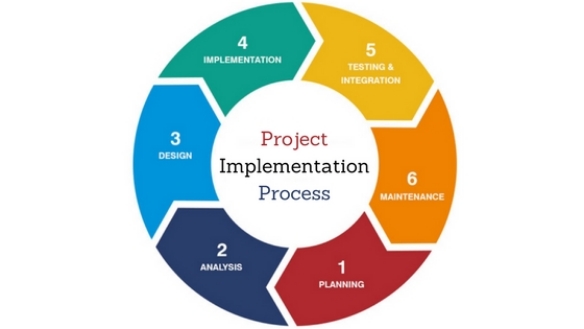
How to Build a Custom Web Application
A successful application starts with understanding the problem it needs to solve.
A typical development process includes:
1. Define the Business Requirements
Identify the problem, users, workflows, required features, integrations, and expected outcomes.
2. Plan the Application
Define the technology architecture, database structure, user roles, integrations, project scope, and development priorities.
3. Design the User Experience
Create the interface and user flows around how people will actually use the application.
4. Develop and Test
Develop the application while testing functionality, performance, compatibility, security, and usability.
5. Deploy the Application
Once the application has been tested and approved, it can be deployed for its intended users.
6. Maintain and Improve
After launch, applications require monitoring, security updates, bug fixes, performance improvements, and new features as business requirements change.
Is a Custom Web Application Worth the Investment?
A custom web application can be a valuable investment when it solves a specific business problem and produces measurable operational or customer benefits.
The strongest business cases usually involve reducing manual work, connecting disconnected systems, improving access to information, supporting complex workflows, or creating functionality that existing software cannot provide.
The decision should therefore be based on the expected business value rather than simply the number of features an application can have.
Frequently Asked Questions
What is a custom web application?
A custom web application is software developed specifically around a business’s workflows, users, requirements, and processes. It can support functions such as customer portals, CRM, inventory management, bookings, reporting, and business process automation.
What are the benefits of custom web applications?
Custom web applications can help businesses automate repetitive processes, connect systems, centralize data, improve customer experiences, support unique workflows, and provide functionality that standard software may not offer.
Is a custom web application better than SaaS software?
Not always. SaaS is often the better choice when standard functionality meets your requirements. Custom development makes more sense when your business has unique workflows, integration requirements, or functionality that existing software cannot provide.
Are custom web applications secure?
Security depends on how an application is designed, developed, deployed, and maintained. Measures such as authentication, role-based access control, encryption, secure coding practices, testing, monitoring, and regular updates can help protect the application and its data.
How long does it take to build a custom web application?
The development timeline depends on the application’s complexity, features, integrations, design requirements, testing needs, and project scope. A simple application may take considerably less time than a large enterprise platform with multiple integrations and user roles.
Can a custom web application integrate with existing software?
Yes. Custom web applications can integrate with other systems using APIs and other integration methods. This can allow businesses to exchange information between systems such as CRM, accounting, payment, inventory, and other business platforms.
How much does custom web application development cost?
The cost depends on the scope and complexity of the project. Features, integrations, user roles, design, security, testing, and ongoing maintenance can all affect the final cost. A requirements assessment is needed to provide a meaningful estimate.
Build a Web Application Around Your Business
A custom web application should do more than add another piece of software to your business. It should solve a real problem, simplify workflows, connect the systems you already use, or create a better experience for your customers and employees.
If your business has requirements that standard software cannot handle effectively, Stellen Infotech provides web application development services for custom business applications, portals, integrations, and enterprise solutions.
The first step is to define the problem you want the application to solve, then determine whether custom development is the right solution for it.