Are you tech wizards or Node.js enthusiasts seeking ways to boost the performance and scalability of your Node.js applications? If yes, you have landed in the right place! Node.js has revolutionized web development by enabling developers to build fast, scalable, and efficient applications using a familiar language. It has gained immense popularity for its non-blocking, event-driven architecture, for building node js performance APIs, and web applications. However, even the most well-designed applications may face performance challenges as they scale.
In this blog, we will go deep into some invaluable tips and strategies to optimize your Node.js applications. These tips will surely be helpful in enhancing performance monitoring and achieving higher scalability. So, sit back and get ready to discover the true potential of your Node.js projects.
Most Effective Ways to Achieve Your Business Goals
As you aim to scale your Node.js applications, remember your ultimate goal: achieving business success with better performance and smooth scalability. In this section, we will unveil the most effective ways to optimize your Node.js projects and elevate your business to new heights.
Node.js Performance Monitoring: Insights for Success
Before beginning with the optimization journey, it is crucial to gain a comprehensive understanding of your application’s performance. Implementing robust node js performance monitoring tools allows you to identify constriction, measure resource consumption, and detect potential issues in real time.
Selecting the Right Performance Monitoring Tool is crucial in optimizing the journey. Explore popular tools like New Relic, AppDynamics, and Prometheus to capture vital metrics like response times, CPU and memory usage, and database queries.
Performance Optimization Techniques for Node.js
Enhancing the performance of your Node.js API or web application involves a combination of smart coding practices and strategic architectural decisions. Some most important strategies for node js performance optimization include:
Asynchronous Programming: Take advantage of Node.js’s event-driven nature and asynchronous capabilities to handle multiple requests concurrently. It will substantially enhance the website’s performance by reducing response time and improving scalability.
Caching Mechanisms: Implement caching strategies like Redis or in-memory caching to store frequently accessed data, minimizing the need for repeated computations and database queries.
Database Optimization: Optimize database queries, utilize indexing, and employ connection pooling to reduce latency and enhance data retrieval efficiency.
Microservices Architecture: Scalability Redefined
Microservices architecture is a game-changing approach to achieve scalability for modern web applications. Such architecture breaks down large applications into smaller, independent services that communicate via APIs. This approach allows you 壯陽藥to scale individual components based on demand, making your application more flexible and resilient.
While microservices architecture offers immense benefits, it also introduces challenges, such as managing communication between services, monitoring, and increased operational complexity. Therefore, proper planning, design, and use of technologies like service mesh and API gateways are essential for a successful microservices implementation.
Load Balancing and Horizontal Scaling
Load balancing and horizontal scaling techniques ensure high availability, optimal performance, and seamless scalability of your Node.js applications. These strategies work collaboratively to distribute incoming traffic and efficiently handle increasing workloads.
Load Balancing:
Load balancing involves distributing incoming requests across multiple servers or instances to prevent overloading a single server. This ensures that each server handles a fair share of the traffic, minimizing response time and avoiding performance obstacles. Load balancers act as intermediaries between clients and servers, intelligently directing requests to the least busy server based on predefined algorithms. It benefits in improving performance, automating traffic redirection, boosting scalability, and reducing the risk of downtime due to server failures.
Horizontal Scaling:
Horizontal scaling involves adding more servers or instances to your application’s server pool to increase capacity. Unlike vertical scaling, horizontal scaling spreads the load across multiple servers, allowing for more efficient utilization of resources. It encourages elasticity, cost-effectiveness, easy deployment, and fault tolerance, ensuring continuous service availability.
Combining load balancing and horizontal scaling helps you create a robust and scalable infrastructure. It can adapt to changing demands, deliver exceptional performance, and provide a reliable user experience.
Optimizing External Service Calls
Optimizing external service calls is essential for ensuring the efficient and reliable performance of your Node.js application. External services like APIs, databases, or third-party applications can directly impact your application’s overall speed and responsiveness. There are certain techniques to handle these dependencies including, caching, request batching, and circuit breaking. Implementing these optimization techniques for external service calls can enhance the resilience and performance of your Node.js application.
We are here to Help – Step up your Website Game!
Are you ready to take your Node.js applications to new heights of performance and efficiency? Look no further than Stellen Infotech, a premier IT solutions provider with a team of skilled and experienced Node.js developers. Our experts are passionate about turning your ideas into high-performing realities.
To hire Node.js developers or explore our wide range of services, visit Stellen Infotech today!
Bottom Line
Improving & scaling your Node.js application’s performance is an ongoing process that requires a combination of optimization techniques, architectural decisions, and continuous monitoring. So, roll up your sleeves, put these strategies into action, and watch as your Node.js applications touch new heights of performance & scalability. With dedication and the right approach, your applications can stand out and make a lasting impact in the dynamic world of technology!
The digital era is evolving rapidly as a result of which businesses and creators find themselves at the threshold of a golden age. Currently, social media is making waves as its main focus is on enhancing the user experience. Many platforms like Instagram, Twitter, and Facebook have extensively gained momentum due to increased user engagement.
Recently, Meta has introduced Threads to investigate marketing opportunities and change the face of our interactions on social platforms. This app is getting more popular day by day and it has already surpassed 106 million members. It certainly possesses more advanced features and potential that offer an extraordinary canvas for artistic expression, community interactions, and entrepreneurial growth.
In this blog post, we are going to unveil a vast set of possibilities that lies at the heart of innovation and collaboration. This post will shed some light on the important developments and updates that Threads bring for both ambitious businesses and passionate creators.
Join us as we thread the past, present, and future, where innovation and imagination entwine to forge a brighter tomorrow. A captivating journey through the vibrant world of Threads 🌟 is awaiting advantageous minds and visionary creators.🚀💡
Exploration of Meta’s Threads App
This section will emphasize the whereabouts of the newly launched Meta’s Threads app. Let us discuss it below.
Meta’s Newly Launched Threads App
Threads is a revolutionary social networking platform aiming at redefining the way we connect and engage with others. It certainly introduces a dynamic and seamless way of sharing content and participating in public conversations.
Exciting Features
Users can effortlessly share text updates that allow them to convey their thoughts, experiences, and stories in up to 500 characters. Individuals can enjoy the added benefit of elevating their content with multimedia elements. Threads empower users to craft rich and immersive posts including five minutes of captivating videos to display stunning photos and linking to intriguing destinations. This can genuinely captivate their audience.
User-Friendly Experience and Interoperability
The app flawlessly integrates with your existing Instagram account. This provides a familiar and user-friendly interface for both new and seasoned users. Meta envisions a future where users will be able to interact and connect across different networks. To achieve this, they plan to make the app open and compatible with other social networking platforms.
Visionary Future and Endless Opportunities
Towards shaping the future of the Internet, the makers see users’ interactions and ideas have the power to spark groundbreaking innovations. Furthermore, they foster meaningful connections and empower them to explore new horizons. They can establish connections that surpass geographical and cultural barriers creating endless opportunities for self-expression.
Key Insights to Unlock the Essence of Threads
The write-up in this section will describe the key insights to unlock the essence of Threads. Let us discuss them further below.
Evaluating the Requirement
Threads can be finely tuned to empower influencers with excellent content sharing, enhanced visibility, and authentic engagement. Consequently, a user-centric approach makes sure that the audience finds enriching content experiences leading to a thriving and devoted community.
Assess the Advantages
Identifying the distinctive benefits of the platform enables a strategic alignment with influencers’ goals, amplifying their reach and impact. Also, understanding the advantages from the audience’s perspective ensures a compelling user experience. This establishes loyalty and engagement.
Crafting a Compelling Content Plan
Drafting concise and captivating micro-blogs, actively participating in conversations, and utilizing the platform’s visual features to their fullest potential is imperative. The content uploaded must be unique and quite engaging.
Fostering Active Audience Participation
Adaption of a different communication style may be necessary to build strong connections with users. It further requires a deep understanding of the platform’s rules and most effective strategies for connection. Connection and engagement of the audience is a must for positive results.
Allocating Assets Effectively
It is critically important to assess your available resources to effectively manage the platform and track its performance. Being adequately resourced will make sure successful integration into your overall marketing strategy.
Exploring Advertising Prospects
Check the platform’s targeting options, analytics, and ad environment to explore new opportunities. Evaluation of its reach and user behavior to ensure alignment with your target market is of utter importance.
Characteristics and Capabilities
Consideration of features provided by Threads can enhance your interactions with followers such as the ability to engage in conversations with multiple replies. Understanding the platform’s capabilities will help you make informed decisions on utilizing its potential for your business success. Prioritizing excellence must be your main motive.
Pinpointing your Market
Research the extent of your target audience’s Instagram usage and find out their interest in the Threads platform. If they engage more on Twitter or other platforms, Threads may be used in the near future when audience engagement increases.
Revolutionizing Usage for Micro-Influencers and Small Businesses
Let us shed some light on the usage of this new platform for Micro-influencers and small businesses in the succeeding paragraphs.
Empowering Micro-Influencers
In order to build a strong personal brand and connect with their target audience Threads empower micro-influencers in their journey as it allows them to showcase their creativity and expertise with ease.
Ideal Content Sharing and Discovery
Influencers can effortlessly share their valuable content while simultaneously discovering new and inspiring content from others. This allows them to stay up-to-date with emerging trends and continuously refine their own unique perspectives.
Utilizing Trending Topics and Hashtags
By riding the wave of trending topics and harnessing popular hashtags, influencers can stay relevant and attract more attention. This amplifies their engagement with the users.
Cultivating a Dedicated Community
Threads harness an environment where meaningful engagements and interactions flourish thus creating a sense of belonging and loyalty.
Comprehensive Content Experiences
Threads has the ability to share up to 10 items in a single post that allows micro-influencers to curate thorough content experiences. This encourages longer browsing sessions and captivates the audience. Also, it enables influencers to weave a narrative that truly resonates.
Algorithms for Enhanced Visibility
Threads provide algorithms that boost visibility and attract genuine followers who share a true interest in their content and message. This helps them to reach a wider audience.
Conclusion
In conclusion, Threads is a new social media app that brings exciting and vast opportunities for businesses and creators. To yield maximum benefits, thoroughly understand its features and see if it aligns with your goals and audience. Evaluate the platform before diving in so that you are aware of the consequences. Verified accounts may get short-term attention but it’s not a necessity to flourish on this exciting platform.
Let us embrace Thread’s potential together for creators, entrepreneurs, and visionaries. Make an impact in social media whilst navigating the digital world. The future is here — Are you ready to rise?
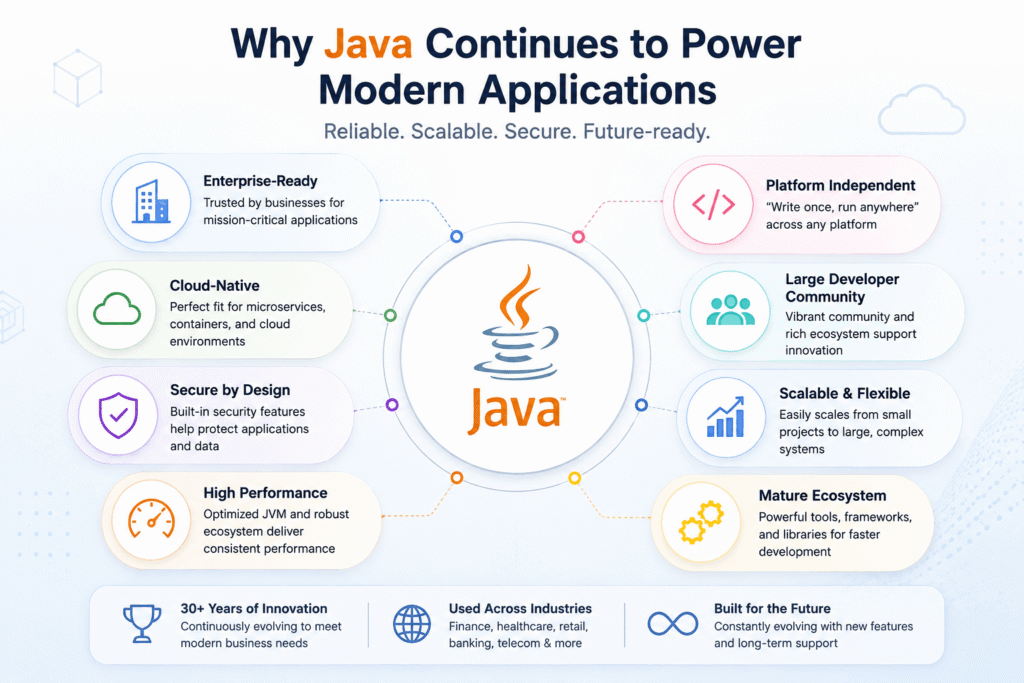
Java has been around for more than three decades, yet it remains a major technology choice for enterprise applications, backend systems, APIs, and large-scale software.
That raises an obvious question: why is Java still popular when so many newer programming languages have emerged?
The answer is not simply that Java is old and widely adopted. Modern Java has continued to evolve, while its ecosystem has expanded around cloud-native development, microservices, enterprise applications, security, and AI-enabled software.
Java 25, released in September 2025, is the latest Long-Term Support (LTS) release from Oracle. It introduced improvements across the language, runtime, security, performance, and developer productivity. The broader Java ecosystem has also continued to evolve, with Spring Framework 7 and Spring Boot 4 providing a modern foundation for Java applications.
So, is Java still relevant?
Yes. Java remains a strong choice for businesses that need scalable, maintainable, and long-lived applications, particularly in enterprise and backend development.
Let’s look at why.
Is Java Still Relevant?
Java remains relevant because it has evolved with modern software development instead of staying tied to the way applications were built decades ago.
Today, Java can be used for:
Enterprise applications
Backend systems
REST APIs
Microservices
Cloud-native applications
Financial and transaction-based systems
E-commerce platforms
Business automation software
Data-intensive applications
AI-enabled enterprise applications
Its long history is also an advantage for organizations that need to maintain large applications over many years. A mature ecosystem, established development practices, and a large pool of Java developers can make long-term development and maintenance easier.
What Is Java Commonly Used For?
Java is particularly useful when an application needs to handle complex business logic, multiple integrations, large numbers of users, or long-term maintenance.
For example, a business may use Java to build a backend that connects its customer portal, payment system, CRM, database, and internal applications.
Java is also widely used with frameworks such as Spring to build APIs and microservices. Spring Boot 4, released in 2025, builds on Spring Framework 7 and provides first-class support for Java 25 while retaining Java 17 compatibility.
This makes the modern Java ecosystem very different from the simple “write once, run anywhere” description often associated with older Java articles.
7 Reasons Businesses Still Choose Java
1. Java Continues to Evolve
One of the strongest reasons Java remains relevant is that the platform continues to receive regular improvements.
Java moved to a six-month feature release cycle, allowing new language, runtime, security, and performance improvements to reach developers more frequently.
Java 25, released in September 2025, included enhancements to the Java language, libraries, security, performance, monitoring, and developer productivity. Oracle also provides long-term support for Java 25, making it particularly relevant to organizations that prefer a stable version for long-running applications.
This matters to businesses because they do not necessarily have to choose between stability and modernization. They can adopt an LTS version for production systems while continuing to evaluate newer Java releases.
2. Java Is Well Suited to Enterprise Applications
Enterprise applications often have more complex requirements than simple websites or small applications.
They may need to:
Handle many users
Process large amounts of data
Connect with multiple systems
Implement complex business rules
Support different user roles
Maintain strong security controls
Remain operational for many years
Java has a mature ecosystem for these requirements.
Frameworks such as Spring help development teams build APIs, business applications, and distributed systems without having to create every underlying component from scratch.
For businesses, this maturity can reduce development complexity and make long-term application maintenance more manageable.
3. Java Can Support Large and Scalable Systems
Scalability becomes important when an application grows from hundreds of users to thousands or millions.
Java’s runtime, concurrency capabilities, performance improvements, and mature ecosystem make it suitable for many applications that need to handle significant workloads.
For example, consider an online financial platform.
It may need to process transactions while customers access their accounts, employees manage operations, and other systems exchange data through APIs.
The technology needs to handle these activities reliably while allowing the application to grow.
Java can be a strong fit for this type of environment, particularly when combined with a well-designed architecture and appropriate infrastructure.
It is important to remember that scalability does not come from the programming language alone. Architecture, databases, infrastructure, caching, application design, and monitoring all affect how well a system scales.
4. Java Has a Mature Development Ecosystem
Java is supported by a large ecosystem of frameworks, libraries, development tools, testing solutions, monitoring tools, and community resources.
Some commonly used technologies in the Java ecosystem include:
Spring and Spring Boot
Hibernate
Maven
Gradle
JUnit
Jakarta EE
JVM-based monitoring and profiling tools
This ecosystem gives development teams access to established solutions for common application requirements.
For businesses, that can be valuable when building complex software because developers do not have to solve every technical problem from the ground up.
5. Java Fits Modern Cloud-Native Development
Java is no longer limited to traditional server-based enterprise applications.
Modern Java applications can be built as microservices, packaged in containers, deployed to cloud platforms, and connected through APIs.
A typical cloud-native Java application might look something like this:
Microservices can split a larger application into smaller services that can be developed, deployed, and scaled independently.
Spring’s current ecosystem is strongly aligned with this model. Spring Framework 7 and Spring Boot 4 continue to develop Java’s role in modern application development, including REST-based applications and cloud-oriented architectures.
This gives businesses a way to modernize Java applications without abandoning the Java ecosystem.
6. Java Has Strong Security and Reliability Foundations
Security is another reason Java remains common in business-critical applications.
The Java platform provides features such as strong type checking, managed memory, exception handling, security-related APIs, and regular platform updates.
Java 25 also includes security improvements as part of its ongoing platform development.
However, it is important not to confuse language features with application security.
Java does not automatically make an application secure.
Security still depends on application architecture, authentication, authorization, dependency management, secure coding practices, infrastructure configuration, testing, monitoring, and regular updates.
Java provides a mature foundation, but development teams still need to implement security correctly.
7. Java Has a Large and Established Developer Ecosystem
A technology is easier to maintain when businesses can find developers, tools, documentation, frameworks, and community support around it.
Java has had decades to build this ecosystem.
That can be particularly useful for companies maintaining long-lived applications or modernizing existing Java systems.
Businesses can also choose from different development models, including in-house teams, dedicated developers, outsourcing, or specialist Java development partners.
For an organization with an existing Java application, this ecosystem can make it easier to find expertise for development, migration, modernization, maintenance, and performance optimization.
Java and AI: Is Java Still Relevant for AI Applications?
Java is not the dominant language for AI research and data science. Python remains extremely popular for those workloads.
However, that does not make Java irrelevant to AI.
Many businesses already operate large Java-based applications. They may want to add AI capabilities without rebuilding their entire technology stack.
Integrate machine learning capabilities into existing applications
Process application data for AI workflows
Develop APIs that connect business systems with AI models
Java 25 also introduced improvements related to AI capabilities, including language enhancements that can benefit applications integrating AI inference.
The practical takeaway is simple:
Python may be the preferred choice for many AI research and data-science workloads, while Java can be highly useful when AI needs to become part of an existing enterprise application.
Java vs Other Programming Languages
There is no programming language that is universally best.
The right choice depends on the application, team expertise, existing technology stack, performance requirements, development timeline, and long-term maintenance needs.
Here’s a simplified comparison:
Requirement
Java
Common Alternatives
Enterprise applications
Excellent fit
C#, Kotlin
Backend development
Excellent fit
Go, C#, Node.js
Microservices
Excellent fit
Go, Node.js, C#
Cloud-native applications
Strong fit
Go, C#, Kotlin
Data science
Good
Python
Machine learning research
Good
Python
Frontend web development
Not typically used
JavaScript / TypeScript
Modern Android development
Supported, but not the primary choice
Kotlin
Long-term enterprise systems
Excellent fit
C#, C++, Kotlin
This is not a ranking. Each language has strengths that make it suitable for different types of projects.
When Is Java a Good Choice?
Java can be a strong option when your application needs:
Complex business logic
Enterprise-grade architecture
Scalable backend services
Multiple system integrations
APIs and microservices
Long-term maintenance
A mature development ecosystem
A large pool of experienced developers
Cloud deployment
Reliable application performance
For example, Java can make sense for a business building an enterprise portal that needs to connect customers, employees, databases, payment systems, and third-party services through a centralized platform.
When Might Another Language Be Better?
Choosing Java should be based on the project rather than its reputation.
Another language may be a better fit in certain situations.
Python may be more suitable for data science, experimentation, and many machine-learning workflows.
JavaScript or TypeScript is generally a better choice for browser-based frontend development.
Go can be attractive for certain lightweight backend, networking, and infrastructure workloads.
Kotlin is generally preferred for modern Android application development.
The best technology decision starts with the application’s requirements rather than selecting a language first.
Is Java Still Worth Learning?
Yes, Java can still be worth learning, particularly for developers interested in backend, enterprise, cloud, and large-scale application development.
However, modern Java development involves more than learning the language syntax.
Developers working with Java may also need to understand:
Spring Boot
REST APIs
Databases
Microservices
Cloud platforms
Containers
Testing
Application security
CI/CD
Monitoring and observability
This broader skill set reflects how Java is actually used in modern software development.
What Does a Modern Java Technology Stack Look Like?
A modern Java project can include several layers rather than Java alone.
For example:
Layer
Common Technologies
Programming Language
Java
Application Framework
Spring / Spring Boot
API Layer
REST / HTTP
Data Access
Hibernate / JPA
Database
PostgreSQL, MySQL, Oracle, etc.
Build Tools
Maven / Gradle
Testing
JUnit and related tools
Deployment
Containers / Cloud platforms
Monitoring
Application monitoring and observability tools
The exact stack depends on the project.
The important point is that Java fits into a much broader modern development ecosystem.
Why Java Remains a Practical Business Choice
Java’s longevity is not simply the result of being an old programming language.
It has remained relevant because the platform has continued to evolve while retaining the ecosystem and stability that businesses value.
For organizations, that combination can be important.
A company may want to modernize an existing application, build a new enterprise platform, develop APIs, migrate a legacy system, or create a scalable backend. Java can support many of these requirements while providing access to a mature ecosystem.
At the same time, Java should not automatically be selected for every project.
The right question is not:
“Is Java the best programming language?”
A better question is:
“Is Java the right technology for this application’s requirements?”
For many enterprise and backend applications, the answer can still be yes.
Frequently Asked Questions
Is Java still popular?
Yes. Java remains widely used for enterprise applications, backend systems, APIs, microservices, cloud-native applications, and other large-scale software. Its mature ecosystem and continued development keep it relevant for modern application development.
Is Java still relevant for modern application development?
Yes. Modern Java development extends beyond traditional enterprise software. Java is now commonly used with frameworks such as Spring Boot for APIs, microservices, cloud-native applications, and distributed systems.
Is Java good for enterprise applications?
Yes. Java is well suited to enterprise applications that require complex business logic, scalability, integrations, security controls, and long-term maintenance.
Is Java good for backend development?
Yes. Java is a strong backend development option for APIs, business applications, microservices, distributed systems, and applications that need to handle significant workloads.
Is Java still relevant for cloud applications?
Yes. Java applications can be designed as microservices, packaged in containers, deployed to cloud infrastructure, and integrated with other cloud services. Modern frameworks such as Spring Boot support these development approaches.
Is Java good for AI development?
Java can be useful for integrating AI capabilities into enterprise applications and backend systems. Python remains more common for many AI research and data-science workflows, but Java can be a practical choice when AI functionality needs to work with an existing Java technology stack.
Is Java better than Python?
Neither is universally better. Java is particularly strong for enterprise and large-scale application development, while Python is widely used for data science, machine learning, automation, and rapid experimentation. The right choice depends on the project.
Is Java still worth learning?
Yes. Java remains relevant for developers interested in backend, enterprise, cloud, and large-scale application development. Learning Java alongside frameworks such as Spring Boot and related backend technologies can provide a broader modern development skill set.
What is the latest Java LTS version?
Java 25 is the current Long-Term Support release. It was released on September 16, 2025, and Oracle provides long-term support for the release.
Looking for Java Development Services?
Choosing the right technology is only the first step. The architecture, development approach, integrations, testing, security, deployment, and ongoing maintenance all influence the success of a Java application.
Stellen Infotech provides Java development services for businesses looking to build, modernize, migrate, integrate, or maintain Java-based applications. Its current Java offering includes custom Java development, enterprise Java development, Java web applications, migration, integration, cloud-based Java solutions, and maintenance and support.
If you are planning a new Java application or modernizing an existing system, the first step is to define your business requirements and determine whether Java is the right fit for your project.
Having a digital presence is crucial for every business these days. The website must be designed in such a way that it is easy for users to navigate and interact with. Among the various website platforms available WordPress stands out as a popular choice.
This is because it provides versatility, scalability, and a distinctive range of features. WordPress development allows the developers to leverage the capabilities of this platform, bringing out the best outcomes in the form of your website.
Moreover, its simplicity has been able to attract more consumers over the past few years. While it is quite straightforward so it is possible to build a website on your own using WordPress. But there are advantages to hiring a professional WordPress developer.
In this blog post, we will explore the benefits of working with a WordPress developer and it can improve your business’s online presence. From making your website easy to use to providing a smooth experience for visitors, find out why hiring a WordPress developer is worth it.
Delay no more and help your business succeed in the online world.
Advantages of Hiring a WordPress Developer for Your Business
There are numerous benefits to hiring a WordPress developer for your business. These are going to be discussed in the section below. So stay tuned with us on the journey ahead.
Increased Customization and Branding
A WordPress developer has all the qualities and expertise to tailor your website’s design. It ensures that it aligns perfectly with your brand identity. These developers can customize themes and templates according to your requirements.
They integrate unique features and functionalities thus setting your website apart from your competitors. You can create a visually appealing and cohesive online presence reflecting your brand’s personality and values.
Technical Expertise and Efficiency
A deep understanding of the coding and technical aspects is required in building a robust website. WordPress developers possess all these qualities and can handle complex tasks.
These include integrating plugins, optimizing website performance, and thus ensuring seamless functionality across different devices. They can troubleshoot any issues that may arise and ensure proper integration of third-party tools.
Enhanced Security and Maintenance
WordPress professionals understand the importance of robust security measures to safeguard against potential threats and hacking attempts. To achieve these goals, they stay updated with the latest security practices and implement essential measures. These include regular updates, strong password policies, and vulnerability scans to ensure your website remains secure.
Furthermore, they are capable of handling routine maintenance tasks ensuring your website operates smoothly and efficiently. Addressing technical glitches and performing backups are mainly performed by them to optimize your website’s performance.
SEO Optimization and Online Visibility
Leverage the expert skills & expertise of a WordPress developer to enhance your website’s SEO performance and improve its visibility in search engine results. A skilled developer can conveniently optimize your website’s structure, meta tags, headings, and URLs to ensure they are search engine friendly.
They are also capable of integrating important SEO plugins and tools. These help analyze & optimize the content and make the required changes to get better search engine rankings. Additionally, they assist you in improving your website’s loading speed, mobile responsiveness, and user experience.
Time and Cost Savings
It is a wise investment in the long run for it can lead to significant time and cost savings. A skilled WordPress developer can effectively handle various tasks related to website development and maintenance. This allows you to focus on core business activities.
They have the expertise to quickly resolve any glitches ensuring your website runs smoothly and without any barriers. A developer can customize your WordPress theme and plugins to meet your business requirements. This eliminates the need for expensive third-party solutions or custom development from scratch.
Responsive and Mobile-Friendly Design
It’s best to hire a WordPress developer for optimizing your website for different screen sizes and devices. A skilled developer can utilize responsive design techniques to adapt your website’s layout, images, and content to fit various screen resolutions.
They can also integrate mobile-friendly features including touch-friendly navigation, simplified forms, and quick-loading pages to enhance usability. You can cater to the growing number of mobile users, improve engagement and reduce bounce rates by prioritizing responsive and mobile-friendly design.
Scalability and Future Growth
With the expertise of WordPress developers, a scalable and flexible website can be designed that can accommodate your growing business needs. They optimize the website’s code and database structure to handle increasing traffic and data volumes efficiently.
A developer can integrate powerful plugins and tools that enable easy management and expansion of your website’s features and functionalities. You can flawlessly accommodate increased user demands, expand your online presence and effectively support your business’s growth by owning a scalable & adaptable website.
Access to Ongoing Support and Updates
A WordPress developer provides you with reliable and timely technical support ensuring that your website runs smoothly and efficiently. They address any issues or bugs that may arise keeping themselves updated with the latest trends and security patches.
For ensuring optimal performance, compatibility, and security they must regularly update your website’s core files. A developer must minimize the risk of vulnerabilities and thus protect your website from potential threats. Moreover, they assist you in implementing new features, functionalities, or design enhancements as your business grows.
Integration with Third-Party Systems
By integrating payment gateways, CRM software, email marketing tools or social media platforms a skilled developer can ensure smooth communication. This would further enable data exchange between your website and external systems.
They make use of plugins, APIs, or custom codes to establish secure and reliable connections. This enables you to automate processes, gather valuable data, and provide a cohesive user experience.
Specialized Functionality and Plugin Development
The expertise of these developers can create plugins and develop new ones that integrate with your website. It further enhances its functionality and provides unique offerings to the target audience.
Conclusion
In a nutshell, appointing a WordPress developer for your business brings a vast number of benefits. It can shoot up your online presence to new heights. These benefits range from optimizing your website for SEO to improving online visibility. It further extends to saving time and costs through efficient solutions and ensures a responsive and mobile-friendly design.
Additionally, their expertise in developing specialized functionalities and custom plugins allows you to offer unique experiences to your audience. Therefore, by investing in a WordPress developer, you are investing in the success and growth of your business.
Reach new heights in the dynamic digital landscape by hiring a WordPress developer today!!
Client stories
What our clients say
Trusted by 2,000+ businesses across 80 countries since 2011.
“
Stellen Infotech and its highly professional team of developers did a great job with my website. Thanks a ton for doing such a marvellous job!
Seth PhillipsBusiness Owner, USA“
I couldn't be any happier with my website. Stellen Infotech has pleased me with its services and customer support. I highly recommend their developers and will surely hire them again.
Tim ConnellFounder, Australia“
Stellen Infotech gave real value to my business website. I highly recommend them as a web development company that is professional, talented and competent.
Peter MeedDirector, UK
Our Clients, Our Pride
Ready to build software that ships and AI that works?
Tell us what is slowing your business down. Our team will map the right mix of custom software, mobile apps and AI automation — and show you a working prototype within weeks.