Java has been around for more than three decades, yet it remains a major technology choice for enterprise applications, backend systems, APIs, and large-scale software.
That raises an obvious question: why is Java still popular when so many newer programming languages have emerged?
The answer is not simply that Java is old and widely adopted. Modern Java has continued to evolve, while its ecosystem has expanded around cloud-native development, microservices, enterprise applications, security, and AI-enabled software.
Java 25, released in September 2025, is the latest Long-Term Support (LTS) release from Oracle. It introduced improvements across the language, runtime, security, performance, and developer productivity. The broader Java ecosystem has also continued to evolve, with Spring Framework 7 and Spring Boot 4 providing a modern foundation for Java applications.
So, is Java still relevant?
Yes. Java remains a strong choice for businesses that need scalable, maintainable, and long-lived applications, particularly in enterprise and backend development.
Let’s look at why.
Is Java Still Relevant?
Java remains relevant because it has evolved with modern software development instead of staying tied to the way applications were built decades ago.
Today, Java can be used for:
- Enterprise applications
- Backend systems
- REST APIs
- Microservices
- Cloud-native applications
- Financial and transaction-based systems
- E-commerce platforms
- Business automation software
- Data-intensive applications
- AI-enabled enterprise applications
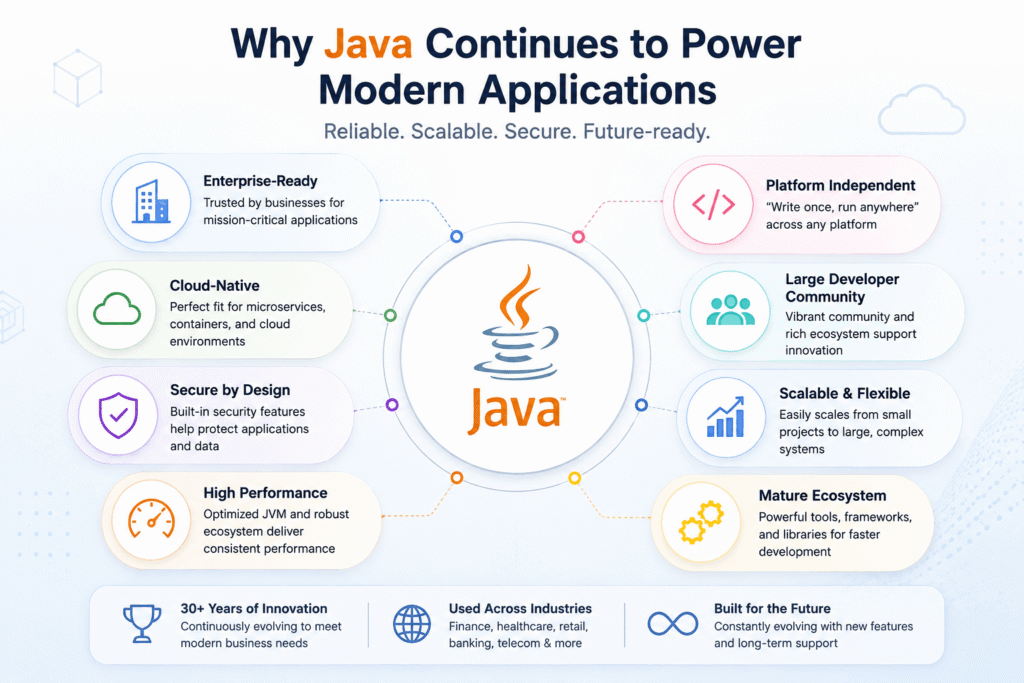
Its long history is also an advantage for organizations that need to maintain large applications over many years. A mature ecosystem, established development practices, and a large pool of Java developers can make long-term development and maintenance easier.
What Is Java Commonly Used For?
Java is particularly useful when an application needs to handle complex business logic, multiple integrations, large numbers of users, or long-term maintenance.
For example, a business may use Java to build a backend that connects its customer portal, payment system, CRM, database, and internal applications.
Java is also widely used with frameworks such as Spring to build APIs and microservices. Spring Boot 4, released in 2025, builds on Spring Framework 7 and provides first-class support for Java 25 while retaining Java 17 compatibility.
This makes the modern Java ecosystem very different from the simple “write once, run anywhere” description often associated with older Java articles.
7 Reasons Businesses Still Choose Java
1. Java Continues to Evolve
One of the strongest reasons Java remains relevant is that the platform continues to receive regular improvements.
Java moved to a six-month feature release cycle, allowing new language, runtime, security, and performance improvements to reach developers more frequently.
Java 25, released in September 2025, included enhancements to the Java language, libraries, security, performance, monitoring, and developer productivity. Oracle also provides long-term support for Java 25, making it particularly relevant to organizations that prefer a stable version for long-running applications.
This matters to businesses because they do not necessarily have to choose between stability and modernization. They can adopt an LTS version for production systems while continuing to evaluate newer Java releases.
2. Java Is Well Suited to Enterprise Applications
Enterprise applications often have more complex requirements than simple websites or small applications.
They may need to:
- Handle many users
- Process large amounts of data
- Connect with multiple systems
- Implement complex business rules
- Support different user roles
- Maintain strong security controls
- Remain operational for many years
Java has a mature ecosystem for these requirements.
Frameworks such as Spring help development teams build APIs, business applications, and distributed systems without having to create every underlying component from scratch.
For businesses, this maturity can reduce development complexity and make long-term application maintenance more manageable.
3. Java Can Support Large and Scalable Systems
Scalability becomes important when an application grows from hundreds of users to thousands or millions.
Java’s runtime, concurrency capabilities, performance improvements, and mature ecosystem make it suitable for many applications that need to handle significant workloads.
For example, consider an online financial platform.
It may need to process transactions while customers access their accounts, employees manage operations, and other systems exchange data through APIs.
The technology needs to handle these activities reliably while allowing the application to grow.
Java can be a strong fit for this type of environment, particularly when combined with a well-designed architecture and appropriate infrastructure.
It is important to remember that scalability does not come from the programming language alone. Architecture, databases, infrastructure, caching, application design, and monitoring all affect how well a system scales.
4. Java Has a Mature Development Ecosystem
Java is supported by a large ecosystem of frameworks, libraries, development tools, testing solutions, monitoring tools, and community resources.
Some commonly used technologies in the Java ecosystem include:
- Spring and Spring Boot
- Hibernate
- Maven
- Gradle
- JUnit
- Jakarta EE
- JVM-based monitoring and profiling tools
This ecosystem gives development teams access to established solutions for common application requirements.
For businesses, that can be valuable when building complex software because developers do not have to solve every technical problem from the ground up.
5. Java Fits Modern Cloud-Native Development
Java is no longer limited to traditional server-based enterprise applications.
Modern Java applications can be built as microservices, packaged in containers, deployed to cloud platforms, and connected through APIs.
A typical cloud-native Java application might look something like this:
Java → Spring Boot → REST APIs → Microservices → Containers → Cloud infrastructure
Microservices can split a larger application into smaller services that can be developed, deployed, and scaled independently.
Spring’s current ecosystem is strongly aligned with this model. Spring Framework 7 and Spring Boot 4 continue to develop Java’s role in modern application development, including REST-based applications and cloud-oriented architectures.
This gives businesses a way to modernize Java applications without abandoning the Java ecosystem.
6. Java Has Strong Security and Reliability Foundations
Security is another reason Java remains common in business-critical applications.
The Java platform provides features such as strong type checking, managed memory, exception handling, security-related APIs, and regular platform updates.
Java 25 also includes security improvements as part of its ongoing platform development.
However, it is important not to confuse language features with application security.
Java does not automatically make an application secure.
Security still depends on application architecture, authentication, authorization, dependency management, secure coding practices, infrastructure configuration, testing, monitoring, and regular updates.
Java provides a mature foundation, but development teams still need to implement security correctly.
7. Java Has a Large and Established Developer Ecosystem
A technology is easier to maintain when businesses can find developers, tools, documentation, frameworks, and community support around it.
Java has had decades to build this ecosystem.
That can be particularly useful for companies maintaining long-lived applications or modernizing existing Java systems.
Businesses can also choose from different development models, including in-house teams, dedicated developers, outsourcing, or specialist Java development partners.
For an organization with an existing Java application, this ecosystem can make it easier to find expertise for development, migration, modernization, maintenance, and performance optimization.
Java and AI: Is Java Still Relevant for AI Applications?
Java is not the dominant language for AI research and data science. Python remains extremely popular for those workloads.
However, that does not make Java irrelevant to AI.
Many businesses already operate large Java-based applications. They may want to add AI capabilities without rebuilding their entire technology stack.
Java can be used to:
- Connect enterprise applications with AI services
- Build AI-enabled backend systems
- Integrate machine learning capabilities into existing applications
- Process application data for AI workflows
- Develop APIs that connect business systems with AI models
Java 25 also introduced improvements related to AI capabilities, including language enhancements that can benefit applications integrating AI inference.
The practical takeaway is simple:
Python may be the preferred choice for many AI research and data-science workloads, while Java can be highly useful when AI needs to become part of an existing enterprise application.
Java vs Other Programming Languages
There is no programming language that is universally best.
The right choice depends on the application, team expertise, existing technology stack, performance requirements, development timeline, and long-term maintenance needs.
Here’s a simplified comparison:
| Requirement | Java | Common Alternatives |
|---|---|---|
| Enterprise applications | Excellent fit | C#, Kotlin |
| Backend development | Excellent fit | Go, C#, Node.js |
| Microservices | Excellent fit | Go, Node.js, C# |
| Cloud-native applications | Strong fit | Go, C#, Kotlin |
| Data science | Good | Python |
| Machine learning research | Good | Python |
| Frontend web development | Not typically used | JavaScript / TypeScript |
| Modern Android development | Supported, but not the primary choice | Kotlin |
| Long-term enterprise systems | Excellent fit | C#, C++, Kotlin |
This is not a ranking. Each language has strengths that make it suitable for different types of projects.
When Is Java a Good Choice?
Java can be a strong option when your application needs:
- Complex business logic
- Enterprise-grade architecture
- Scalable backend services
- Multiple system integrations
- APIs and microservices
- Long-term maintenance
- A mature development ecosystem
- A large pool of experienced developers
- Cloud deployment
- Reliable application performance
For example, Java can make sense for a business building an enterprise portal that needs to connect customers, employees, databases, payment systems, and third-party services through a centralized platform.
When Might Another Language Be Better?
Choosing Java should be based on the project rather than its reputation.
Another language may be a better fit in certain situations.
Python may be more suitable for data science, experimentation, and many machine-learning workflows.
JavaScript or TypeScript is generally a better choice for browser-based frontend development.
Go can be attractive for certain lightweight backend, networking, and infrastructure workloads.
Kotlin is generally preferred for modern Android application development.
The best technology decision starts with the application’s requirements rather than selecting a language first.
Is Java Still Worth Learning?
Yes, Java can still be worth learning, particularly for developers interested in backend, enterprise, cloud, and large-scale application development.
However, modern Java development involves more than learning the language syntax.
Developers working with Java may also need to understand:
- Spring Boot
- REST APIs
- Databases
- Microservices
- Cloud platforms
- Containers
- Testing
- Application security
- CI/CD
- Monitoring and observability
This broader skill set reflects how Java is actually used in modern software development.
What Does a Modern Java Technology Stack Look Like?
A modern Java project can include several layers rather than Java alone.
For example:
| Layer | Common Technologies |
|---|---|
| Programming Language | Java |
| Application Framework | Spring / Spring Boot |
| API Layer | REST / HTTP |
| Data Access | Hibernate / JPA |
| Database | PostgreSQL, MySQL, Oracle, etc. |
| Build Tools | Maven / Gradle |
| Testing | JUnit and related tools |
| Deployment | Containers / Cloud platforms |
| Monitoring | Application monitoring and observability tools |
The exact stack depends on the project.
The important point is that Java fits into a much broader modern development ecosystem.
Why Java Remains a Practical Business Choice
Java’s longevity is not simply the result of being an old programming language.
It has remained relevant because the platform has continued to evolve while retaining the ecosystem and stability that businesses value.
For organizations, that combination can be important.
A company may want to modernize an existing application, build a new enterprise platform, develop APIs, migrate a legacy system, or create a scalable backend. Java can support many of these requirements while providing access to a mature ecosystem.
At the same time, Java should not automatically be selected for every project.
The right question is not:
“Is Java the best programming language?”
A better question is:
“Is Java the right technology for this application’s requirements?”
For many enterprise and backend applications, the answer can still be yes.
Frequently Asked Questions
Is Java still popular?
Yes. Java remains widely used for enterprise applications, backend systems, APIs, microservices, cloud-native applications, and other large-scale software. Its mature ecosystem and continued development keep it relevant for modern application development.
Is Java still relevant for modern application development?
Yes. Modern Java development extends beyond traditional enterprise software. Java is now commonly used with frameworks such as Spring Boot for APIs, microservices, cloud-native applications, and distributed systems.
Is Java good for enterprise applications?
Yes. Java is well suited to enterprise applications that require complex business logic, scalability, integrations, security controls, and long-term maintenance.
Is Java good for backend development?
Yes. Java is a strong backend development option for APIs, business applications, microservices, distributed systems, and applications that need to handle significant workloads.
Is Java still relevant for cloud applications?
Yes. Java applications can be designed as microservices, packaged in containers, deployed to cloud infrastructure, and integrated with other cloud services. Modern frameworks such as Spring Boot support these development approaches.
Is Java good for AI development?
Java can be useful for integrating AI capabilities into enterprise applications and backend systems. Python remains more common for many AI research and data-science workflows, but Java can be a practical choice when AI functionality needs to work with an existing Java technology stack.
Is Java better than Python?
Neither is universally better. Java is particularly strong for enterprise and large-scale application development, while Python is widely used for data science, machine learning, automation, and rapid experimentation. The right choice depends on the project.
Is Java still worth learning?
Yes. Java remains relevant for developers interested in backend, enterprise, cloud, and large-scale application development. Learning Java alongside frameworks such as Spring Boot and related backend technologies can provide a broader modern development skill set.
What is the latest Java LTS version?
Java 25 is the current Long-Term Support release. It was released on September 16, 2025, and Oracle provides long-term support for the release.
Looking for Java Development Services?
Choosing the right technology is only the first step. The architecture, development approach, integrations, testing, security, deployment, and ongoing maintenance all influence the success of a Java application.
Stellen Infotech provides Java development services for businesses looking to build, modernize, migrate, integrate, or maintain Java-based applications. Its current Java offering includes custom Java development, enterprise Java development, Java web applications, migration, integration, cloud-based Java solutions, and maintenance and support.
If you are planning a new Java application or modernizing an existing system, the first step is to define your business requirements and determine whether Java is the right fit for your project.