Every team has work that needs attention but not much judgment. Someone searches three systems to find an order status. Numbers are extracted from an email and entered into a spreadsheet. Someone forwards the appropriate request and follows up on it one day later.
AI agents are designed for jobs such as these. What an AI agent does is take instructions, understand what needs to be done, and take action within the boundaries you set. This sounds good, and yet it is not some kind of magic. Agents cannot manage a company without control, and expecting such behavior is dangerous, not an option.
This blog will provide information about what AI agents are, how they compare to chatbots and old automation methods, where they can help, where they won’t, and whether your business needs AI agent development or not.
What Is an AI Agent?
Start with the basics. Here is what an AI agent does, how it differs from a simple chatbot, and why that difference matters for your business.
Explaining AI Agents in Business Language
An AI agent is a tool that uses artificial intelligence to achieve a goal. It receives the request, collects all necessary information, performs an action, and then verifies whether the action was performed successfully.
While an AI-based tool answers a question by giving you information, an agent can take this information and perform further actions with it.
AI Agent vs. Chatbot: What Is the Difference?
While a chatbot reacts to the input from the user, an AI agent may also interact with external tools, access approved information sources, and perform certain actions, such as editing the record or opening a ticket.
The distinction is not always clear. Some chatbots possess the capabilities of an AI agent, such as the ability to check the status of the order. It comes down to the way how the system is set up rather than its name.
Difference Between AI Agents and Automation
Automation has long been employed by businesses. With AI agents, there is something new; however, it does not mean that every rule-based workflow will be replaced. Understanding the difference will help you make the right choice.
Rule-Based Automation vs. AI-Powered Decision-Making
Automations work based on rules that were pre-defined by someone. If this happens, do that. It performs effectively if the inputs are clear and consistent.
Real work is often messier. Customers write long emails. Invoices arrive in different formats. Requests do not fit neat categories. AI agents can read this kind of unstructured information and choose from a set of available actions.
Support tickets show the gap. A rule-based system routes a ticket by a fixed category, such as “billing” or “shipping.” An AI agent can read the customer’s message, check the related records, and recommend the next step. The rule-based system sorts. The agent interprets.
When Should a Business Choose Each Approach?
| Approach | Best for | Main trade-off |
| Traditional automation | Predictable, repetitive tasks with clear rules | Breaks down when inputs vary |
| AI agents | Changing inputs, multiple steps, or decisions that depend on context | Needs more testing and closer monitoring |
| Hybrid workflows | Processes that need both speed and control | Takes more design work up front |
Indeed, hybrid workflow tends to add the most value. Rules take care of the routine tasks. AI takes care of decisions. Humans approve everything that contains risks. If the task can be done with a simple rule, then apply a rule. It is cheaper, faster, and easier to track.
Autonomous Agents and Agentic AI: What Do They Actually Mean?
These buzzwords are frequently used by vendors. The terms tend to overlap; however, there is a difference between them. Let us see what they mean in practice.
What Is an Autonomous Agent?
An autonomous agent is capable of completing several actions without human supervision. You provide a goal, and an agent does everything in between.
Autonomy is relative. It greatly depends on the permissions of the agent, the architecture of the system, and the environment in which the agent operates. An agent that just prepares the text of the email to be reviewed afterwards is relatively autonomous. An agent that is capable of making a refund is less autonomous.
What Is Agentic AI?
Agentic AI describes AI that is designed to pursue goals through planning, tool use, and multi-step action.
Not every AI feature is agentic. A tool that summarizes a document is useful, but it is not working toward a goal. Not every agent needs full autonomy either. Many good business agents work with a person approving the key steps.
For decision-makers, the label matters less than the task. Ask what the system can actually complete, with which data, and under what limits. If a vendor cannot answer those questions clearly, the label is doing all the work.
How Do LLM-Based Agents Function?
Today, most advanced agents operate on the basis of a large language model. It performs all the reasoning; however, it is not enough for the proper functioning of the system.
The Role of Large Language Models in AI Agents
A large language model (LLM) is capable of comprehending and generating natural language. In an agent, it is responsible for processing commands, comprehending information, summarizing texts, and choosing appropriate actions.
An LLM cannot independently perform any actions. To perform its functions, an LLM needs to communicate with other parts of the agent: business data, APIs (application programming interfaces, which are the way different software systems interact with each other), and workflow platforms. In that way, an agent can retrieve a certain record or create a new task.
A Simple AI Agent Workflow
Here is how an agent moves from a business goal to a finished task.
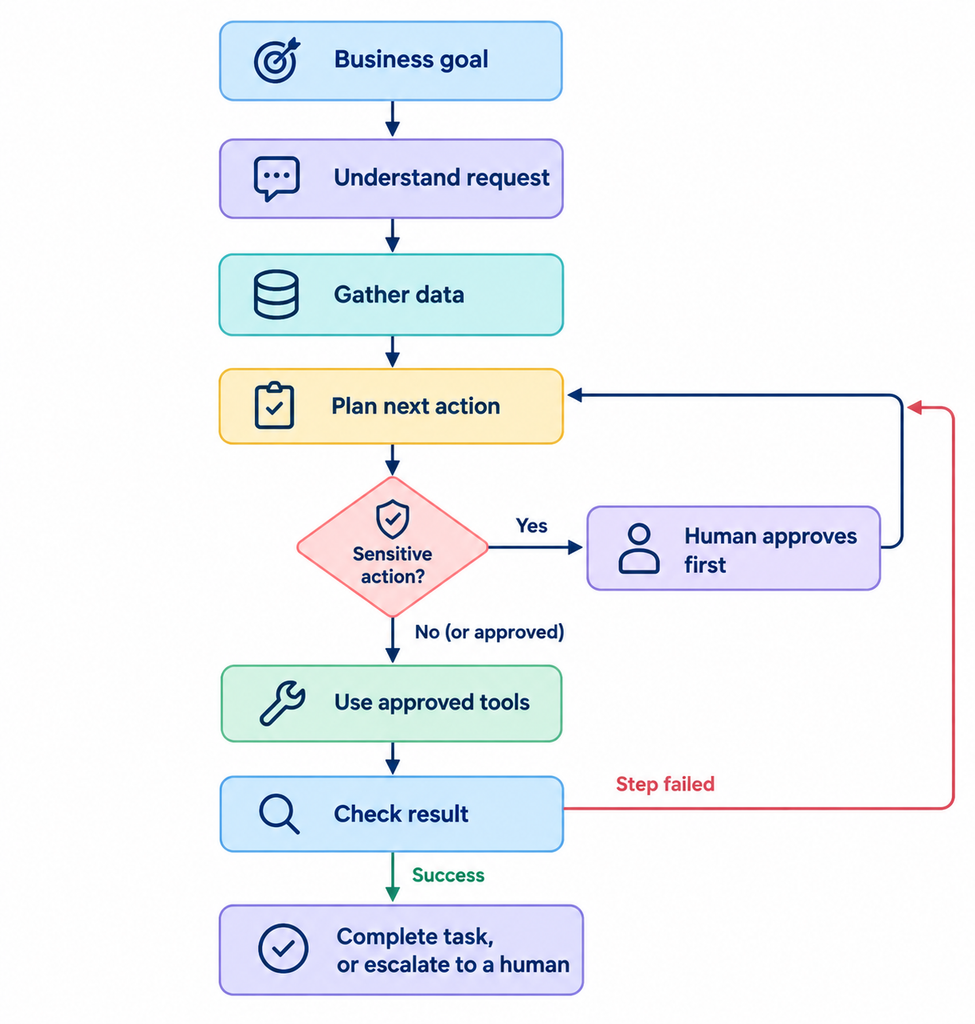
Two components in this process need to be highlighted. One of these is the loop. In case a certain activity does not work out well, then rather than proceeding with the outcome, the agent reevaluates and comes up with another strategy altogether. The other component is the approval gate. Before undertaking any risky activity, one gets it approved by someone else.
AI Agent Applications for Businesses: Where Are the Opportunities?
Agents will prove most useful where tasks are repetitive and involve a lot of text processing with data distributed across multiple systems. Four opportunities can be highlighted:
Customer Support and Service Operations
The agent will classify incoming requests, retrieve the relevant account/order details, write the reply, and escalate complicated queries to the right individual. The business benefit will be fast responses and less repetitive work.
Sales and Marketing
The agent will do research on the prospects from the allowed sources, compile summary information about previous customer communications, draft follow-ups, and assist in qualifying leads. The business benefit will be reduced manual research and more time for relationship building.
Finance and Back-Office Operations
The agent will retrieve information from invoices, highlight any inconsistencies, collect information for expenses reviews, and write reports. The business benefit will be reduced manual steps and fast processing. Human decisions remain necessary for finance.
IT and Internal Business Operations
Agents could classify IT tickets, advise on troubleshooting actions, access the internal knowledge base, and assist in onboarding of employees.
The above-mentioned possibilities are just examples and cannot be considered as certain outcomes. It all depends on the specific case, quality of the data you have, integration level of the agent and controls around it.
Where Can AI Agent Development Deliver Real Business Value?
Value comes from fit. The best projects start with a specific workflow and a measurable goal, not with a decision to “use AI.”
Identify Business Challenges, Not AI Trends
Start with the list of workflows that eat up your employees’ working hours or require frequent data collection. Next, pick the workflows that have well-defined goals, quantifiable results, and low risk. The workflow with a well-defined “end state” is much easier to automate compared to one where the end state is ambiguous.
The development of AI agents is most efficient when each agent is focused on one specific workflow with tools and boundaries defined. Trying to force AI into all the processes will increase the cost and risk, but not the value.
Measure Results Before Scaling
Decide how you will measure success before the first pilot begins. Useful numbers include:
- Task completion rate
- Processing time
- Error rate
- Cost per task
- How often a human has to step in
Compare these numbers to your current system. Begin small and grow only when the returns warrant the expense. Time-saving software that doubles the error rate is ineffective, no matter how impressive its demonstration may be.
Limitations and Risks Businesses Should Understand
Agents carry real risks. Most can be managed, but only if you plan for them before launch and not after the first problem.
Potential Errors of the AI Agent
The agent may misunderstand the request, provide erroneous information, or perform actions that are inappropriate for this particular situation. Since the agent performs actions, its mistakes will go beyond providing inaccurate answers on the screen.
Test the agent with actual examples before deployment. Ensure that its output is correct. Establish limits on what actions the agent may take and what it may not.
Data Security, Privacy, and Access Control
With unrestricted access, the agent may reveal sensitive information or alter records it is not supposed to have any access to. It should be treated like a newly hired employee, who gets only that access which the job requires from day one.
Ensure least privilege access – the agent should have access only to the resources which are necessary for completing its task.
- Allow it to access only authorized data sources.
- Audit logs should reflect the activity of the agent.
Why Human-in-the-Loop Workflows Matter
Human-in-the-loop means people review, approve, or correct AI decisions at important points in a workflow.
Human review is essential for high-value transactions, legal or compliance-sensitive tasks, and decisions with a significant impact on customers. Build this oversight into the workflow from the start. Adding it after something goes wrong is much harder and much more expensive.
How Stellen Infotech Helps Businesses Explore AI Agent Development
Choosing a development partner is part of the decision. Look for one that starts with your processes, not with a tool.
Stellen Infotech is a software development partner that can help businesses assess where AI fits and plan suitable AI agent solutions. That work starts with understanding how your processes run today, then identifying the tasks that suit an agent and designing workflows around the systems you already use.
Integration, access controls, human oversight, and measurable outcomes should shape the plan from day one. Most of all, begin with a clearly defined business challenge. Adopting AI agents only because they are trending is how projects lose focus.
Final Thoughts: Should Your Business Use AI Agents?
AI agents work well for specific, well-defined workflows. They are not a universal replacement for employees or for traditional automation. Before investing, weigh the task, the risks, the expected value, and the need for human oversight.
Which repetitive business process would create the most value if your team spent less time managing it manually?