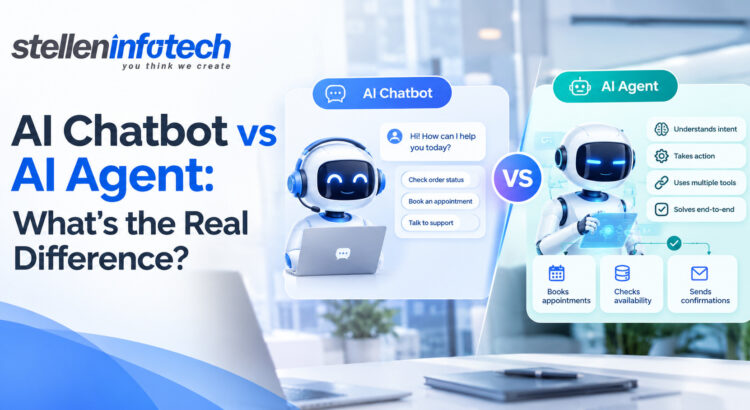
A support ticket gets resolved before a human ever sees it, and nobody on the team can quite explain how. That’s usually the moment someone asks whether the system is “using AI?” The answer is almost always yes. The meaning of that “yes” is another thing entirely. Some systems answer questions. Others complete tasks. That’s where the real debate between an AI chatbot and an AI agent begins: talking versus doing.
Chatbots are built to converse. Agents are built to pursue a goal, using tools and business systems to get there. For operations teams deciding where to spend budget, this isn’t semantics. It changes:
- What can realistically be automated
- What still needs a human in the loop
- What the technology is even allowed to touch
So before you choose which platform to use or what development partner to work with, the question really comes down to whether your company needs one thing or the other.
What Is an AI Chatbot?
An “AI chatbot” actually refers to a lot more functionality than what people think of when they think about old, clunky, and automated scripts from a few years back.
How AI Chatbots Work
A classic chatbot is based on a decision tree. You choose from a list of options or type in a phrase that matches a rule, then the bot responds with a scripted response.
Today’s AI-powered chatbots rely on NLP, or natural language processing, to understand the intent behind the words, rather than just the literal text of the typed message. Unlike a fixed answer list, a generative AI chatbot can generate original answers based on context. It holds a more natural conversation. It handles phrasing variation without breaking. But it still stays inside one lane: answering, explaining, guiding.
What Can an AI Chatbot Do?
Within that lane, a well-built chatbot handles quite a lot:
- Answers frequently asked questions
- Provides product, service, or policy information
- Walks users through a process step by step
- Handles basic customer support issues
- Collects details like a name, order number, or contact info
- Routes anything complex or sensitive to a human
Where AI Chatbots Work Best
Chatbots earn their keep in high-volume, repeatable situations:
- Customer support
- Website assistance
- Internal employee help desks
- Lead qualification
- Basic service requests
When a business receives the same set of questions hundreds of times daily, a chatbot alleviates the workload for human teams with minimal operational risk.
What Is an AI Agent?
An AI agent starts from a different premise entirely. Instead of waiting for a question, it’s handed a goal, and it works out the steps needed to get there.
Working of AI Agents
The agents interpret the situation, plan out a series of actions, and implement those actions through any means they have access to. Let’s say that a customer wants to change an appointment. The agents do not just inform the customer on how they can reschedule; they reschedule for the client.
None of that happens without integrations. It need to be connected with:
- The CRM
- The ticketing platform
- The ERP
- The internal database
Without that access, an agent is just a chatbot with a longer memory and a bigger vocabulary.
What Can an AI Agent Do?
An AI Agent works through connected systems rather than a single chat window; its task list looks different from a chatbot’s:
- Schedules or reschedules appointments
- Retrieves and updates records across systems
- Processes requests that span multiple platforms
- Triggers downstream workflows
- Makes decisions within predefined business rules
- Escalates exceptions that fall outside its permissions
Why AI Agents Are More Action-Oriented
Chatbots provide answers, while agents solve problems and take action within the rules set by the business. This is very important. More freedom for an agent does not necessarily mean a good thing. Freedom becomes meaningful only in conjunction with proper permissions, rules, and assistance mechanisms. Unlimited freedom without any controls is meaningless; it may create difficulties in case of some mishap.
Difference between AI Chatbot and AI Agent?
A comparison at a glance makes the practical difference clear.
| Factor | AI Chatbot | AI Agent |
| Primary role | Conversations and responses | Goal completion and task execution |
| Interaction | User-led | Can be goal-driven |
| Decision-making | Usually limited | Can make contextual decisions |
| Actions | Limited | Can execute multi-step actions |
| Integrations | Often basic | Usually deeper system integration |
| Autonomy | Lower | Higher |
| Best suited for | FAQs, support, guidance | Workflows, operations, automation |
Conversation vs Action
A chatbot answers the first question fine. It doesn’t need to touch a calendar, check staff availability, or write to a booking system to do that. Completing the booking requires all three. That gap is where most businesses overestimate what a basic chatbot rollout will actually deliver.
Response Generation vs Task Completion
A generative AI chatbot can produce a genuinely useful, well-formed answer to almost anything a customer asks. An AI agent can take that same question and, where the systems allow it, finish the task the question was really about. To the person asking, both can look similar in the moment. Only one of them closes the loop.
Human Handoff and Escalation
Chatbots and agents are not meant to replace all human interactions. Chatbots will pass a conversation to a human when the question is too complicated for them. Agents will escalate a request if it falls outside their limits, like issuing a refund above a specific amount or handling an unusual request. Both chatbots and agents should know their limits and direct inquiries as needed. If a system never passes along any requests, it is not working correctly.
AI Chatbot vs AI Agent: How They Handle Business Workflows
The right choice gets a lot clearer once it’s mapped against actual workflow complexity instead of a feature list.
Simple, Repetitive Requests
For high-volume, low-complexity interactions, a chatbot is usually the right call. It can tell:
- Order status questions
- Shipping policy queries
- Basic troubleshooting steps
None of these need system-level action. They need accurate, fast information, which is exactly what chatbots are good at.
Multi-Step Operational Tasks
In cases where requests need several systems to be processed, chatbots have trouble keeping up. For example, fulfilling a request for a refund will mean that inventory will be checked, CRM details will be updated, and a refund issued. This is not just an issue of conversations but also one of coordination. It is at this point that human agents come into play.
Data, APIs, and Business-System Integration
An agent’s usefulness comes down almost entirely to what it can connect to:
- CRM platforms
- ERP systems
- Ticketing and helpdesk software
- Appointment and scheduling platforms
- Internal databases
- Communication tools like email or messaging systems
Without those connections, even a well-designed AI agent can reason about a task perfectly and still not be able to finish it.
Rule-Based Bots vs Generative AI Chatbots vs AI Agents
Think of these three as points on a spectrum, not as labels for the same product that come with different price tags.
| Capability | Rule-Based Bot | Generative AI Chatbot | AI Agent |
| Conversation style | Scripted flows | Natural, context-aware | Natural, goal-driven |
| Flexibility | Low | Moderate to high | High |
| Decision-making | None | Limited | Contextual, rule-bound |
| System integration | Rare | Sometimes | Usually deep |
| Best use case | Predictable, narrow tasks | Broad Q&A and guidance | Multi-step automation |
Rule-Based Bots
- Follow predefined flows
- Give predictable, if inflexible, responses
- Work well for narrow, unchanging tasks; and poorly for almost anything else
Generative AI Chatbots
- Handle a much wider range of questions
- Produce context-aware, natural-sounding responses
- Still fundamentally reactive. They wait, then respond
AI Agents
- Operate with a goal, not just a prompt
- Use available tools to move toward that goal
- Reason through multiple steps
- Execute actions that actually move a workflow forward
When Should a Business Choose an AI Chatbot?
For a large share of customer-facing needs, a chatbot is genuinely the right, and cheaper, choice. No need to overbuild.
Choose a Chatbot When You Need To
- Automate common, repetitive questions
- Improve first-response times
- Support customers outside business hours
- Reduce repetitive workload on support staff
- Offer guided self-service without full automation
Signs that a Chatbot Is Enough
- Most incoming requests are informational
- Workflows are predictable and rarely change
- A human still needs to approve or execute anything meaningful
- The business doesn’t yet need deep, system-level automation
Forcing agent-level capability onto a problem this size adds cost and complexity without much return to show for it.
When Should a Business Choose an AI Agent?
The math changes once the goal shifts from answering faster to reducing manual work altogether.
Choose an AI Agent When You Need To
- Automate workflows that span multiple steps
- Connect and act across several business systems
- Make context-based decisions mid-task
- Reduce manual operational work, not just ticket volume
- Move from assisting a process to actually completing it
Questions to Ask Before Deploying AI Agents
- What systems will the agent be able to access?
- What specific actions is it allowed to perform?
- What permission levels does it need, and who sets them?
- Where does human approval stay mandatory, no exceptions?
- How will its actions be logged, monitored, and audited?
- What happens when it hits a situation it wasn’t built to handle?
Skip these, and an agent deployment tends to turn into a governance problem about six months in.
The Role of an AI Chatbot Development Company in Building Smarter AI Solutions
Chatbot platforms solve generic problems well. Most businesses don’t have generic problems. They have specific workflows, specific systems, and specific compliance requirements a template was never built to account for.
From Conversational AI to AI-Powered Business Automation
An experienced development partner helps a business move past a basic FAQ bot toward something built around how the company actually operates:
- Conversational AI shaped by real workflows, not a generic template
- Integration with the systems already in daily use
- A design that assumes it will need to grow, not stay static
Building AI Solutions Around Business Goals
Depending on the business, that could mean:
- Customer support automation
- Internal operations support
- Lead qualification
- Appointment management
- Broader workflow automation
- Faster information retrieval and decision support
The right starting point depends on where the actual friction is, not which feature demos best.
Why Custom AI Development Matters
No two organizations run the same combination of workflows, data sources, permission structures, and risk tolerance. Scalable architecture, real integrations, solid security, and clear human oversight aren’t add-ons. They’re what separates an AI system a business can trust with real tasks from one that quietly creates new problems six months later.
Stellen Infotech works with businesses on this kind of custom AI development — building conversational AI and automation shaped around the systems a company already runs on, instead of asking the business to bend around a fixed product.
AI Chatbot vs AI Agent: Cost, Complexity, and Scalability
Budget conversations tend to happen too early or too late. Getting the cost structure straight upfront avoids both.
Development and Implementation Complexity
A basic chatbot, especially on an existing platform, can be configured and deployed fairly quickly. An AI agent needs:
- Integration work across multiple systems
- Defined permission structures
- Testing against real operational scenarios, not just demo scripts
Maintenance and Governance
Neither system is set-and-forget. Ongoing work usually includes:
- Monitoring performance
- Updating the knowledge base or rule set
- Managing integrations as connected systems change
- Maintaining access controls
- Tracking how well the system performs against its actual goals
Scaling Across Departments
Chatbots tend to scale horizontally, the same support bot handling more customers. Agents tend to scale across departments instead:
- Customer service
- Sales
- HR
- IT
- Operations
Each can use agent-based automation differently, provided the integration and governance work was done properly the first time around.
Can AI Chatbots and AI Agents Work Together?
These aren’t mutually exclusive. In practice, a lot of the better deployments use both.
The Chatbot as the Conversational Interface
A chatbot serves as the front door where a customer or employee communicates naturally, asks questions, and describes what they actually need.
The AI Agent as the Action Layer
Behind that interface, the agent takes over whenever real execution is required: updating a record, processing a request, triggering a workflow.
Why a Hybrid Approach Can Make Sense
- The chatbot handles simple interactions directly
- The agent takes over complex, multi-step tasks
- Human teams stay in the loop for sensitive or exceptional cases
This split often produces a better experience than forcing either technology into a job it wasn’t built for.
Difference Between AI Chatbot and AI Agent: Which Is Suitable for Your Company?
Rather than declaring one technology categorically better, it helps to work from a simple framework.
Choose an AI chatbot if:
- The priority is communication and self-service
- Most incoming requests are informational
- Fast deployment for repetitive interactions matters more than deep automation
Consider an AI agent if:
- The priority is workflow automation, not just conversation
- AI needs to actively use business systems, not just describe them
- Tasks involve multiple steps and contextual decisions
- The goal is moving from answering requests to completing them
The Real Question Isn’t Chatbot vs Agent
The decision comes down to the actual business problem: workflow complexity, how much autonomy the business is comfortable granting, what integrations are required, and how much risk is acceptable for automated action. For a lot of organizations, the honest answer isn’t one or the other. It’s both. Deployed for the parts of the operation each is actually suited to.
Final Takeaway
Chatbots are built to converse. AI agents are built to pursue goals and take action. Neither is a universal upgrade over the other, and the right pick depends on what a business is actually trying to solve, not on which term sounds more advanced in a sales deck.
Businesses that get this right start by mapping their own workflows honestly:
- Where are requests simple and repetitive?
- Where do they involve multiple systems, real decisions, and consequences that matter?
That mapping, more than any platform comparison, is what determines whether the investment pays off.
If your business is weighing conversational AI against workflow automation, or trying to work out where a custom AI solution would actually move the needle, Stellen Infotech can help think through the architecture, integrations, and controls that make either approach work in practice. What would change in your operations if the system your customers talked to could actually finish what it started?