Ten years ago, automation meant one thing: a bot clicking buttons in the exact order a person used to click them. Fast, tireless, and completely literal. That model still earns its keep in plenty of back offices. But hand it a scanned invoice from a vendor who changed their template last month, or a customer email that doesn’t phrase its request the way the script expects, and it stalls.
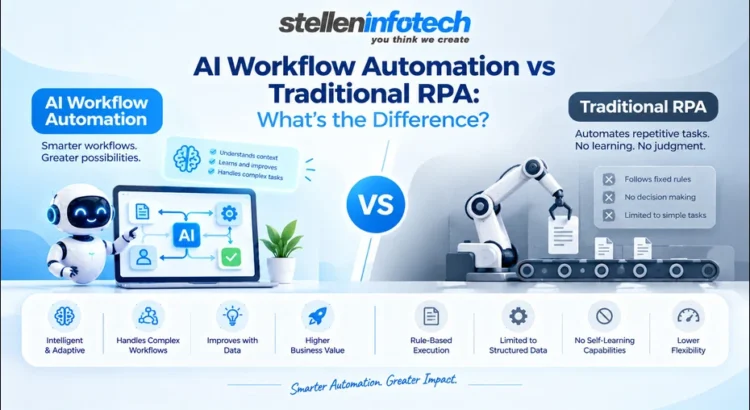
That’s the gap driving most conversations about AI workflow automation vs RPA right now. A traditional RPA system does only what it is told to do. An automated process using AI technologies can recognize something new, put it into context, and decide what should happen next. Small difference on paper. Large difference in which processes can actually be automated and how much babysitting they need once they’re running.
What follows is a look at how each approach works, where each one holds up, where each one doesn’t, and why more enterprises are landing on “both” instead of picking a side.
What Is Traditional RPA?
Before weighing robotic process automation and AI, it’s worth being precise about what RPA was actually built to do.
How RPA Bots Work
The RPA bot is designed to mimic keystrokes and clicks. The process involves opening up the document, extracting data from a constant source, and then moving it elsewhere. There you have it, and as long as nothing changes in the input, this works fine.
Which is the catch. RPA needs structured, predictable inputs: the same spreadsheet columns, the same form layout, and the same screen every time. A vendor tweaks their invoice format, an application gets a UI refresh, and the bot that worked fine last week now needs someone to go back in and rebuild it.
Popular RPA Platforms
UiPath and Automation Anywhere has built real enterprise businesses on this model. Visual designers, bot orchestration, monitoring dashboards — the tooling around deployment has matured a lot. And for the right kind of process, that maturity shows.
Where it fits well: high-volume, rules-based work on legacy systems that were never built with modern APIs in mind. Payroll runs. Batch data migration. Routine reporting. Processes that look the same on Tuesday as they did last Tuesday.
Where Traditional RPA Falls Short
The same rigidity that makes RPA dependable is also its ceiling.
- It struggles with unstructured data — free-text emails, scanned PDFs, anything that doesn’t arrive in a fixed shape
- It can’t deviate from the rules it was given, so anything outside that logic gets punted to a human
- Unexpected changes upstream (a new form field, a redesigned screen) usually mean manual rework, not automatic adjustment
- Every application update is a potential maintenance ticket
None of that makes RPA a bad tool. It makes it a specific one.
What Is AI Workflow Automation?
AI workflow automation is built on a very different foundation: rather than programming specific actions, AI workflow automation uses models that understand what is presented to them and act upon it accordingly.
How AI-Powered Workflows Work
Feed it a customer email, and it can figure out what’s actually being asked; however, the sentence is worded. Point it at a contract with no consistent template, and it can still extract the relevant clauses. Show it a support ticket, and it can classify the issue and route it, without anyone writing a rule for every possible phrasing.
But the bigger shift isn’t at the task level; it’s at the workflow level. Speeding up one step is automation. Coordinating five steps across three systems with far less manual handoff between them; that’s a workflow getting automated, and it’s usually where the actual business value sits.
The Role of AI in Decision-Making
A few specific capabilities do most of the work here:
- Natural language understanding — reading free text, documents, and requests the way a person would
- Pattern recognition — flagging anomalies, sorting information into categories, spotting likely outcomes
- Context-aware decisions — factoring in what surrounds a piece of information, not just the information itself
- AI-assisted recommendations — suggesting or initiating the next step based on that interpretation
There’s a real difference between this and bolting a chatbot onto an existing process. Here, the decision-making sits inside the workflow itself.
From RPA to Intelligent Automation
Intelligent automation is what results when the boundaries between automation, AI, data, and decision-making dissolve into a single unified system. Cognitive automation is the particular name given to the AI component of a system that can interpret data just like a person.
It’s worth being clear: this extends RPA; it doesn’t retire it. The execution layer often still looks like traditional RPA. What changes is the logic deciding what gets executed and why.
AI Workflow Automation vs RPA: Key Differences
The practical differences look like this.
| Factor | Traditional RPA | AI Workflow Automation |
| Approach | Rule-based | AI-driven and context-aware |
| Data | Mostly structured | Structured and unstructured |
| Decision-making | Predefined rules | AI-assisted decisions |
| Adaptability | Limited | Higher adaptability |
| Workflow complexity | Repetitive tasks | End-to-end workflows |
| Human involvement | Often required for exceptions | Can reduce exception handling |
| Maintenance | Rule and bot maintenance | Workflow and AI model management |
| Best suited for | Stable, repetitive processes | Dynamic, complex processes |
Look closely at that maintenance row. AI doesn’t remove maintenance from the picture; it just changes shape. Instead of fixing a broken script, someone’s watching for model drift, retraining where accuracy slips, and governing how AI-driven decisions get made and reviewed.
Robotic Process Automation vs AI: Where Does Each Fit?
Neither wins outright. It comes down to what the process actually looks like on a normal Tuesday.
When RPA Makes More Sense
- The process is highly repetitive with little variation from run to run
- Rules are stable, and inputs are predictable
- The system involved is legacy, with no modern API to work through
- The job is basically moving data from one system to another
- It’s high-volume, back-office work like batch entry or reconciliation
When AI Workflow Automation Makes More Sense
- Documents and language vary in structure or wording
- The work involves judgment, classification, or interpretation
- Customer or employee requests rarely arrive phrased the same way
- Exceptions are frequent rather than rare
- The workflow spans multiple systems that need coordinating
When Businesses Should Combine RPA and AI
Most enterprises don’t actually have to choose. AI reads an incoming request or document and figures out what needs to happen. RPA then does the mechanical part inside existing systems — updates a record, moves a file, kicks off a downstream process. Put together, that’s an intelligent automation architecture where each piece does the part it’s actually suited for.
AI Workflow Automation vs Traditional RPA: Real-World Use Cases
A few functions where the contrast shows up clearly.
Finance and Accounting
Invoice processing and reconciliation have run on RPA for years when documents arrive in a consistent format. The moment invoices show up as scanned PDFs from forty different vendors, each formatted differently, rule-based bots start missing things. AI-assisted extraction and classification tends to hold up better here, especially around exceptions that need flagging.
Customer Operations
Request classification and ticket routing both depend on understanding what a customer actually wants, and customers rarely phrase things the same way twice. AI handles the interpretation; RPA can still take care of the mechanical follow-through, like updating a CRM record once intent has been figured out.
HR Operations
Onboarding usually mixes structured steps (provisioning accounts, setting permissions) with unstructured ones (reading a resume, verifying a document). Leave requests and benefits questions increasingly get interpreted by AI before RPA handles the administrative side.
IT Operations
Incident classification is the most important thing in the entire service desk process chain. In many cases, monitoring and response will involve both approaches, in which the AI classifies the problem, while the RPA does its work based on the classified issue.
Which Is Easier to Scale and Maintain?
Scaling either one comes with its own set of headaches, and they’re not the same headaches.
Scaling RPA Bots Across the Enterprise
More bots means more deployment work, more need for process standardization so bots can be reused, ongoing monitoring to catch failures early, and rework every time a connected application changes underneath it.
Scaling AI Workflow Automation
It’s not just about the number of bots here, but about managing these AI-driven processes across various departments, integrating these processes that weren’t even supposed to interact, dealing with ever-changing inputs, and making sure there’s somebody responsible for the decisions made by the AI.
The Hidden Cost of Automation Maintenance
The number on the initial quote is rarely the real cost of running an automation. Bot failures after an app update. Workflow changes when a process shifts. Exceptions that still need a human. Ongoing model management. Add it up over eighteen months and it’s often close to what the initial build cost. Businesses that budget only for the build tend to be caught off guard by this.
Stellen’s Approach to AI Workflow Automation
The decision between RPA and AI isn’t really a technology question first. It’s a question of which processes need which kind of automation, and how the pieces fit together once you’ve figured that out.
Moving Beyond Task Automation
Stellen Infotech’s work here starts with workflow transformation, not deploying one bot at a time and hoping it adds up to something. That means identifying which processes suit RPA, which need AI’s ability to interpret, and which need both stitched together.
Building Intelligent Automation Around Business Processes
Automation only pays off long-term when it connects properly to what a business already runs on, whether that’s an ERP, a CRM, or something built in-house. The aim is workflows that scale and cut manual intervention without introducing new fragility, tied to whatever broader technology plans the business already has underway. More on how Stellen Infotech approaches this kind of work is at stelleninfotech.com.
AI + RPA: A Practical Automation Strategy for Enterprises
Practically speaking, this often means using RPA for deterministic, high-volume work, while using AI only when the task has an interpretive component. The metric of success is fewer handoffs to a human, faster processing, and robustness to changes in the inputs, not simply the use of AI in the architectural diagram.
How to Decide Between AI Workflow Automation and RPA
Get this right before any platform gets shortlisted.
Start With the Process, Not the Technology
A handful of honest questions settle most of this:
- Is the process repetitive, or does it vary in meaningful ways each time?
- Are the rules genuinely stable, or do they shift often?
- Does the data arrive structured, or as documents, emails, free text?
- Is there an actual decision involved, or is it purely mechanical?
- How often do exceptions come up, and what happens to them right now?
Consider a Hybrid Automation Model
Most enterprise automation strategies end up as a mix: RPA doing the execution, AI doing the interpretation, APIs handling system integration, and people still making the calls that are too sensitive or too high-stakes to hand off entirely.
Build an Automation Roadmap
The path that tends to work: find the high-volume processes first, rank them by effort against impact, pilot before rolling out broadly, measure against numbers that actually matter, and only expand the ones that prove themselves.
The Future of Enterprise Automation: From Bots to Intelligent Workflows
Enterprise automation is moving away from bots operating independently to perform individual actions towards workflow automation involving entire business processes in one go. AI is what is enabling automation to extend its scope beyond repetitive tasks to areas that require context and interpretation.
Here, human supervision becomes all the more important. As AI assumes more interpretative functions, companies must come up with distinct points of review and override at which someone can supervise any decision made by the machines, especially in those areas where there may be serious repercussions of any error: finance, human resources management, and anything related to customers.
Conclusion: Choosing the Right Automation Approach
Strip away the vendor names and platform choices, and the core distinction still holds: RPA automates predefined actions; AI workflow automation can handle processes that require interpretation and judgment. Neither is automatically the right call.
It all depends on the details of the situation; that is, how difficult the process itself is, what sort of data is involved, how many exceptions are expected, what the process has to interface with, and what the business aims to achieve through the process. For CTOs and operations leaders sitting on this decision, the order of operations matters — look at the workflow first, then figure out where RPA, AI, or some mix of the two earns its place.
If you’re weighing where AI workflow automation fits alongside RPA you’ve already invested in, Stellen Infotech can help map out which processes are ready for AI, which are still better served by traditional automation, and how to combine the two without piling on complexity you don’t need. Which of your current workflows would actually benefit from that kind of second look?