The chatbot on most company websites can tell you the returns policy. Ask it to actually start a return, though, and you’ll usually get a link to a form. AI agents close that gap between answering and doing. An agent reads the request, works out the steps, uses your tools to carry them out, and updates the records when it’s done.
So the question on founders’ and CFOs’ desks has shifted from “should we try AI?” to something more pragmatic: How much will we pay for constructing an AI agent and maintaining its operations?
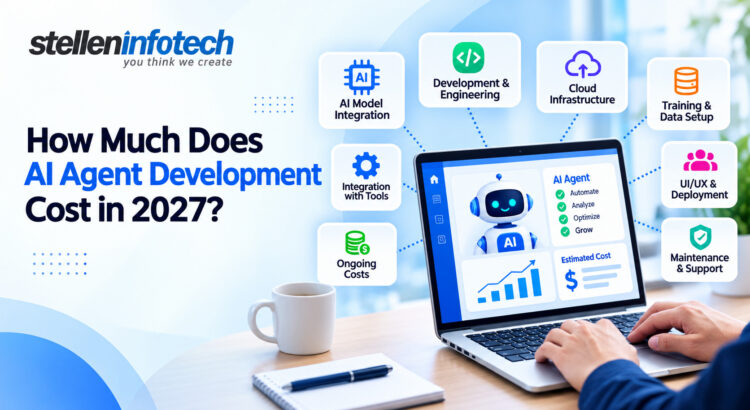
Nobody can give you one honest number without knowing more. AI agent development cost depends on how complex the agent is, which model it runs on and how heavily, how many of your systems it touches, how far it’s customized, what security rules apply, and who maintains it after launch. What we can do is show how each of those moves the price, with realistic ranges, timelines, running costs, and a way to test the ROI before you sign anything.
Cost of Developing an AI Agent in 2027: What Would It Be?
Averages hide too much here, so it helps to think in three bands. Where a project lands depends mostly on how much the agent is trusted to do without a person checking its work.
| AI agent type | Typical cost range | Development timeline |
| Basic | 15,000–40,000 | 4–8 weeks |
| Intermediate | 40,000–120,000 | 8–16 weeks |
| Advanced | 120,000–400,000+ | 4–9 months |
These are planning figures for 2027 budgets, based on what development firms were quoting through 2026. Offshore teams can come in below them, and regulated work in healthcare or financial services usually comes in above.
Basic AI Agents
A basic agent answers customer questions from your help center, product guides, and policies, in plain language and at any hour. When it can’t help, it collects contact details and passes the conversation to your team. It typically connects to one system or none, which keeps both the build and the risk small. For most companies, this is the right shape for an MVP AI agent, because it shows what customers actually ask before you invest in anything bigger.
Intermediate AI Agents
At this tier, the agent starts doing work instead of describing it. A sales agent might qualify an inbound lead, find a free slot on a rep’s calendar, book the demo, and log the whole exchange in HubSpot or Salesforce. A support agent might open and update Zendesk tickets on its own. It also keeps context through a conversation and, in some setups, across visits.
Expect most of the extra spend to go on integration work rather than the AI itself, since every system the agent can write to needs access controls, error handling, and testing.
Advanced AI Agents
Advanced agents handle multi-step processes with little human involvement, often as a small team of specialized agents. In accounts payable, for instance, one agent reads incoming invoices, a second matches them against purchase orders in the ERP, and a third routes exceptions to someone in finance. These systems run at high volume and make decisions in real time.
A large share of the budget at this level goes on things a demo never shows: role-based permissions, audit logs, live monitoring, and a fallback plan for failures. Without them, no finance team should let an agent near real money.
What Factors Affect AI Agent Development Cost?
1. AI Agent Complexity
Scope drives cost more than anything else, and it tends to grow once work starts. An agent that answers order-status questions is a modest project. Ask it to handle returns, refunds, and exchanges too, and you’ve multiplied the rules to design and the cases to test.
Autonomy matters just as much. An agent that drafts a refund for a person to approve is a far smaller build than one allowed to issue it. Hard decisions add cost as well. Picking between two clear options is simple, but weighing policy, purchase history, and stock levels in one step is not. Moving from one agent to several specialized ones adds power, along with the work of building, testing, and coordinating each one.
2. Customization Requirements
Ready-made AI systems are cheaper since the development cost has already been borne by some other person. You use the system as it is.
A custom agent is shaped around your business. That might mean your discount and approval rules, your brand voice, your industry’s workflows, a knowledge base built from your own documents, dashboards for reviewing chats, and firm limits on what it may say or must pass to a person. Each one takes design and testing time. In return, you get software that matches how your team already works, which matters more than it sounds once hundreds of chats a day flow through it.
3. Integrations and Third-Party Systems
Budgets slip here more than anywhere else. A working agent may need to connect to your CRM, ERP, helpdesk, payment processor, HR platform, email and Slack, internal databases, outside APIs, and single sign-on. Each link needs secure access, data mapping, error handling, and testing against the live system. A modern, well-documented API is quick to connect. A decade-old internal tool with patchy documentation can take weeks. We’d recommend scoping the AI integration work before agreeing on any budget.
The deciding question is whether the agent only answers questions or also acts inside your tech stack. An agent that reads a knowledge base can be live within weeks. One that updates orders in an ERP and issues refunds through a payment provider is a different class of project, priced to match.
AI Model and API Costs: What Will You Actually Pay For?
Development is paid once. The AI usage bill arrives every month, and it rises with every extra conversation.
Most agents use a model from OpenAI, Anthropic, Google, or a similar provider, and you pay for what you use. The main line items are:
- Input and output tokens. Providers charge per token, which is roughly three-quarters of a word. The customer pays for the input (instructions, documentation, and chat logs) and the output. Output is usually priced several times higher.
- Reasoning tokens. Many newer models think through a problem before they reply. That hidden thinking is billed as output.
- Embeddings and vector databases. Your documents are turned into numbers and stored in a vector database so the agent can search them. Hosting that database is a monthly fee.
- Speech and image APIs. Voice agents pay by the minute to turn speech into text and back. Agents that read photos or scanned forms pay for image processing.
Rates vary a lot. In September 2026, flagship models were listed at about $2 to $10 per million input tokens. The cheapest cost a few cents.
Volume is what turns small numbers into a real budget line. Take a support agent on a model priced at $2 per million input tokens and $10 per million output tokens. Say an average conversation, with the several model calls that happen behind the scenes, uses 40,000 input tokens and 3,000 output tokens. Each conversation then costs about 11 cents.
| Conversations per month | Estimated model cost per month |
| 5,000 | $550 |
| 20,000 | $2,200 |
| 100,000 | 11,000 |
Double the average conversation length and the bill roughly doubles. Design choices pull it back. Caching can cut the cost of repeated input by up to 90%, and batch work that isn’t urgent often runs at about half price.
Building or fine-tuning your own model is rarely worth it at the start. You’d pay for data preparation, GPU time, and specialist staff, then keep the model current yourself. Hosting an open-weight model on your own servers can make sense at very high volume, or when data must stay on your network. Even then, you’re trading API fees for servers and the people who run them.
For 2027 budgets, also check whether a running-cost estimate relies on a launch discount. At least one major provider has set a newer model’s introductory rate to double on January 1, 2027. It’s one more reason to treat AI automation pricing as a monthly expense that needs as much scrutiny as the build.
How Much Does It Cost to Build an AI Chatbot vs. an AI Agent?
The two terms get swapped freely in sales calls. They describe different products, though, and the prices differ a lot.
AI Chatbot
A chatbot answers questions. It follows set flows or pulls facts from a knowledge base, and it rarely changes data in other systems, so it’s simpler to build, test, and maintain. Setting one up on an existing platform may cost little beyond setup and a monthly fee. A custom chatbot built on your own content usually falls between $10,000 and $40,000.
AI Agent
An agent works toward a goal. Told “these shoes don’t fit,” it can look up the order, create a return label, update the CRM record, and email the customer with no one stepping in. To do that, it has to understand the goal, choose the steps, and use tools and APIs to carry them out. Each of those actions needs permissions, safeguards, and testing for the times something fails, and that is what drives the higher price.
So looking up the cost to build an AI chatbot can give you a number that’s far too low if what you need is a whole process handled end to end. The opposite mistake happens too. If your customers mostly want quick, accurate answers, focused AI chatbot development will likely serve them well, and agent features would be wasted spend.
MVP AI Agent Cost: Is Starting Small the Smarter Option?
In most cases, yes. A limited initial deployment will allow you to verify that the agent does indeed work, without investing a large sum upfront.
An MVP (minimum viable product) exists to answer a few questions cheaply. Do people use the agent? Does it get the task right? Does it save the time you expected? It works best with one workflow that has steady volume and a cost you can measure. Good examples include common support questions, website lead qualification, appointment booking, internal HR or IT questions, and follow-ups after sales demos.
Keeping the scope small shouldn’t mean cutting corners. A credible MVP still needs:
- The core AI capability for that one workflow
- One or two integrations, typically a CRM or calendar
- Basic analytics on volume, resolution rate, and handoffs
- Login and security controls
- A reliable route to a human when the agent is unsure
The majority of MVPs exist in the basic category or the low part of intermediate. The more valuable output is data. After a few months, you’ll have real usage figures, a real API bill, and a measured drop in workload. That makes the case for the next phase much easier to build and defend.
Timeline of AI Agent Development: How Long Does It Take?
The more systems, rules, and approvals a project involves, the longer it takes to get from kickoff to launch.
Basic AI Agent: 4–8 Weeks
This covers requirements, AI setup, the knowledge base, a simple chat window, testing with real customer questions, and launch. The knowledge base often takes longer than planned, because help content tends to be out of date or spread across several tools.
Intermediate AI Agent: 8–16 Weeks
The first weeks go into workflow design, mapping each step, decision, and exception. Then each integration is built and tested in turn, and security controls are added. The project ends with user acceptance testing, where your own staff tries to break the agent before customers see it.
Advanced AI Agent: 4–9 Months
These projects begin with architecture, which is how the agents split the work and share data and access. Next come several integrations, complex workflows, security and compliance review, and a lot of testing. After launch, expect a stretch of monitoring and tuning. Internal approvals for security and vendor contracts can add weeks on their own.
Since most of the budget pays for people’s time, a longer timeline usually costs more. Length is not a sign of quality, though. We prefer an eight-week schedule that delivers something usable over a six-month schedule that doesn’t have anything useful to offer until the fifth month.
AI Agent Development Cost vs. Ongoing Maintenance Cost
Build quotes get most of the attention. Running costs decide whether the agent still makes sense in year two and year three.
Initial Development Costs
The one-time expenses include the following:
- Discovery & Requirements
- UX & Workflow Design
- Development of AI (prompts, search, logic & guardrails)
- Backend
- Integration
- Testing & Deployment
Ongoing Costs
After launch, you keep paying for AI and API usage, cloud hosting, and monitoring of accuracy, errors, and spend. Add security updates, bug fixes, speed tuning, and the odd new integration or feature as the business changes. Model changes need their own budget line. Providers retire models on their own schedule, and a new one may behave differently enough that you have to test again.
A fair planning figure is 15–25% of the build cost per year for upkeep, before usage fees.
This is why CFOs should look at total cost of ownership. Take two made-up proposals. Agent A costs $40,000 to build and $4,000 a month to run. Agent B costs $90,000 to build and $1,500 a month. Over three years, A costs $184,000 and B costs $144,000, so the lower build quote ends up $40,000 more expensive.
How Customization Changes AI Agent Pricing
Cost rises at each step from generic to configured to custom to enterprise-grade. Each step adds more design, build, and test work, and the price follows.
| Level | What it means | Effect on cost |
| Generic | An off-the-shelf AI tool, used as it is | Lowest upfront cost, a monthly fee, little control |
| Configured | The same tool set up with your content, tone, and basic rules | Low setup cost, with limits on logic and integrations |
| Custom | An agent built around your workflows, data, and systems | Mid to high build cost, full control over behavior |
| Enterprise-grade | A custom agent with strict security, compliance, and uptime needs | Highest build and upkeep cost |
In custom and enterprise builds, a few groups of needs push the price up most. The first is workflow and data work, such as workflows with many exceptions and private data that has to be cleaned, sorted, and kept safe. The second is the rules around the agent: industry rules, separate access rights for each type of user, security and compliance reviews, and custom reports for managers and finance. The third is scale. That covers staying online when traffic spikes, support for several languages (each one tested), and complex links to older or poorly documented systems.
Our advice is to pick the lowest level that solves the problem, then add enterprise features once the workflow has proved its value.
A Simple Framework to Estimate AI Agent Development Cost
A rough estimate is easier to build than most people expect, and it gives you something solid to hold vendor quotes against.
If a quote leaves out one of these parts, ask about it. Maintenance and API usage are the easiest to miss, because they only show up after launch.
Sample AI Agent Cost Estimate
The figures below are made up for illustration. They price an intermediate support agent that answers customer questions, looks up orders in a helpdesk, and logs new leads in a CRM.
| Cost component | Estimated cost |
| Discovery and planning | $6,000 |
| AI agent development | $22,000 |
| UI and backend development | 12,000 |
| Integrations (helpdesk and CRM) | $14,000 |
| Testing and deployment | $8,000 |
| Initial AI/API budget (first three months) | $3,000 |
| Estimated initial investment | $65,000 |
Monthly costs sit outside this total. For this agent, they would cover model usage, hosting, monitoring, and a few hours of support. We’ll call it about $3,000 a month for the example. Your own number should come from expected conversation volume, using the token math from the model cost section.
How to Calculate the ROI of AI Automation
The more useful question for a CFO is what the agent will save or earn, and how quickly that covers the investment.
Calculate the Current Cost of the Manual Process
Start with the cost of the work if done manually. That includes staff hours and ticket or chat volume, along with less visible costs: repetitive activities, slow reaction times, cold leads, work requiring corrections, and off-hour inquiries that must wait until the next day. Get these numbers from your helpdesk, CRM, and payroll records whenever possible, because it is difficult to back up your guesses with facts during a budget discussion.
Estimate the Financial Impact
The usual benefits are lower labor costs, faster responses, better lead conversion, extra sales capacity without new hires, lower support costs, fewer errors, and 24/7 availability. Some of these, like faster responses, are hard to put a dollar value on, so it’s sensible to count only what you can measure and treat the rest as upside.
Why Businesses Choose Stellen Infotech for AI Agent Development
In our case, the agent project begins with the workflow that needs to be improved. The choice of model comes later.
Stellen Infotech designs and builds custom AI agents around how your business really runs, using your data and aiming at the result you need. We work with OpenAI, Claude, and Gemini models. We connect agents to the systems you already use, such as your CRM, ERP, and WhatsApp, and keep a person in the loop wherever you want one.
Projects can start as a focused MVP and grow into larger multi-agent systems once the results justify it. We’ve built custom software since 2011, so our team handles the backend, integrations, launch, and tuning after launch, as well as the AI layer. Success is judged by time and money saved.
AI Agent Development Cost Checklist for Businesses
Clear answers to the questions below make vendor quotes far more precise. Vague ones produce wide ranges and, later on, change orders.
Before requesting a quote, decide:
- What problem will the AI agent solve?
- Which tasks should it automate?
- How much autonomy should it have?
- Who will use it?
- Which systems must it connect to?
- Which AI model or API will it use?
- What data will it access?
- What security requirements apply?
- What monthly user or message volume do you expect?
- What should the MVP include?
- What is the expected timeline?
- What will ongoing maintenance cost?
- How will you measure ROI?
- What payback period would you accept?
Final Takeaway: Don’t Choose an AI Agent Based on Price Alone
AI agent development cost varies so widely because every business brings different workflows, integrations, data, and goals to the project. The lowest bid may not automate anything meaningful, and the highest may include capabilities you’ll never use.
A sounder approach is to define the business problem, begin with a focused MVP, work out the full cost of ownership, and estimate the ROI before scaling. When you don’t know how to begin, start by looking at the process that consumes the most time from your people while varying the least.
Ready to estimate what an AI agent could cost for your business? Start with the workflow you want to automate, the systems it needs to connect with, and the business outcome you expect. That gives you a far more useful number than a generic AI development price tag. When you have those answers, talk to Stellen Infotech about your AI agent project and get an estimate built around them.