Imagine at 9pm someone contacts your business on WhatsApp inquiring about pricing. No one answers till the early morning. By then, they have probably contacted two of your competitors already. Whoever answered first probably gets the deal. Now multiply that by every lead who writes in after hours. That’s a lot of revenue you’ve just lost.
WhatsApp has become the standard tool for many B2B communications. It’s faster than email and more informal than a contact form. The trouble is that once the messages are delivered, the salespeople have to manage all of those conversations on their personal phones and in shared inboxes. The leads disappear since there is no record of the actual question the customer had.
An AI chatbot integrated into WhatsApp and your CRM solves this problem by taking care of the initial conversation, capturing the details, and passing them over to your CRM as leads, rather than messages hidden away in people’s phones. This is the essence of AI chatbot WhatsApp integration: the chatbot communicates with customers via WhatsApp, and the data from those conversations goes directly into the software your salespeople use.
Here is what this blog will cover. How everything works together. Why it is important for marketing and sales. The exact process of implementation. How Salesforce and HubSpot play into it. And common pitfalls of such projects.
What Is AI Chatbot WhatsApp Integration?
Three parts, three jobs. That includes:
The chatbot:
- Reads a customer’s message and works out what they need.
- Replies in plain language instead of forcing them through a menu.
- Answers common questions and asks a follow-up if needed.
- Guides the person toward booking a call or getting a quote.
The CRM:
- Without it, the chatbot is just a smart way to answer messages, nothing more.
- Without a connection, the conversation just sits in WhatsApp.
- Someone would need to copy the details into a spreadsheet by hand. Most of the time, that doesn’t happen.
- Connect WhatsApp to the CRM, and the whole conversation moves into the system for sales to check every day.
- Reps stop opening calls with, “Sorry, why are you calling again?”
Both parts together:
- A customer sends a message.
- The bot figures out what they want: pricing, support, or a demo.
- It asks a couple of simple questions to learn more.
- The CRM creates or updates the lead on its own.
- The right sales rep gets notified with real information, not a blank form.
- No single tool does all of this alone. It’s the connection between them that turns a chat into a working sales process.
Why Marketing and Sales Teams Should Care
Marketing already invests in making people communicate via WhatsApp using advertisements and campaigns. The next step will determine whether all those investments become actual sales or remain nothing more than unanswered messages.
- The majority of consumers do not like filling out lengthy forms when there is an option of sending a short message. That’s what WhatsApp provides.
- The chatbot turns that message into a real lead, with a name and a reason attached.
- Replies happen instantly, since the bot can handle several conversations at once. No single person on your team could keep up with that on a busy day.
- The bot can ask a few questions about budget or timeline before a human ever joins the chat. That way, your sales team spends time on the leads actually worth following up.
- A discussion stored on the personal WhatsApp app of one individual vanishes once he or she gets occupied with some other task or even forgets about it. Automate this whole process, and now the lead does not depend on anyone’s memory.
The Reality of How a CRM Chatbot Integration Works
It doesn’t happen with one click at all but is rather a sequence of events.
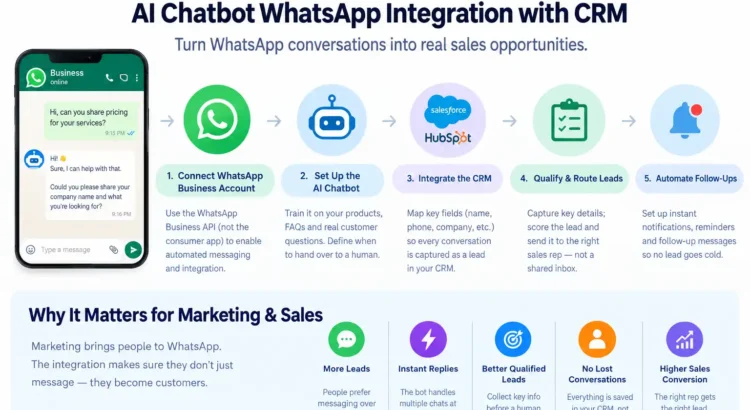
Step 1: Connect the WhatsApp Business account.
Everything runs through the WhatsApp Business API, the channel Meta built for automated messaging. The consumer app doesn’t support this. The API is the foundation the rest of the whatsapp business api ai stack sits on.
Step 2: Connect the AI chatbot.
Decide what it’s for: support, qualification, or both. Train it on products, FAQs, and the questions people genuinely ask, not the ones you assumed they’d ask. Set firm rules for when a conversation stops being automated.
Step 3: Integrate the CRM.
This is where Salesforce or HubSpot enters. Fields need mapping, name to name, phone to phone. Sloppy work here means untangling duplicate contacts for months afterward.
Step 4: Build the qualification workflow.
Capture name, company, requirements, budget, location, whatever fits your business. Score the lead based on the answers. Then route it to the right representative, rather than a shared inbox nobody checks closely.
Step 5: Automate the follow-up.
A qualified lead sitting untouched for three days is still a lost one. Reminders, tasks, and relevant WhatsApp messages, often through HubSpot automation or something similar, keep momentum going without needing anyone to remember.
Step 6: Test it, and keep testing it.
Nothing works right on day one. Run customer journeys through it, watch the bot respond to real people, track where conversions and human handoffs happen. What looks correct on a whiteboard tends to need adjusting once actual customers start typing.
Most vendors will tell you this is a weekend project. It isn’t, not if the qualification logic is meant to hold up under real traffic.
Salesforce AI vs. HubSpot Automation
Both can power this integration. They suit different shapes of business, though. Pick the wrong one, and it turns into expensive rework rather than an obvious mistake up front.
| Factor | Salesforce AI | HubSpot Automation |
|---|---|---|
| Best fit | Larger sales teams, complex pipelines | Growing teams focused on lead nurturing |
| Strength | Sales workflow and pipeline visibility | Marketing and sales on one system |
| Typical use | Enterprise deal tracking | Inbound nurturing, campaign follow-up |
| Setup | More configuration | Faster to get running |
- Salesforce fits businesses that already run sales through it: lead management, data syncing, workflows reps depend on daily. Add your WhatsApp bot information to Salesforce; the leadership will see all messages without needing any manual entry.
- HubSpot emphasizes the marketing aspect: nurturing sequences, behavioral segmentation. If your teams have marketing and sales operating on a single funnel, starting from the very first interaction until closing the deal, you may consider HubSpot.
Sales volume, your existing CRM, team size, and how customers prefer to communicate decide which one wins for you. There isn’t a universally correct answer here.
What the Bot Can Actually Automate
| Function | What it does |
|---|---|
| Lead generation | Collects contact details, promotes offers, catches inbound inquiries |
| Lead qualification | Asks set questions, scores and sorts by buying intent |
| Appointment booking | Books meetings in-chat, syncs the booking to the CRM |
| Customer support | Answers common questions, escalates anything complex |
| Lead nurturing | Sends follow-ups and content, re-engages quiet prospects |
None of these are separate bots running side by side. It’s the same conversation working toward a different goal depending on what the person on the other end requires at the time.
Key Advantages of Integrating AI Chatbots, WhatsApp, and CRM
The benefits can be seen in a couple of specific ways, not just one general improvement.
- Faster lead response. Replies happen in seconds instead of hours. That matters most right after someone shows interest.
- Better lead qualification. Sales teams spend time on prospects who already answered the questions that matter. Not on cold guesswork.
- Higher sales team productivity. Reps stop copying WhatsApp chats into spreadsheets. They spend that time on calls instead.
- More personalized conversations. With CRM data on hand, the bot can bring up what a customer asked before. It doesn’t start from zero every time.
- Fewer missed opportunities. Automatic logging and follow-up triggers mean a lead doesn’t quietly vanish because someone got busy.
- Better marketing and sales visibility. Everyone can see which campaigns actually drive WhatsApp chats that turn into pipelines.
- Scalable customer communication. The system can handle a spike in inquiries during a campaign launch. No need to hire more reps to keep up.
Challenges in Integrating AI Chatbots on WhatsApp
None of these things work out of the box. Projects generally go wrong at the planning stage.
Poor Conversation Flow Design
When a chatbot can answer only FAQS and cannot continue the conversation, the user quickly gets irritated. The flow needs to guide someone toward an outcome. Not just react to keywords.
Incomplete CRM Data
Fields need to be mapped properly between the chatbot and the CRM. Get this wrong, and you end up with duplicate contacts, missing phone numbers, or leads that never get scored right. Clean field mapping isn’t exciting work. But it’s the difference between a system that works and one that quietly produces bad data for months.
Losing the Human Touch
Automation should speed things up. It shouldn’t replace every human interaction. Set clear handoff points where the bot knows it’s out of its depth and brings in a person. That keeps the experience from feeling like a wall.
Privacy and Customer Data Concerns
WhatsApp chats often include personal details. Access controls matter. Clear consent around how that data gets used matters too. So does handling it responsibly. None of this is optional. It’s part of running the system correctly.
Measuring the Wrong Metrics
Chatbot conversation volume looks good on a dashboard. It does not really tell you anything either by itself. What matters is how many of those chats turn into leads, booked meetings, and revenue.
How Stellen Infotech Can Help With AI Chatbot, WhatsApp & CRM Integration
Building this properly takes more than deploying a chatbot and hoping it connects to whatever CRM you already use. Stellen Infotech works with marketing and sales teams on the full stack. From conversation design to the CRM work behind it.
Build AI-Powered WhatsApp Customer Journeys
Custom chatbot development built around your actual sales goals. WhatsApp conversations designed to match the customer journey you already have. Not a generic bot template.
Connect WhatsApp Conversations With Your CRM
CRM integration work covering platforms such as Salesforce and HubSpot. Customer and lead data syncs cleanly, instead of creating duplicate records or blind spots.
Develop Lead Qualification & Sales Automation Workflows
Automated qualification logic, lead routing rules, follow-up sequences, and clear points where a chat gets handed to a human.
Create Scalable AI Chatbot Integrations
Integrations built around the systems your business already runs on. The goal is measurable sales and marketing outcomes. Not just another chatbot sitting on your website for the sake of having one.
If your team is weighing what a WhatsApp, CRM, and AI automation setup would actually look like, that’s a conversation worth having. Have it before you commit to a specific platform or vendor.
Best Practices for Successful AI Chatbot WhatsApp Integration
Start with one high-value use case. Trying to automate lead qualification, support, and appointment booking all at once, from day one, usually means none of them work well.
Keep conversations short and clear. Long paragraphs of bot text feel like reading a brochure. Short messages that ask one thing at a time work better.
Give customers an easy human handoff. A simple, visible way to reach a person should always be one message away.
Keep CRM data updated automatically. Manual syncing breaks down the moment someone forgets. That’s exactly when the system stops earning trust.
Personalize messages using CRM data. A returning customer shouldn’t get the same opening line as someone reaching out for the first time.
Track business outcomes, not just chatbot activity. Conversation counts look nice on a slide. Qualified leads and booked meetings are what actually count.
Improve the bot using real conversation insights. Real chats turn up questions nobody planned for when the bot was first trained. Reviewing them often is what keeps it useful.
Turning Conversations Into Sales Opportunities
The value here was never the automated reply on its own. It’s what happens next. A lead gets captured instead of lost, qualified instead of guessed at, handed to a rep who already knows what the person wants.
Most businesses already have the traffic showing up on WhatsApp. What decides whether it becomes revenue is whether there’s a system behind it, or a person checking their phone between meetings. With Stellen Infotech’s assistance, you can have your AI chatbot, WhatsApp, and CRM implementation planned around how your sales team works. What will be the impact on your pipeline if all those conversations were to hit right at their spot?