Most LLM buying decisions are made prematurely. One person within the group likes one particular LLM, there is an excellent demonstration from the vendor, and a week later, the decision is made. Then the pilot starts, and the model that looked brilliant in a demo struggles with your actual documents.
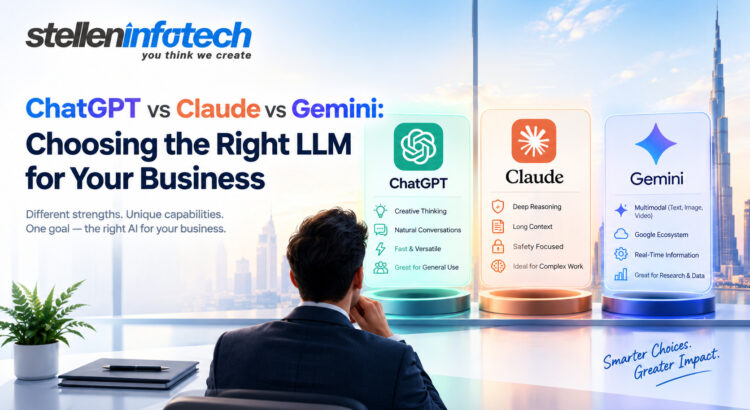
Being the most popular one doesn’t mean being the best LLM to use for business purposes. It all depends on how well it performs within your workload and how affordable it is to continue using it. This comparative review of ChatGPT vs. Claude vs. Gemini has been put together with this in mind.
Why LLM Selection Matters for Business AI Applications
These will have an impact on you for years to come, based on your AI model choice: quality of answers, operating cost, and scalability of the product.
The LLM is within your system and is doing the language-heavy lifting. It’s reading, writing, classifying, summarizing, deciding what tool to use next, etc. If it’s not getting it right, the users know. If it’s too costly, then finance knows. If it’s slow, then everyone knows. You can change out your model, but your prompts, tests, and guardrails are typically written for a specific model.
Where Businesses Are Using LLMs Today
- Customer support assistants and conversational interfaces
- Document processing, summarization, and knowledge retrieval
- Code generation, software development, and testing
- Workflow automation and AI agents using business software
- Enterprise search and internal knowledge assistants
What CTOs Should Evaluate Before Choosing a Model
Start from the application, not from the brand. A model that writes good marketing copy may still fumble a messy invoice, and one that’s great at code may be overkill for a simple FAQ bot.
Five questions usually settle most of it:
- How accurate and consistent is it on your real tasks?
- Which input formats and context sizes does it support?
- What do API latency and throughput look like under load?
- How hard is the integration, and what will it cost to run?
- Do the security and data terms satisfy your governance team?
Comparing ChatGPT, Claude, and Gemini: The Three LLM Platforms
All three companies sell a chat app, a developer API, and several model families. People blur these together, and that causes trouble.
A ChatGPT subscription is not the OpenAI API. The same split exists for Claude and Gemini. Your staff uses the apps, while your software calls the APIs. Pricing, data terms, and controls can differ between the two, so don’t judge one by the other.
OpenAI and ChatGPT: General Intelligence and Application Creation
The OpenAI models power ChatGPT and the OpenAI API. They are used by developers for applications involving conversation, structure, tools, programming, and processes, including both text and imagery. While GPT-4 is still the general term that many people refer to, there have been new changes since then. Check out what is available currently before trying anything out.
Integration is rather simple to understand. The prompt will be sent by your backend, and text or structured data will be returned by it.
Anthropic Claude: Document Work, Reasoning, and Coding
Claude gets a lot of attention for long-document analysis, writing, coding, and tasks with detailed instructions. The Claude API lets teams build it into custom applications and AI workflows.
Reputation is just a beginning, but not the proof itself. Try it out on your files and see if it refers to your software every time, not just most of the time.
Google Gemini: Multimodal AI and Google Ecosystem Integration
Gemini works with text, images, and other supported input types, and developers reach it through the Gemini API. It’s an obvious candidate if your data and infrastructure already sit in Google Cloud or other Google services. Whether it’s the best choice depends on the integration path you pick.
ChatGPT vs Claude vs Gemini: Key Differences Compared
Here’s the quick view. Notice how many cells depend on the specific model, because that’s the honest answer.
Side-by-Side LLM Comparison Table
| Factor | OpenAI / ChatGPT | Anthropic / Claude | Google Gemini |
| Commonly cited strengths | General tasks, coding, tool use, multimodal work | Writing, document analysis, coding, detailed instructions | Multimodal work, long context, Google ecosystem |
| Developer access | OpenAI API | Claude API | Gemini API |
| Integration paths | API apps, tools, supported cloud options | API apps, supported integrations | Gemini API, Google Cloud, supported integrations |
| Context size | Varies by model | Varies by model | Varies by model |
| Multimodal input | Varies by model | Varies by model | Varies by model |
| Pricing | Model, tokens, features | Model, tokens, features | Model, tokens, features |
| Enterprise controls | Product, plan, deployment | Product, plan, deployment | Product, plan, deployment |
Names, limits, and prices change often. Confirm them in each provider’s official documentation before you decide.
Context Windows, Performance, and Model Selection
A large context window sounds like a shortcut. Drop in every contract you own and let the model find the answer. In practice, a bigger window doesn’t guarantee better recall. Details buried deep in a long prompt can still get missed.
Several things shape the result. Prompt design matters. Output limits matter, since a model may read a great deal but write back only so much. Task difficulty matters too. Most businesses would benefit from RAG systems, which would search for the relevant information before passing it to the users; having a small window but with successful retrieval is better than having a big window filled with irrelevant text.
OpenAI versus Anthropic versus Google: What Does the Comparison Mean?
A search on the web for “openai vs anthropic” clearly implies a competition between two chatbots. The real comparison is bigger. You’re weighing model families, APIs, developer tools, cloud options, and enterprise terms, and all of them shift every few months. A ranking that’s true today may look dated by next quarter. Your own test results will last longer than any headline comparison.
APIs, Integrations, and Development Requirements
Choosing a model takes an afternoon. Building, securing, and maintaining the application around it takes much longer.
OpenAI API and GPT-4 Models
Developers pick a model, set up authentication, define the response format, enable tool calling, and write the orchestration code. The error many people make is to think all variants of GPT-4 are identical. They don’t. Choose from the available models using benchmarks and your own task requirements.
Claude API for Business Applications
The Claude API works through message exchanges and supports tool use, so it can plug into services you already run. Prompt design matters here, and so does validation. If the model returns a malformed answer, your code should catch it before a customer sees it. Error handling then decides whether to retry, fall back, or hand off to a person.
Gemini API and Google Cloud Integration
The Gemini API accepts supported multimodal inputs, which helps when your data includes scans or screenshots. Calling the API directly is different from using a managed enterprise deployment on Google Cloud. The controls, billing, and governance options aren’t the same, so settle that question early.
What Every LLM Integration Needs
Whichever provider you choose, a production setup needs the same foundation:
- A secure backend with careful API key management
- Prompt templates, output validation, and guardrails
- RAG or approved data connectors where needed
- Logging, monitoring, retries, and rate-limit handling
- Evaluation datasets and human review for high-impact decisions
Pricing, Enterprise Security, and Data Privacy
Token price is the number everyone quotes. It’s rarely the number that surprises you later.
Comparison of API Pricing and Total Cost of Ownership
First, compare the prices for input/output tokens, where output tokens are always more expensive. Compare different model tiers; a smaller tier can do simpler tasks much more cheaply. Use prompt caching and batching if it is possible to reduce the price of redundant requests and non-urgent work.
Afterwards, count everything that is not included in the bill: the costs of retrieval systems, hosting infrastructure, observability tools, additional tries, and human hours of review. Rate limiting, latency, and commitment are also important factors, as they determine if your system is going to withstand peak traffic.
Enterprise Security and Data Governance
Ask every vendor the same questions. Do they retain submitted data, and can it be used to improve their models? What encryption and access controls exist? Can you control where data is processed? What do the contracts promise, and what audit and compliance material will they share for your vendor risk review?
Here’s the point teams often miss. Consumer chat privacy settings and enterprise API data terms are not the same thing. Read the terms for the exact product and plan you’ll deploy, not the ones attached to the app your team already uses.
Which LLM Performs Best for Different Business Use Cases?
Nobody can answer this from the outside. Treat what follows as starting hypotheses, and let your own evaluation data confirm or overturn them.
For AI Customer Support and Knowledge Assistants
Test retrieval accuracy first. Then ask the same question multiple times and observe whether the response is consistently the same. See how the model handles not knowing, because an accurate transition to a human is better than a guess. Check how well it works with your approved knowledge sources too.
For Coding and Software Development
Consider problems such as correctness, debugging, repository understanding, and testing. One measure people overlook is review time. If developers spend as long checking the output as they would writing the code, the gain disappears.
For Document-Heavy and Multimodal Workflows
Use your real documents, including the ugly ones with odd layouts and scanned pages. Measure extraction accuracy and long-document retrieval. If images matter, confirm which input types each model supports.
For AI Agents and Workflow Automation
Agents are the hardest case. Test tool selection, structured output reliability, and multi-step completion. Then break things on purpose and see how the model recovers. Permission controls matter most here, because an agent acting on a wrong assumption can do real damage.
How to Select the Most Appropriate LLM for Your Business
You don’t need a complicated process. You need one your team will actually repeat.
Step 1: Define the Business Outcome
Name the workflow and the result you expect. Decide what error rate you can accept and how you’ll measure success. “Better support” isn’t a metric. “Resolve a certain number of tickets with no human intervention” comes close.
Step 2: Test the Leading Models on the Same Tasks
Use representative prompts and real data, or anonymized data where safe to use. Evaluate all models using the same criteria, and make your evaluations reproducible to allow rerunning them when new models come out.
Step 3: Quality, Cost, Latency, and Risk Tradeoff
Evaluate the full cost per completed task, not only the price list. A model that fails tasks more often will have a higher total cost per completed task, even if its price list looks smaller.
Step 4: Conduct a Controlled Pilot
Route actual tasks into a limited roll-out. Examine the failures, verify the security and determine ahead of time what to do if the model cannot complete the task.
The basic idea here is clear: pick the model that provides the best possible outcome within your constraints.
How Stellen Infotech Helps Businesses Integrate the Right LLM
Comparing models is one job. Turning the winner into dependable software is another, and that’s where many AI projects slow down.
From LLM Selection to Production-Ready AI Applications
Stellen Infotech collaborates with companies from the software end of AI. Stellen’s development experts will analyze your processes and pick the right models for you, and then create the API integrations to make your LLM work with your existing software applications. They will help you build your AI assistants, automation workflows, and agent applications. Even after launch, there is more work ahead, including performance testing and cost management.
Final Verdict: Which LLM Should Your Business Choose?
No provider wins every use case. Good performance is a result of using an appropriate model for the task and proving its appropriateness with the data.
Quick Recommendations Based on Business Needs
- General purpose AI applications: Prioritize OpenAI, Claude, and Gemini and then select based on task requirements and integration considerations.
- Document-heavy workloads: Consider Claude and other models in competition using documents and retrieval tests.
- Google platform and multimodal requirements: Test Gemini against your own data formats and deployment environment.
- AI assistants and automation: Benchmark tool use reliability, structured outputs, error handling, and security.
- Cost-sensitive applications: Benchmark smaller and larger models to find the lowest cost per successful outcome.
If the model choice is what’s holding your project back, run the test before you run the debate. And if you want help building around the result, talk to Stellen Infotech about your AI application requirements.