Mobile apps aren’t competing with other apps anymore. They’re competing with how little patience people have. A slow screen, a generic recommendation, or a clunky sign-up flow is enough for someone to delete an app and move to a competitor’s. That shift is what’s actually driving the trends below, not novelty for its own sake.
Here’s what’s shaping mobile app development in 2026, and what each trend means if you’re building or maintaining an app right now.
AI Is Now Built Into the App, Not Added On Top
For years, AI in mobile apps meant a chatbot bolted onto an existing product. That’s changed. Apps today are increasingly designed around AI from the first architecture decision, so the model can act on data in real time instead of waiting on a server round trip.
Practically, this looks like:
Home screens and content feeds that rearrange themselves based on what a specific user does, not a generic segment
Push notifications timed to when a user is likely to act, instead of a fixed daily schedule
On-device models that make predictions without sending personal data to a server first, which also helps with privacy compliance
If your app still treats AI as a single “smart search” feature, that’s the gap worth closing first.
Cross-Platform Development Is the Default, Not the Compromise
Building separate native apps for iOS and Android used to be the safer bet for performance. That trade-off has narrowed. Frameworks like Flutter, React Native, and Kotlin Multiplatform now let teams share one codebase for business logic, API calls, and state management, while still shipping platform-specific UI where it matters.
For a business, this usually means faster releases and a smaller maintenance bill, since a bug fix or feature update happens once instead of twice.
On-Device AI and Privacy-First Personalization
Sending less data off the device is becoming a selling point, not just a compliance checkbox. On-device AI processes information locally, which means faster responses and fewer privacy concerns for users who are increasingly aware of how their data gets used.
Health apps, banking apps, and anything handling sensitive information are moving here first, but the pattern is spreading to everyday consumer apps too.
AR and VR, Minus the Expensive Hardware
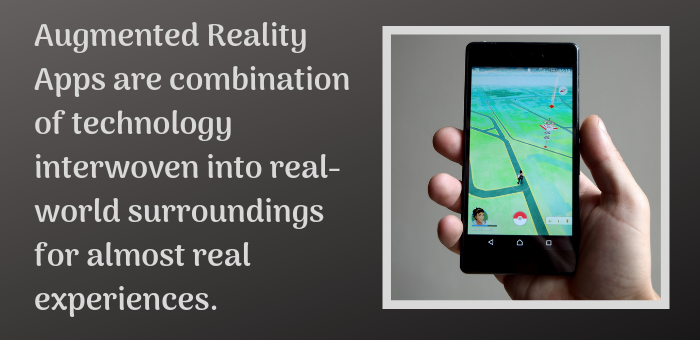
Augmented and virtual reality stalled for a while because the hardware was clunky and the experiences felt gimmicky. Cloud-based XR is changing that by handling the heavy rendering on remote servers, so users get immersive experiences through a regular phone screen instead of a headset.
Retail try-before-you-buy features, virtual property tours, and interactive product catalogs are the practical, revenue-generating use cases, not gaming alone.
Super Apps and Mini-App Ecosystems
Instead of building one app that does one thing well, some companies are building a platform where smaller mini-apps live inside it, payments, bookings, messaging, delivery, all under one login. Fintech apps in Southeast Asia and India have led this pattern, and larger enterprise platforms are now experimenting with the same structure.
This isn’t the right model for every business. It makes sense when a company already has a large, engaged user base and wants to keep people inside one ecosystem rather than sending them elsewhere.
AI Coding Agents Are Shortening the Build Cycle
Development teams are using AI agents for scaffolding, code review, and repetitive testing, which frees up developers to focus on architecture and product decisions instead of boilerplate. Combined with low-code platforms, this is letting smaller teams and even non-technical founders ship working apps faster than a traditional build timeline would allow.
The catch: speed doesn’t replace the need for a technical review before launch, especially around security and data handling.
5G and Connected Devices
5G rollout has matured enough that apps can now assume faster, more reliable connections in most markets, which opens the door for heavier AR content, real-time video features, and smoother IoT device syncing. Wearables, smart home devices, and connected vehicles all lean on this same infrastructure, and apps that integrate with them well have an edge over ones that treat mobile as the only screen a user has.
How AI Is Changing Web Responsiveness
Responsive design used to mean setting breakpoints for a handful of screen sizes and testing until it looked right on each one. AI has changed what “responsive” even means.
Layout generation. Tools can now take a brand’s design system and generate a fully responsive page, spacing, breakpoints, and components included, from a written description. This cuts down the manual CSS work needed for a first draft.
Behavior-based adaptation. Instead of a fixed layout, some sites now adjust in real time based on how a specific visitor scrolls, clicks, and lingers. This goes beyond screen size and starts responding to actual behavior, though it needs to be done carefully so it doesn’t feel invasive.
Accessibility checks. AI tools can flag low color contrast, missing alt text, and keyboard navigation traps automatically, then suggest fixes. This matters more each year, since accessibility compliance is becoming a legal requirement in more regions, not just a best practice.
Performance tuning. On the backend, AI can adjust image compression, lazy-load assets, and route content through the best CDN path based on a visitor’s location and connection speed. The result is a site that stays fast under load without a developer manually tuning every setting.
None of this replaces a designer’s judgment. AI is good at handling the repetitive setup work; a person still needs to make sure the result matches the brand and actually serves the user, not just the metrics.
Frequently Asked Questions
What is the biggest mobile app trend in 2026?
AI moving from an add-on feature to the core architecture of the app. This means apps that predict what a user needs and adapt in real time, rather than apps with a single AI-powered feature attached.
Do I need separate iOS and Android apps, or is cross-platform enough?
For most businesses, a cross-platform framework like Flutter or React Native is enough and cuts development cost and time significantly. Separate native apps still make sense for performance-heavy use cases like high-end gaming or apps that need deep hardware integration.
How does AI make websites more responsive?
AI helps in three ways: generating responsive layouts faster, adjusting content and layout based on real user behavior instead of just screen size, and automatically catching accessibility and performance issues before they affect visitors.
Will AI replace mobile app developers?
Not in the near term. AI is speeding up scaffolding, testing, and repetitive coding work, which lets developers spend more time on architecture, security, and product decisions instead of boilerplate.
Working With the Right Development Partner
Trends are only useful if a team can actually implement them well. Stellen Infotech builds mobile and web applications with current AI integration, cross-platform frameworks, and responsive design practices built in from the start, not added as an afterthought. If you’re planning a new app or want to bring an existing one up to date with where the market is heading, our team can walk you through what’s actually worth prioritizing for your specific product.
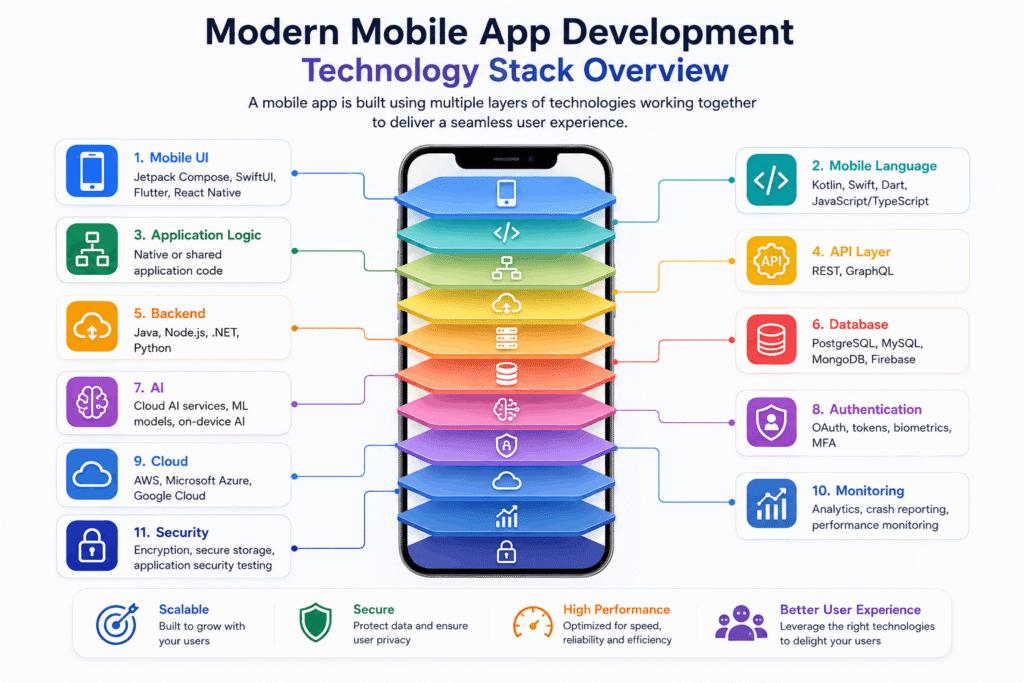
Mobile apps have evolved far beyond simple screens, forms, and notifications. Modern applications can use artificial intelligence, cloud services, real-time data, connected devices, biometrics, advanced graphics, and platform-specific capabilities to deliver highly personalized experiences.
At the same time, development teams have more choices than ever when selecting a technology stack. A business can build separate native applications for Android and iOS, use a cross-platform framework, share selected code through a multiplatform approach, or combine mobile technologies with cloud and AI services.
The answer depends on the type of application, target platforms, performance requirements, features, budget, development team, and long-term maintenance plans.
This guide covers the major technologies used today and explains where each approach can make sense.
What Technologies Are Used in Mobile App Development?
Modern mobile applications usually combine several technologies rather than relying on a single programming language or framework.
Development Area
Common Technologies
Android Development
Kotlin, Android SDK, Jetpack Compose
iOS Development
Swift, SwiftUI, Xcode
Cross-Platform Development
Flutter, React Native
Multiplatform Development
Kotlin Multiplatform, Compose Multiplatform
Backend Development
Java, Node.js, .NET, Python
APIs
REST, GraphQL
Cloud Services
AWS, Microsoft Azure, Google Cloud
Databases
PostgreSQL, MySQL, MongoDB, Firebase and others
Artificial Intelligence
AI APIs, machine learning frameworks, on-device AI
The right combination depends on the application. A banking app, social platform, e-commerce application, IoT solution, and enterprise mobility app can all require very different technology stacks.
1. Native Mobile App Development
Native development means building an application specifically for a particular operating system using its preferred development tools and technologies.
The two dominant mobile platforms are Android and iOS.
Android Development
Kotlin is the primary language used for modern Android development.
Android development also commonly involves the Android SDK and Jetpack libraries. Jetpack Compose provides a modern declarative approach to building Android user interfaces.
Native Android development can be a strong choice when an application needs deep access to Android features, platform-specific functionality, or highly optimized performance.
iOS Development
Swift is Apple’s modern programming language for application development.
For the user interface, SwiftUI provides a declarative framework for building applications across Apple platforms. Apple continues to expand SwiftUI with new capabilities as its platform ecosystem evolves.
Native iOS development is often appropriate when an application needs precise control over the Apple ecosystem, platform-specific features, or a highly customized iOS experience.
When should you choose native development?
Native development can make sense when you need:
Maximum platform-specific control
High-performance applications
Advanced device capabilities
Specialized hardware integrations
Complex animations or graphics
Platform-specific user experiences
Early access to new operating-system capabilities
The trade-off is that building separate Android and iOS applications usually means maintaining separate codebases and development workflows.
2. Cross-Platform Mobile App Development
Cross-platform development allows teams to build applications for multiple operating systems while sharing a significant amount of code.
Instead of maintaining completely separate implementations for Android and iOS, developers can share application logic and, depending on the framework, parts or most of the user interface.
Flutter
Flutter uses Dart and provides a framework for building applications from a shared codebase.
It can be useful when a team wants consistent UI behavior across platforms and needs to move quickly while maintaining a single development environment.
React Native
React Native uses JavaScript or TypeScript and is particularly familiar to teams that already work with React.
Its modern architecture has continued to evolve, with the New Architecture becoming the default for React Native projects from version 0.76 onward.
When should you choose cross-platform development?
Cross-platform development can be a good option when:
You need both Android and iOS applications
A large portion of functionality can be shared
Development speed is important
You want to reduce duplicated development work
Your team already has relevant cross-platform expertise
The application does not depend heavily on platform-specific functionality
However, cross-platform does not automatically mean better or cheaper. The decision should consider performance, integrations, native APIs, team skills, testing, and long-term maintenance.
3. Kotlin Multiplatform
Kotlin Multiplatform takes a different approach to cross-platform development.
Instead of requiring an application to be completely shared, teams can decide which parts of the application should be shared and which should remain platform-specific.
For example, a development team might share:
Business logic
Data models
Networking
Authentication
Validation
Data access
while keeping the user interface native on Android and iOS.
Kotlin Multiplatform can also be combined with Compose Multiplatform when teams want to share UI code. The technology supports gradual adoption, meaning an existing application does not necessarily have to be rewritten from scratch.
This flexibility makes multiplatform development particularly interesting for teams that want code reuse without giving up access to native platform capabilities.
4. AI and Machine Learning in Mobile Apps
Artificial intelligence has become one of the most significant developments in mobile application technology.
However, AI in mobile apps is no longer limited to simple chatbots.
Modern applications can use AI for:
Personalized recommendations
Intelligent search
Voice interactions
Image and document analysis
Content generation
Predictive features
Customer support
Fraud detection
Smart notifications
AI assistants
Workflow automation
Generative AI
Generative AI can allow mobile applications to create or transform content based on user input.
For example, an application could help users:
Summarize documents
Generate product descriptions
Draft messages
Analyze information
Ask questions about their data
Interact with an AI assistant
The implementation can involve cloud-based AI models, application APIs, or a combination of both.
On-Device AI
Another important direction is running some AI capabilities directly on the device.
On-device processing can provide advantages such as:
Lower latency
Better offline functionality
Reduced data transmission
Greater privacy for certain use cases
More responsive interactions
This does not mean every AI workload should run on a smartphone. Larger models and complex tasks may still be better suited to cloud infrastructure.
The practical approach is often to decide which processing belongs on the device and which belongs in the cloud.
AI Agents in Mobile Applications
AI is also moving toward more action-oriented experiences.
Instead of simply answering a question, an AI system can potentially help users complete multi-step tasks by interacting with tools, data, and application functionality.
This is an emerging area, so businesses should evaluate security, permissions, reliability, privacy, and human oversight carefully before allowing AI systems to perform actions on behalf of users.
5. Cloud and Backend Technologies
A mobile application rarely operates by itself.
Most feature-rich apps communicate with backend systems that handle authentication, business logic, databases, payments, notifications, analytics, and other services.
A simplified architecture might look like this:
Mobile App → API → Backend → Database → Cloud Services
Common technologies include:
REST APIs
GraphQL
Java
Node.js
.NET
Python
PostgreSQL
MySQL
MongoDB
Cloud databases
Serverless services
Cloud infrastructure can also help applications scale as usage increases.
For example, an e-commerce app may use mobile technologies for the customer experience while its backend manages products, orders, payments, customer accounts, inventory, and notifications.
This is why mobile app development increasingly involves both mobile engineering and backend architecture.
6. IoT Integration
Mobile applications can also act as interfaces for connected devices.
In an IoT-based solution, the mobile application may communicate with sensors, appliances, vehicles, wearables, or industrial equipment.
A typical architecture could look like:
Connected Device → Network → Cloud/Backend → Mobile App
Examples include:
Smart home applications
Fitness and wearable applications
Connected vehicle platforms
Industrial monitoring systems
Smart appliances
Healthcare devices
Asset tracking systems
The mobile application becomes the user’s interface for viewing data, receiving alerts, controlling devices, or managing connected services.
7. AR, VR and Immersive Mobile Experiences
Augmented and virtual reality can add another layer of interaction to mobile applications.
Augmented Reality
AR can overlay digital information onto the physical environment.
Potential applications include:
Furniture visualization
Retail product previews
Navigation
Education
Tourism
Training
Product demonstrations
For example, a furniture retailer could allow customers to see how a product might look inside their room before purchasing it.
Virtual Reality
VR provides a more immersive environment and can be useful for:
Gaming
Training
Education
Simulations
Virtual experiences
Not every application needs AR or VR. These technologies are most valuable when immersive interaction solves a genuine user problem.
8. Mobile App Security and Privacy
Security should not be treated as a temporary mobile development trend. It should be part of the application architecture from the beginning.
Mobile applications often handle sensitive information such as personal data, payment information, location, authentication credentials, and business information.
Important security technologies and practices include:
Biometric authentication
Multi-factor authentication
Encryption
Secure API communication
Secure data storage
Access controls
Token-based authentication
Application security testing
Dependency management
Secure coding practices
Privacy also needs to be considered when applications collect location, contacts, images, microphone data, or other sensitive information.
The right approach is to collect only the information the application actually needs and clearly communicate how that information is used.
9. Adaptive Interfaces and Foldable Devices
Mobile applications no longer need to be designed around a single screen size.
Users may access applications on:
Traditional smartphones
Foldable phones
Tablets
Large-screen devices
Different orientations
Devices with multiple window configurations
This makes responsive and adaptive UI design increasingly important.
Instead of building an interface for one fixed screen, developers should consider how layouts behave when the available space changes.
This can improve usability across different devices without requiring an entirely separate interface for every screen configuration.
The broader lesson is that modern mobile apps need to be flexible rather than tied to one device format.
10. Mobile App Testing and Performance Technologies
A mobile application can look excellent and still fail if it crashes, loads slowly, drains the battery, or behaves differently across devices.
Testing therefore needs to happen throughout development.
Common approaches include:
Unit testing
Integration testing
UI testing
Automated testing
Performance testing
Security testing
Device compatibility testing
Network testing
Regression testing
Performance monitoring can also help teams identify crashes, slow screens, memory issues, and other problems after an application is released.
Testing is particularly important for applications that need to support multiple operating systems and a wide range of devices.
11. APIs and Third-Party Integrations
Modern mobile applications rarely exist in isolation.
They often need to connect with external systems such as:
Payment gateways
CRM platforms
Maps
Social platforms
Analytics tools
Marketing platforms
Identity providers
Enterprise software
AI services
APIs provide the connection between the mobile application and these external systems.
REST remains widely used, while GraphQL can be useful when applications need more flexible control over the data requested from backend services.
The important consideration is not simply which API technology is used, but whether the overall integration architecture is secure, reliable, scalable, and easy to maintain.
How Do You Choose the Right Mobile App Development Technology?
There is no single technology that is best for every mobile application.
The right choice depends on the project’s requirements.
Requirement
Possible Approach
Maximum platform-specific control
Native development
Android application
Kotlin
iOS application
Swift
Android and iOS with shared code
Flutter / React Native
Shared business logic with native UI
Kotlin Multiplatform
AI-powered application
Native or cross-platform + AI services
IoT application
Mobile + backend + IoT infrastructure
Enterprise mobile application
Architecture based on business requirements
Highly specialized device features
Native development
Before choosing a technology, consider:
Target platforms
Do you need Android, iOS, or both?
Application complexity
Is the app a relatively simple consumer application or a complex enterprise platform with multiple integrations?
Performance requirements
Does the application involve intensive graphics, real-time processing, or specialized hardware?
Device capabilities
Will you need cameras, GPS, Bluetooth, biometrics, sensors, NFC, or other device features?
Development resources
What technologies does your existing team already know?
Time to market
Do you need to release Android and iOS applications simultaneously?
Long-term maintenance
Who will maintain the application after launch, and how easy will it be to update?
Scalability
Will the application need to support a growing number of users, transactions, devices, or integrations?
These questions are more useful than simply choosing the technology that is currently receiving the most attention.
Native vs Cross-Platform: Which Approach Is Better?
The answer depends on the project.
Native development provides maximum control over each platform and can be ideal for performance-intensive or highly specialized applications.
Cross-platform development can reduce duplicated development work when an application needs to support multiple platforms and much of its functionality can be shared.
Kotlin Multiplatform provides another option by allowing teams to share selected application logic while retaining native code where it matters.
The best approach is therefore the one that balances performance, development speed, platform requirements, budget, and long-term maintenance.
What Does a Modern Mobile App Technology Stack Look Like?
A small consumer application might need only a few of these components, while an enterprise application could require nearly all of them.
The Future of Mobile App Development
Mobile development is moving toward applications that are more intelligent, connected, adaptive, and personalized.
AI will continue to influence how users interact with applications, while on-device processing can make some experiences faster and more private.
Cross-platform and multiplatform approaches will continue to give teams more choices for sharing code across Android and iOS. At the same time, native development will remain important when applications require precise platform control.
Cloud services, APIs, connected devices, adaptive interfaces, and stronger security practices will also remain important parts of the mobile development ecosystem.
Rather than following every new technology trend, businesses should focus on building a technology stack that supports their users and business objectives.
Frequently Asked Questions
What technologies are used in mobile app development?
Mobile applications can use a combination of native languages such as Kotlin and Swift, cross-platform frameworks such as Flutter and React Native, multiplatform technologies such as Kotlin Multiplatform, backend technologies, APIs, databases, cloud services, AI tools, and security technologies.
Which technology is best for mobile app development?
There is no universally best technology. Native development can be suitable when platform-specific performance and functionality are important, while cross-platform or multiplatform development can be useful when businesses need to support Android and iOS with shared code.
Which language is used for Android app development?
Kotlin is the primary language for modern Android development. Android applications can also use Java, particularly in existing projects and legacy codebases.
Which language is used for iOS app development?
Swift is Apple’s primary modern programming language for iOS and other Apple-platform applications. SwiftUI can be used to create user interfaces across Apple’s platforms.
Is Flutter good for mobile app development?
Flutter can be a good option for teams that want to build applications for multiple platforms from a shared codebase. The right choice still depends on the application’s requirements, native integrations, team expertise, and long-term maintenance needs.
Is React Native still used for mobile app development?
Yes. React Native remains an established cross-platform option. Its modern architecture has continued to evolve and is now enabled by default in React Native projects.
What is Kotlin Multiplatform used for?
Kotlin Multiplatform allows developers to share code across platforms such as Android and iOS while retaining the ability to use platform-specific code when necessary. Teams can share business logic, data layers, or other components without necessarily rebuilding the entire application.
Can AI be integrated into mobile apps?
Yes. AI can be integrated into mobile applications through cloud-based APIs, backend services, machine learning models, and in some cases on-device AI. Common applications include intelligent search, recommendations, assistants, content generation, image analysis, and automation.
What backend technologies are used for mobile applications?
Mobile applications can connect to backend systems built with technologies such as Java, Node.js, .NET, or Python. These backend systems typically manage APIs, authentication, business logic, databases, integrations, and other server-side functions.
How do I choose the right mobile app development technology?
Start with the application’s requirements rather than the technology. Consider target platforms, features, performance, device capabilities, integrations, development resources, budget, time to market, scalability, and long-term maintenance before choosing the technology stack.
Build a Mobile App With the Right Technology Stack
Choosing the right technology is an important part of mobile application development, but it is only one part of the process.
The application’s architecture, UX, backend, integrations, security, testing, deployment, and ongoing maintenance all contribute to its success.
Stellen Infotech provides mobile application solutions for businesses looking to build custom mobile experiences for their customers, employees, and business operations. The company also provides enterprise mobility solutions, including mobile application development, mobile UX/UI, testing, security, and integration services.
Whether you are starting a new mobile application or modernizing an existing one, the right approach is to evaluate the business requirements first and then select the technologies that support them.
The world seems to run usingexcellent-performing mobile apps today. The number of smartphone users across the globe using applications to get things done is constantly increasing. Regardless of the business or industry type, a well-designed with cost-effective robust and secure mobile application is a must to strengthen your brand connection with customers. A stellar-performing application with extensive functionalities and modern technological features is a great way to skyrocket success.
Certain features make an application great, and this article is all about such features. Integrating cutting-edge and advanced functions like machine learning and artificial intelligence can make your smartphone solution intelligent and intuitive.
You can capture the attention of the maximum number of smartphone users worldwide by creating a user-friendly application. The user-friendly features are cross-platform functionality, excellent performance, offline capabilities, and a robust security system.
10 Must-Have Features For Every Mobile Application
Employing the following features will offer a seamless user experience and set your apps apart from others. So, scroll down to see the ultimate features you should incorporate to enrich your mobile solution.
1. Simple And Intuitive Interface:
An excellent-performing mobile application is great for attracting users, but retaining them for a long time is often a challenging task. Users love applications that are easy to use and have an intuitive interface. A simple application design and intuitive interface allow users to navigate back and forth and collect the information required.
Create a mobile application that can be easily used and accessed by every user with as little effort as possible. Also, make sure the display elements have a clear layout. Doing so will ultimately drive users to an excellent user experience.
2. Emphasize Cross-Platform Compatibility:
Integrating this feature into your mobile application type is critical to stand out from the increasing competition in developing stellar-performing applications. Cross-platform compatibility is the holy grail of excellent application development. This technology allows the app to mark its presence on both Apple App Store and Google Play Store.
Choosing a cross-platform application development helps reach a wider audience as these applications design perform seamlessly across multiple platforms. Businesses can utilize this technology and target their audiences on Android and IOS device platforms. Also, you can use the same codebase for both platforms. For that, you need excellent mobile application developersthat will create a unique codebase.
Additionally, this is a strategy to cut down on unnecessary costs of developing unique applications for different devices.
3. Excellent Mobile Application Performance: Quick And Responsive:
A quick-loading and responsive mobile application is a key characteristic that makes an app excellent. Also, it leads to a seamless user experience and higher user retention. No smartphone application user likes waiting. Every user prefers stable, speedy, and reliable applications that load quickly. Your application should not take a long time to load, as it frustrates the customer to leave your app.
The two most common factors that affect application speed are unoptimized elements and too much information. Use a reliable content delivery system to ensure that your application is quick and responsive. Also, optimize data like visuals, videos, and audio content.
It is also vital to see that your application is an error and bugs free. Doing so helps prevent forthcoming clashes, glitches, crashes, and many app efficiency-affecting issues.
4. Offline Capabilities:
Accessing a smartphone application in times of low or no internet connection feels no less than heaven. Get your application designed in a way that your users will be able to have access to every network type.
An offline mode feature permits the users to collect crucial data and information and access it in times of urgent need. This technological feature will ultimately ensure the maximum usability of your application.
When a user can access information whenever and wherever required, it heavily increases the users’ reliance on the app.
5. Integrate Push Notifications in Mobile Apps:
Push notifications are a must-have communication feature in every application type. Unlike lengthy emails, this is an excellent way to let your customers see content that they may find interesting. Keep the messages short, precise, and to the point.
Also, you can send push notifications in graphics, text, or both, whichever way you find appealing. You can even personalize a message about your forthcoming deals and offers to attract customers and encourage a purchase.
6. Incredible Chat Support System:
Instant solutions to customer queries is a great way to build customer loyalty. Your mobile apps should have an excellent chat support system to answer prospective customer product queries.
You can maximize your customer support team productivity by incorporating a 24/7 AI-powered chatbot with customized query replies. You can contact the finest mobile app developers and get a chatbot integrated into your mobile apps
A virtual customer support system will shorten your prospective customers’ wait time and answer queries within a flash.
7. Integrate Machine Learning Attributes:
Integrating ML in mobile applications is crucial to stay ahead of the competition. Machine learning attributes can understand and provide your targeted users with accurate information results.
You can even analyze your targeted mobile application users’ behaviour patterns and make product recommendations automated based on their past purchase history.
8. A Robust Security System:
Your mobile application should be excellent when it comes to security. Cyber attacks are not new news in the times of the internet. As your application will store your users’ sensitive information like personal data and bank details, implementing a robust security system is highly required.
Biometric authentication, iris scan, voice and signature recognition, and facial mapping are some of the excellent security features you should implement.
9. Add Search Option:
As you move towards providing your mobile apps users with an excellent experience, do not miss out on adding a search option. A search feature in your application will allow users to look for required product information and similar products.
It significantly eliminates users’ application navigation hustle, adding an advantage to maximize user engagement. When placed strategically, it reduces or can completely eliminate the bounce rate.
10. Integrate Social Media:
Integrating features that allow users to share content with their loved ones on social media platforms is a great traffic-boosting technique. Social media integration is a whole new marketing strategy as it helps to extend your reach to a larger number of people worldwide and engage new users.
Conclusion:
Make sure that your application is fully packed in all aspects with these incredible features. Each feature is critical to the success of a mobile application. You need to hire an excellent mobile app development servicesprovider and imbibe these attributes to enrich the user experience. The robust smartphone application developers of Stellen Infotech will transform your idea and needs into a feature-rich solution.
The future of mobile app development is expected to rule by advancements in technology such as artificial intelligence, machine learning, and 5G networks. These technologies will enable mobile apps to become more personalized, efficient, and user-friendly. In 2023, we can expect an increased demand for cross-platform Mobile App Development and the integration of augmented reality and virtual reality into mobile apps. The reason is proven.
The use of blockchain technology will also become more prevalent, providing increased security and transparency in mobile transactions. Overall, the future of building mobile apps is exciting and full of possibilities, and we can expect continued innovation and progress in the coming year.
The Emerging Technologies for Innovative Mobile App Development in 2023
Increased Focus on Cross-Platform Development
With the rise of 5G technology, cross-platform development would become more popular in the near future. This means that app developers will increasingly focus on creating apps that run seamlessly on multiple platforms, such as iOS and Android. The goal of cross-platform development is to provide users with a consistent experience across different devices and platforms.
Artificial Intelligence and Machine Learning
AI and ML technologies can become more integrated into mobile apps, allowing for more personalized and intuitive experiences. For example, AI algorithms can analyze user behavior patterns to make app recommendations and show personalized content. This will help to increase user engagement and improve the overall user experience.
Rise of Progressive Web Apps
Progressive web apps would be ruling in the near future, offering a more seamless experience between desktop and mobile devices. Progressive web apps are web-based applications that are designed to feel like native mobile apps. They are easily accessible through a web browser and provide users with a fast, responsive, and reliable experience, regardless of their device or platform.
Chatbots and Virtual Assistants
Chatbots and virtual assistants are expected to become more prevalent in mobile apps. Thus, providing users with instant access to information and services. These technologies use natural language processing to understand and respond to user queries, making them more accessible and user-friendly. They can ideal for a variety of purposes, such as customer support, booking appointments, or ordering food.
Internet of Things (IoT) Integration
The integration of IoT devices and technologies will become more common in mobile app development. Therefore, providing users with new and innovative ways to interact with the world around them. For example, mobile apps could be developed to control smart home devices, such as lighting, temperature, and security systems.
Blockchain Technology
Blockchain technology will be playing a greater role in mobile app development, offering new opportunities for secure data storage and transactions. It is a decentralized ledger that enables secure, transparent, and tamper-proof transactions. This makes it ideal for use in a variety of applications, such as financial services, supply chain management, and online voting.
Augmented Reality (AR) and Virtual Reality (VR)
AR and VR technologies will continue to play a significant role in mobile app development, providing users with more immersive and interactive experiences. For example, AR would be helpful in enhancing navigation, gaming, and education. On the other hand, VR would be ideal for training, simulation, and entertainment. These technologies will become more accessible and user-friendly, making them increasingly popular in the coming years.
Beacon Technology
Beacon technology is a valuable tool for mobile application development. It allows for location-based interactions between mobile devices and physical locations. By using BLE (Bluetooth Low Energy) signals, beacons can communicate with nearby mobile devices and trigger actions. For example, sending push notifications, providing location-based information, or displaying augmented reality content. This opens up new opportunities for businesses to engage with customers in real time. Also, it allows for providing a more personalized and interactive experience. Undoubtedly, the use of beacons is becoming more widespread. It means the mobile app developers will have to consider their integration into their designs and understand how they can enhance the user experience.
Extended Reality
Extended Reality (XR) is a fast-growing trend in mobile app development that combines the physical and digital worlds. XR technologies, including Augmented Reality (AR), Virtual Reality (VR), and Mixed Reality (MR), provide a more immersive and interactive experience for users. With the increasing popularity of smartphones, XR will revolutionize the way we interact with digital content. Also, it will play a crucial role in shaping the future of mobile app development. From gaming and entertainment to education and healthcare, XR has a vast range of applications and has the potential to transform many industries.
Conclusion
The future of mobile app development would be marked by increasing advancements in technology, particularly in areas such as artificial intelligence, augmented reality, and 5G connectivity. The trend toward multi-platform development and the use of low-code platforms will continue to make it easier for businesses to create and launch apps. Additionally, privacy and security concerns will become increasingly important. Thus, leading to a greater emphasis on data protection and secure app development practices. The rise of wearable technology and the Internet of Things will also provide new opportunities for app development in the coming years. Overall, the mobile app development industry will continue to grow and evolve. Thereby, providing new and innovative solutions for users. Stellen Infotech is a well-renowned website and mobile app development companydelivering the best solutions to its clients. Our expert app developers follow the defined approach and effective practices to surpass the client’s expectations.
Building the best mobile application is not something that can be accomplished by following a single step. The final result is the outcome of following various Mobile Application Developmentsteps properly and effectively. Today, mobile applications are the best and a great way of building an audience and converting into prospect leads. Google Play and Apple App Store feature millions of applications. The competition for the best mobile application development in the market is massive. Fully optimizing your mobile application is vital for great user engagement.
Mobile application performance majorly determines engagement with users. Poorly performing application fails at engaging and retaining users and often results in losing valuable prospect leads. Monitoring your mobile application constantly is essential for encouraging long-term application success. Also, cultivating result-oriented ways for improving application performance is a great way of increasing user engagement.
Let’s take a deeper look at the best ways to be implemented for achieving desired results.
Mobile Application Performance Optimization: 5 Ways To Increase User’s Engagement:
1. Facilitate An Offline Mode:
Gone are those days when users find it difficult to access mobile applications due to issues in internet connectivity. With technological advancements, businesses are facilitating offline mode within mobile applications for user-friendliness in every network condition. Offline mode is a trending feature in the market of mobile application development encouraging user engagement in poor network areas and conditions.
Integrating offline mode within your mobile application will allow users to save their crucial data and return to the same once connected. It creates a buffer for users’ information storing it safely in case of loss in a network connection. Facilitating so will allow your prospective users to visit your app store in an offline mode. Additionally, the application will run seamlessly allowing users to facilitate access to your products and services. As a result, it will not only increase user engagement but, also the chances of users purchasing from your app store.
2. Use CDN For Accelerating APIs:
Today businesses are using a content delivery network (CDN) for accelerating their mobile application programming interface (API). We all have used weather forecast or traffic update applications for required information once in our entire lives. An API performs heavy lifting behind the scenes. This interface is a building block responsible for effectively communicating and properly displaying content information from third-party source applications.
A Content delivery system positively speeds up API’s process in retrieving information delivered through native applications. Using CDN in your applications will use servers all around the globe to accelerate information close to your user location. This edge server mitigates the user’s location in a geographical sense, round-trip time, payload, size, and latency. It reduces the distance of information to the user. As a result, this significantly boosts mobile applications’ programming interface speed providing users with relevant information quickly and positively impacting users’ engagement.
3. Optimize Your Application Code:
We all are aware of the fact that not optimizing website aspects properly including visuals, and technical aspects affect loading speed. The same goes for code optimization. Optimizing your application’s code is crucial to avoid your app’s taking longer to respond on various devices. Not only it affects user engagement but, also impacts sales influencing the overall ROI of the business. Code optimization is best understood as the method of modifying code to improve quality and efficiency.
Unoptimized code is one of the major concerns for slow performance and even potential crashes. Developers need to ensure that the code is clean, compressed concisely, and executes rapidly with the best coding practices during mobile application development. Ensure that the application’s size is smaller and consumes less memory. This will allow more users to download applications retaining them for a long resulting in increasing user engagement.
4. Gamification To Increase User Engagement:
Making use of gamification for building engagement with users is a great option. Turning your application offerings including products and services into a gamified experience will drive users to engage more with your valuable deeds. The craze of today’s youth generation for games is clearly visible in our everyday lives. Getting forward for achieving rewards in games keeps poking users’ heads. Various businesses are using custom mobile application developmentservices to get their application best customized according to their needs. Competition for driving users crazy with the aim of increasing user engagement is massive. The best way is to offer valuable rewards to your application users as they keep on getting ahead within your mobile application. Doing so, will not only build more engagement but, also encourage greater lead conversion rates.
5. Set An APM System:
What’s best than setting up an application performance monitoring system for constantly monitoring your application’s overall performance? The role of APM is far beyond monitoring application crashes. This system is a combination of approaches including product reviews and ratings, monitoring crashes, and, most importantly, products or services health. It is one of the integral ways to provide a top-notch user experience by keeping your users happy and encouraging them to come back for more.
Setting up an APM system has become one of the crucial ways for increasing user engagement in today’s competitive world. Integrating this system within your mobile application will help to quickly understand your application’s end users’ difficulties. As a result, this will help in providing your users with presenting your products and services in the best manner possible.Doing so will not only encourage better engagement with users but will also facilitate a lead conversion.
Conclusion:
In conclusion, improving app performance and increasing user engagement are crucial for the success of your business. The five strategies outlined in this blog, such as optimizing the app’s design, reducing loading times, and implementing push notifications, are proven methods for achieving these goals. At Stellen Infotech, we understand the importance of providing users with a seamless and enjoyable experience, and we are dedicated to helping our clients achieve this through our expertise in app development and optimization. We hope this blog has been informative and helpful for you in your quest to improve your app’s performance and user engagement.
As more people use smartphones and tablets, eCommerce businesses have the opportunity to grow their revenue by attracting even more customers via mobile apps. Mobile apps are convenient and easy to use on any device, be it a smartphone, a tablet, or even a laptop computer. They let you shop from anywhere at any time, which helps save time and money by avoiding unnecessary trips to physical stores. Moreover, mobile apps are more convenient than desktop applications and provide added value to your customers. For example, a customer can use your mobile app to check out in-store and pay for his/her purchase at any time, anywhere.
So, why not consider Mobile App Development for your eCommerce business. It will help you to reach out to your customers better. You can create a variety of new products, as well as improve your marketing strategy.
Also, it will be beneficial because apps help achieve a competitive edge over other online retailers. So, if you want your eCommerce venture to stand out from the crowd, then you need to make the most of mobile apps.
Key Benefits of Mobile App Development for eCommerce Store
Mobile app development for eCommerce businesses has been already driving increased customers to shop for goods or services at their leisure. The stats prove it better:
>According to eMarketers, Retail eCommerce profits have already reached the mark of $2.3 trillion in the year 2019. >Insider Intelligence says m-commerce is about to generate $620.97 billion, or 42.9% of revenue by the year 2024.
All of this means you need to learn the lot of benefits mobile apps have to offer eCommerce businesses.
Here are some of the key benefits:
Mobile Apps Increase Conversion Rates:
Having a mobile app for eCommerce businesses is undoubtedly beneficial. How? Revenue matters the most for every venture and mobile applications are known to drive increased conversion rates. These feature several capabilities like push notifications, multiple payment gateways for easy checkouts, etc. All these characteristics assure users of a seamless buying experience. Thus, increasing the chances of improved eCommerce business conversions.
Enhances Brand Recognition:
Huge brand exposure is essential for any business and mobile apps assure it. This is the reason why Mobile app development is popular.
As many people spend most of the day scrolling mobile devices, apps can make your business connect with them easily. However, keeping in mind criteria like exceptional experience is essential. Users can easily get annoyed if the app is not easy to use and does not load quickly. Thus, resulting in poor UX. So, get a mobile app developed with beautiful UI/UX. Also, make sure it conveys the brand message efficiently and provides solutions to all customer concerns.
Improves Direct Marketing:
Mobile gadgets are the resource that keeps customers and businesses interconnected 24*7. It improves the way consumers communicate with brands, gather data, and make purchases. Also, mobiles are the devices they prefer the most to shop online. Hence, no eCommerce business can stay behind by not including mobile apps in its marketing strategies.
Also, mobile apps are useful in offering discounts, deals, referrals, and coupons to users. Thus, increasing their interest in your brand and keeping them returning.
Increases Business Efficiency and Overall Profitability:
Mobile apps are user-friendly and easy to manage. However, the right functionality and concept of having an app must be capable of fulfilling the customer’s needs. The more customers will be, the increased the profits.
Furthermore, the push notifications of mobile applications help to enhance the brand reputation. You can immediately send notifications about any new product launched, any item restocked, or upcoming sales. It will convince the customers for impulse purchases. Thus, increasing the overall business profits.
Improves Customer Experience:
Modern customers in this digital world expect personalized experiences throughout their journey with the venture, especially the eCommerce ones. Here, websites fail to assure all this. Hence, it comes to mobile apps to ensure customer retention. Many custom mobile app development experts combine the latest technologies like AI, ML, and more to know more about the users. You can gather information like customer interests, what they usually prefer to buy, and so on. Knowing all such things helps to customize your offerings and deliver a more optimized shopping experience to the users. Therefore, increasing sales.
Increases Loyal Clientele:
We know every individual these days is spending more time using mobile apps, especially when it comes to buying anything online at their leisure. Here, having a mobile app for your eCommerce business is not sufficient. To build a loyal customer base, provide the customers with the exact product information, your contact details, and an engaging experience to make them shop from you.
You can do this by ensuring an appealing application layout and overall design. Provide 24*7 customer support for resolving customer queries without any delays. Additionally, you can run loyalty programs, offer amazing deals and discounts, and run sales.
Conclusion:
A well-developed mobile app can help you increase your sales, improve customer satisfaction and boost brand awareness among your current customers. A successful mobile app will also help you attract new customers who haven’t heard about your brand yet or who aren’t familiar with your brand’s products or services yet.
Hence, considering all these benefits supporting mobile app development for eCommerce businesses, why understate its significance for your brand. You can hire Stellen Infotech, a leading mobile app development services provider. Our well-versed mobile application developers have all the skills and expertise in hand to get the job done hassle-free. Thus, meeting the needs and goals behind building a mCommerce application.
The need for mobile apps is increasing every day. We can easily see how convenient communication has become. You can connect with your dear ones via video calls and make online payments with one tap. In terms of shopping, mobile apps let you browse everything at your leisure and get the things delivered to your doorstep. In simple words, the applications are great for saving one’s time, dependency, and additional effort.
On the other hand, businesses need mobile apps to ensure increased productivity, sales, brand recognition, and clientele.
The stats prove these points better:
>The number of mobile users to 7.5 billion by 2026 says how significant mobile app development is for businesses. >The revenue from mobile apps has risen from 461 to 639 billion by 2021.
However, mobile apps can only generate revenue for businesses or provide convenience to users if it is designed using the right technology. From native to hybrid and cross-platform mobile app development, businesses have access to multiple mobile app technologies evolving every day. Besides, employing iOS or Android App Development Services relies on growing such technologies that can fulfill the varying business needs and customer satisfaction.
First, we will cover the evolving technologies that assure efficient iOS and Android app development.
Top Technologies for Effective Mobile App Development:
Flutter:
Flutter is a cross-platform and open-source mobile app development that enables developers to design, test, and launch interactive mobile apps. The range of plugins offered by Google eases both iOS and Android app development using a single code base.
In addition, it relies on “Dart” rather than JavaScript. It allows efficient and quick analysis of the app, ensures interactive UI, and helps fix bugs in no time. The best thing that makes Flutter an ideal choice is its in-built engine that helps customize widgets.
Swift:
Swift is another open-source, fun, intuitive, and safe mobile app development language. Its lightweight yet powerful syntax helps implement complex ideas in a more clear and more concise form. Many developers consider Swift as it optimizes performance in multiple use cases. Its in-built error handling feature helps eradicate mistakes and ensure code is readable. The best of all is the existing app’s Objective-C files work well with Swift code interoperability.
Python:
Python is the most renowned app development technology used by developers worldwide. It is an object-oriented, dynamic, and easily portable language with vast capabilities that accelerate the development process. These include extensive community support, in-built debugging capacity, multiple libraries, GUI programming, etc. In simple terms, developers can use Python to build scalable, feature-rich, and speedy mobile applications.
React Native:
Building mobile apps with React Native is ideal for developers who quickly build robust native apps without sacrificing their JavaScript skills. The learning curve for such tools is much lower than many other development tools, which can help you get your application in front of users faster.
React Native is an ideal and developer’s preferred app development technology. The reason is that it assists in building robust native apps efficiently and quickly. The learning curve of React Native becomes easier with prior knowledge of CSS and HTML. Being a cross-platform app development framework, you can expect to design a user-friendly and fast app.
Xamarin:
Xamarin is a software development technology or framework that enables developers to build apps for all platforms: iOS, Android, or Windows. The developers can use open-source libraries, easily share code throughout multiple devices, and write code in C#.
Additionally, Xamarin allows web developers to build an app and run it on multiple platforms like iOS, Windows, or Android. This way, both the resources and time are saved. Furthermore, a wide range of open-source plugins coming with Xamarin helps expand app functionality.
Ionic:
Ionic is another open-source and modern SDK compatible with building both Android and iOS apps. It works on all web technologies including JS, CSS3, and HTML5 to ensure the building of robust and multiple platform-compatible applications. Furthermore, it supports building UI capabilities using a single code base.
Its in-built CI/CD tools help with easy testing and app deployment. The security and safety guards Ionic offers are best in protecting sensitive data.
Java:
Java is undoubtedly the most reliable programming language of all. It is an object-oriented and platform-independent technology that enables programmers to write a single code once and use it everywhere. As a result, the need for code recompilation every time is avoided.
Open-source and extensive libraries are offered by Java. As a result, the developers can easily build the best cross-platform mobile applications. It is also ideal for creating flexible websites, Android apps, games, etc.
Kotlin:
Kotlin, an open-source programming language, runs on the Java Virtual Machine and can be used to develop mobile, desktop, web, and server-side applications. It was created by JetBrains. It was developed to be an alternative to Java for developing mobile applications, but can also be used for other purposes.
Kotlin programming language runs on the virtual Java machine and is best to build desktop, server-side, and mobile apps. The developers find the convenience of bytecode compilation excellent. It helps to run the app on any platform but it must be Java-supportive. Besides, Kotlin compiles better and faster than Java.
Final Words:
To conclude, these are some of the top mobile app development technologies ruling the IT industry. However, choosing the right solutions comes as the main challenge for many developers and businesses.
Here, businesses can better decide to pick mobile app development. It helps analyze and design the solutions as per the user’s behavior. Also, having an active and robust app can assist in adding value to existing products and customers.
Stellen Infotech is a mobile app development company specializing in iOS and Android app development. Our expert professionals have the expertise to take your app’s responsibility from ideating to launching. We use the right frameworks and tools to build a solution that stands out. Furthermore, our app development services help improve your brand exposure and engage consumers in multiple ways.
Picking a framework for a new app usually comes down to one question: build twice, once for iOS and once for Android, or build once and ship to both. React Native exists to make the second option viable without giving up the feel of a native app.
It’s built and maintained by Meta, runs in production across apps used by hundreds of millions of people, and has stayed relevant for cross-platform mobile app development for years, not because it’s the newest option, but because the core trade-off it offers keeps holding up. Here’s why it’s still a solid pick, and where it isn’t.
What React Native Actually Does
React Native lets developers write app logic in JavaScript or TypeScript using React, then renders real native UI components instead of a webpage wrapped in an app shell. That distinction matters: the buttons, lists, and navigation a user taps are the same native components a fully native app would use, not an embedded browser pretending to be an app.
Core Advantages
One Codebase, Two Platforms
The biggest reason teams choose React Native hasn’t changed: business logic, API calls, and state management can live in a single codebase shared across iOS and Android. Platform-specific code is still sometimes needed for deep native features, but most of an app doesn’t require it.
In practice, this means a bug fix or a new feature ships once instead of twice, and a smaller team can maintain both platforms without doubling headcount.
Native Performance, Not Just a Native Look
Older versions of React Native routed everything through an asynchronous bridge connecting JavaScript and native code, which was the most common source of complaints about laggy animations and slow list scrolling. That bridge has been replaced by what the React Native team calls the New Architecture: JSI (JavaScript Interface) allows direct, synchronous calls to native code, Fabric handles rendering, and TurboModules load native modules only when needed instead of all at once.
This became the default starting with React Native 0.76 and the old bridge was fully retired in version 0.82. The practical effect is faster app startup, smoother animations, and far less of the jank that used to be a fair criticism of the framework.
Genuinely Native Look and Feel
Because React Native renders actual native UI components rather than simulating them, apps built with it pick up platform conventions automatically, iOS-style navigation on iPhones, Android-style behavior on Android devices, without a developer manually recreating each platform’s design language from scratch.
Fast Iteration During Development
Fast Refresh lets developers see most code changes reflected in a running app within a second or two, without a full rebuild. This shortens the loop between writing code and seeing the result, which adds up over the life of a project, especially during UI-heavy work where small visual adjustments happen constantly.
Access to Native Modules and a Large Package Ecosystem
When something needs true native functionality (camera access, biometric authentication, background location tracking), React Native supports native modules written in Swift, Kotlin, or Java that plug directly into the JavaScript layer. On top of that, a large ecosystem of community packages already covers most common needs, so teams aren’t writing native integrations from scratch for every feature.
Lower Cost to Build and Maintain
Shared code, a large hiring pool, and a mature package ecosystem combine to bring costs down compared to building and maintaining two fully separate native codebases. The savings show up most clearly in long-term maintenance, where every update is written once instead of twice.
Backed by a Large, Active Community
React Native is open source and maintained by Meta, with contributions from a wide developer community and adoption by companies well beyond Meta itself. That means documentation, troubleshooting help, and third-party tooling are easy to find, and the framework isn’t dependent on a single company’s continued interest to stay maintained.
Where React Native Isn’t the Right Fit
No framework is the right choice for everything, and being upfront about that is part of making a good technology decision.
Extremely graphics-heavy apps, like high-end 3D games, usually still perform better built natively or on a game-specific engine.
Apps needing deep, constant access to brand-new OS-level APIs may hit a short lag before community modules catch up, since native modules take time to be written and tested after a platform update ships.
Very small, simple apps with no real complexity may not need cross-platform tooling at all; a lightweight native build or a no-code tool could be faster to ship.
For the large majority of business apps, e-commerce apps, booking platforms, and internal tools, none of these caveats apply, which is why React Native remains a default recommendation rather than a niche one.
Frequently Asked Questions
Is React Native still relevant for new projects? Yes. It’s maintained by Meta, used in production by companies with hundreds of millions of users, and its New Architecture (JSI, Fabric, TurboModules) has closed most of the performance gap that used to be a valid criticism.
Does React Native perform as well as fully native apps? For the vast majority of business apps, the performance difference is not noticeable to users. Extremely graphics-intensive apps, like high-end 3D games, are the main exception where a fully native build or a dedicated game engine still has an edge.
What is the New Architecture in React Native? It’s the current default system connecting JavaScript to native code, replacing the older asynchronous bridge. JSI allows synchronous native calls, Fabric handles rendering, and TurboModules load native functionality only when it’s needed, which together reduce lag and improve startup time.
Is React Native good for small businesses and startups? Generally yes, since one codebase covering both iOS and Android lowers both build cost and ongoing maintenance, which matters most for teams without a large in-house engineering staff.
Building With React Native
React Native still holds up because the trade-off it offers, one codebase, near-native performance, a mature ecosystem, keeps being the right call for most mobile apps. Stellen Infotech’s React Native developers work with the current architecture rather than legacy patterns, so apps built today are set up to stay maintainable as the framework keeps evolving. If you’re deciding whether React Native fits your project, our team can walk through the specifics with you.
Artificial intelligence refers to the use of Automated software or program which performs different activities on instructions and settings. The complete different actions quickly and efficiently without requiring any human intervention. Several industries, such as information technology, medicine, aviation, eCommerce retail, etc, depend on artificial intelligence to process a large number of data, segment users into different groups and offer personal business solutions to the right people at the right time and generate leads and sales in bulk on a daily basis.
A helping hand in keyword research
Keyword research is one of the main activities of Search Engine Optimization in which digital marketing professionals explore the main search terms used by internet users to find the desired info products and services over the global internet. SEO specialists have to determine the user intent and the potential audience the exact keyword that can represent their business on the web and assist search engines to track and display appropriate web pages in search results. So, they use artificial intelligence based keyword research tools to automate the Keyword Research and Analysis work and find the best keyword for their business.
A great help in Search Engine Optimization
A large number of SEO experts optimize the sites for different search engines but only a few of them are able to generate the results expected by a professional SEO company. It is because the rules of Search Engine Optimization keeps changing every now and then following Google’s update. So new as well as experience digital marketing professional find it very difficult to optimize sites for higher ranking. that is why they used artificial intelligence based plugins and tools to optimize websites in a proper manner and help it rank in the top search results of different search engines. AI-based SEO tools also track irregularities in your SEO campaigns and red mark them. You can work on those issues and improve your SEO skills greatly.
Content Grilling
There are many digital marketing professionals who are reckless about the content quality they use in website optimization. They just get the content from content developers and upload it on websites for consumption. Such content may have many errors which diminish the reputation of your brand in the search engines and visitors. Google will never show your website in its top search results if it is loaded with outdated and low-quality content. You should not forget that there are many content writers who just do the copy paste job to produce content. If you use such low-quality content for Website Optimization you will not be able to find a place on the first page of Google.
Therefore it is very important for all digital marketing professionals to check the content quality carefully. But due to the excessive work pressure, it is not possible for the same to check each and every content manually and find out all possible mistakes as it demands a lot of time and attention. So, they can use the AI-based content moderation tools to find possible errors, check it’s uniqueness, keyword placement, grammatical mistakes. Such tools automatically point out errors in your content and suggest possible changes. You can easily fix those mistakes and make the content more useful for the targeted audience.
Automated protection to your website
Almost all digital marketing professionals unanimously agree that safe websites attract a large number of audience and help their owners to convert visitors into paying customers. You must always keep in mind that tell at your side is prone to different types of online security threats. It is impossible for a Webmaster to keep a close eye on activities taking place on a website. That is why they use artificial intelligence based security plugins and tools to automate the site security work. Such tools prevent attacks on your site successfully and keep it safe in all circumstances.
Automation of Data Collection and storage
All those digital marketing professional who optimizes eCommerce website need data to know the user intention and provide a personalized business solution accordingly to sell more products and generate leads. You must always keep in mind that eCommerce website Optimization is not a child’s play. An eCommerce website may have several product pages making it very difficult for Digital Marketing professionals to take care of their Optimization aspect and help search engines to rank those pages in top search results. That is why today digital marketing professionals use the dedicated CRM software to automate the collection of data and its storage on cloud servers. The CRM software automatically optimizes the customer data and assist SEO professionals in E-commerce website optimization.
Automation of email marketing activities
Email marketing campaigns are one of the most important works of Search Engine Optimisation. In this process, digital marketing professionals send newsletters to subscribers to introduce new products and services to them, create awareness of the brand, retain the lost customers and increase the website conversion rate sooner or later. Digital marketing professionals experience a lot of pressure while conducting even marketing activities If a company has the largest subscriber base which is growing with each passing day. It is because the preferences of different uses are totally different from each other. There is no benefit of sending a newsletter which doesn’t meet the needs of targeted audience. So company used artificial intelligence based email marketing tools automatic delivery of personalized newsletters to customers at the right place and nighttime. This increases the possibility of reaction to the delivered newsletters and enable entrepreneurs to get it business benefits.
Website Optimization for voice search
Of course, there are a large number of internet-Savvy people type keyword in the search bar of search engines to find the desired information, products,and services. But young generation is using voice search for the same. Instead of typing text in the search bar of search engines they use voice command to find the desired stuff. Out of 100, 20 people use voice search command. And the most interesting thing is that then numbers are growing with each passing day. Therefore you should optimize your website for voice search. You will be able to generate more traffic to your website and convert them into leads. All this is made possible with the use of artificial intelligence in Search Engine Optimization.
Let’s conclude
In 2019, the dynamics of Search Engine Optimization is changing fast. Digital marketing professionals are using the latest technology for the site Optimization and increasing the overall business opportunities. Use artificial intelligence in Search Engine Optimization to boost the effectiveness of your SEO campaigns and stay at in the online business at all times. Good luck.
Have you been procrastinating to build an app for your business from a long time? Is it getting difficult for you to digitize your business and ultimately monetise it?
Think no longer as competition is already hard, so if you play hooky you will end up losing a great deal of traffic and profit simultaneously…
App Traffic + Conversion = Revenue
Did you know that mobile application developmentcan really help you reach very high levels of business transformation? Conversion calls for action which must be taken by every ‘far-sighted entrepreneur’.
There are a hundred thousand ways of creating an app- right from conceiving an idea to designing a wireframe and coding work to launching an app on Google Play Store (if you are creating an Android app.)
Things can become quite obscure if you don’t pre-plan the whole mobile development process in advance. Of course, it matters a great deal when all strategies are laid out well and followed well.
“Every day, on average, 4.3k apps are released on the Google Play Store…”
When it has become incredibly important to bring your business on a smartphone/ tablet, what else than a mobile app would be helpful? Current scenario values out-of-the-box and never thought-off ideas so that app users are impressed at first glance.
Witness Business Growth with these best 8 App Ideas 2019:
We are already aware of the top 3 apps that people can’t live without. If you haven’t guessed until now- Amazon, gmail and Facebook are the three giants that people deny to skip.
Artificial Intelligence (AI) apps:
Undoubtedly, apps with Artificial Intelligence (AI) and Machine Learning (ML) have led to skyscraper popularity in a very less span of time. With apps based on these two technologies, any mobile application development companycan create productive and fun apps with ease.
Thinking upon ways to create such apps is important, no matter what! Pain is gain.
There should be a proper plan through brainstorming sessions to create such apps to provide meaningful solutions to client business. It is high time to capture the market with this technology and show your business vision to transform businesses through mobile app development.
Why Artificial Intelligence in apps matter?
AI brings extreme perfection and efficiency.
Boring tasks can be completed easily.
It takes customer satisfaction to high level.
“Siri, Google Now, andCortana are obvious examples of artificial intelligence, but AI is actually all around us…”
For Instance: AI apps such as AI Assistant apps, AI camera apps have come to attract the future of trending apps.
Blockchain apps:
Blockchain has come to take a high position in the most amazing app ideas, Android developers should be creating. Isn’t it like entering into a world of advanced technologies making things simpler through complex processes. Indeed surprising that we have come to a threshold of the best of technological era.
“Tech will transform from something we actively use to a more seamless integrated experience that is ‘on’ all the time.”
For Instance: Blockchain wallet app, distributed cloud storage, networking and more…
Internet of Things (IoT) apps:
IoT apps utilizes interconnected machines/ devices or computers on a large-scale so as to receive real-time information of things and never miss a moment! Internet of Things has helped automate tasks and free up time with the humans like never before.
You should always put your best team and your best app on your mobile app.
– Eric Schmidt, Executive Chairman of Alphabet Inc.
IoT devices save a lot of time and money. Users experience the highest level of satisfaction while using these devices or machines. Things happen which were mere dreams. Thanks to the technology of Internet of Things that imagination is transformed to the best of the industry for good.
Why IoT should be your choice in apps?
Error-free integration of sensors in devices.
Real-time analytics and embedded systems.
User-experience of highest level.
“$60 trillion in Industrial IoT investments by 2030″
Internet of Things Examples in terms of apps: Smart home apps, Smart city apps, cars etc.
Apps for Wearable devices:
Wearable technology has entered into the world of app development and has found unlimited admirers. Wearable technology future definitely shines bright with high-class innovation in healthcare, education and so much more. With this in mind, we have included it in the list of top app ideas Android. Obviously, the same applies to iOS platform as well.
“The relationships between the apps that a user has installed on their phone will become exponentially more important, to both the consumer and the businesses themselves.”
For Instance: Wristbands, blood pressure monitors, fitness tracker and many other wearable devices are up in the market. Get an app built to manage these devices to get maximum benefits.
Augmented Reality (AR) apps:
Augmented Reality Definition: It is a combination of technology interwoven into real-world surroundings for almost real experiences. The objects are thus, enhanced by computers and technology that UX is taken to a level of hyper-realism and craziness. It is not just about visual experience but the olfactory, auditory and other surprising elements.
Why Augmented Reality apps?
These apps engage the user in a blink of an eye.
Personalised experience to the users is possible.
Hyper level of interactivity with users.
If you still don’t know, Google maps is an AR based app which is also the most inspiring app every for any mobile application development company.
Can you ever forget Pokémon Go?
It belongs to an era of AR based apps.
Make your app the next best-thing in the mobile app industry with these clues at your disposal.
“Mobile is not the future, it is the now. Meet your customers in an environment of their choice, not where it is convenient for you.”
For Example: Augmented Reality apps for education, Augmented Reality game apps, Makeup trial apps, dress try-on apps and more.
Virtual Reality (VR) apps:
Virtual Reality apps have brought a revolution in mobile development industry. Unfortunately, there is still much in a latent phase. So much remains to be discovered and so, every entrepreneur has an opportunity to dig deeper into concepts and apply them to their app development processes.
Talking about Virtual Reality and Virtual Reality headset, there is no looking back when it comes to giants like Google, Facebook, Samsung and Youtube who are trying to capture the market with their own products.
“About 75 percent of the Forbes World’s Most Valuable Brands have created some form of virtual reality or augmented reality experience…”
It has become extremely important to look up to technological advances such as VR apps as compared to traditional apps. Users find it easy and interesting to use high-tech apps.
Pros of Virtual Reality app:
This technology makes things highly captivating.
Enhancement of user experience.
Error-free training in defense, aviation and industries.
For Example: Virtual Reality 3D, Education and sports Virtual Reality apps, Marketing and Games.
Shopping (m-Commerce) apps:
If there is a kind of app that would rarely go out of trend, then it has to be a shopping app. M-commerce (mobile commerce) is the fastest way to gain fame and popularity in this pushing era. You have to have a twist in an online shopping app that can help you stand out in the crowd. Thinking of features that are not yet seen, would help your users stick to your shopping app.
“From 2013, when Zara first launched their mobile app, their sales have increased well over 60% today”
Online shopping apps bear a tag of giving a hassle-free shopping experience to users. This is pretty true as well customers love to purchase from apps which was able to give smooth experience while shopping. On similar terms, giving a crowd-free environment with maximum payment methods never fail to attract and retain customers.
Why choose to create m-commerce apps?
Variety of products can be added to the app database.
For Instance: Mobile shopping apps for fashion, clothes, electronics, grocery and more…
Chatbot apps:
Chatbot technology is being integrated by app development companies into apps for better customer service as well as quick handling of customers. But, these days everyone has an option to develop apps with this technology just for fun. An extension of Artificial Intelligence, Chatbots are fun and functional at the same time.
“Visitor interactions with bots on your website increase lead conversion by up to 36%”
If bot conversations can lead to such a high increase in sales through a website, why would it be not possible to double the numbers in apps? As soon as you utilize this awesome technology, it hits your users right away and engage them in seconds! Hire a chatbot development company to get your own bot app developed. Certainly worth putting into the list of app ideas.
Why use chatbots?
Chatbots help optimizes sales and marketing.
Helps to acquire, engage and support customers.
Conversing just like a real person.
Example: Joke bot, Quote bot, Meditate bot, Health bot and more
The Rundown:
We pulled together an ultimate list to create apps with high-tech technology integration such as Blockchain, Artificial Intelligence and so much more.
We believe you will choose the best viable trend for your business domain and hire an experienced Android app development agency for services.
Client stories
What our clients say
Trusted by 2,000+ businesses across 80 countries since 2011.
“
Stellen Infotech and its highly professional team of developers did a great job with my website. Thanks a ton for doing such a marvellous job!
Seth PhillipsBusiness Owner, USA“
I couldn't be any happier with my website. Stellen Infotech has pleased me with its services and customer support. I highly recommend their developers and will surely hire them again.
Tim ConnellFounder, Australia“
Stellen Infotech gave real value to my business website. I highly recommend them as a web development company that is professional, talented and competent.
Peter MeedDirector, UK
Our Clients, Our Pride
Ready to build software that ships and AI that works?
Tell us what is slowing your business down. Our team will map the right mix of custom software, mobile apps and AI automation — and show you a working prototype within weeks.