Choosing how to build a mobile app is one of the first major decisions a business needs to make. The two approaches most businesses compare are native and cross-platform development.
Native apps are built specifically for Android or iOS, while cross-platform apps use a shared codebase to target multiple platforms. Native development offers deeper platform-specific control, while cross-platform development can reduce duplicated development work and help businesses launch on multiple platforms more efficiently.
Neither approach is automatically better. The right choice depends on the app’s features, performance requirements, budget, timeline, target platforms, and long-term maintenance needs.
This guide explains the key differences between native and cross-platform app development and when each approach makes sense.
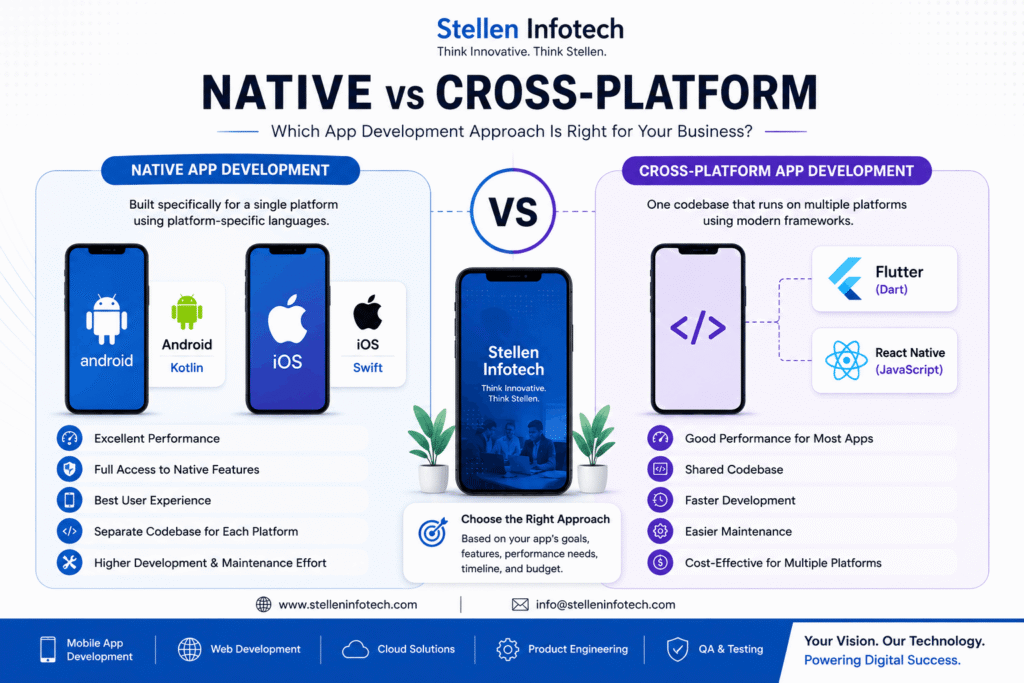
Native vs Cross-Platform App Development: Quick Comparison
| Factor | Native App Development | Cross-Platform App Development |
|---|---|---|
| Platforms | Built separately for Android or iOS | One shared codebase can target multiple platforms |
| Android technology | Kotlin | Flutter, React Native and others |
| iOS technology | Swift | Flutter, React Native and others |
| Performance | Excellent platform-specific performance | Very good for most business applications |
| Code reuse | Limited between platforms | High |
| Platform-specific features | Excellent access | Good, with native modules when required |
| Development effort | Higher when building for multiple platforms | Often lower for multi-platform apps |
| Maintenance | Separate platform codebases | More shared code |
| Best suited for | Performance-heavy or platform-specific apps | Many business and consumer apps targeting multiple platforms |
What Is Native App Development?
Native app development means building an application specifically for a particular operating system.
For Android, developers commonly use Kotlin, while iOS applications are typically developed using Swift. Because the application is designed for a specific platform, developers can work closely with the operating system and its native APIs.
This approach is particularly useful when an application needs advanced device capabilities, highly customized platform-specific interfaces, or intensive processing.
Businesses looking to use a hybrid app development approach do not need to write unique codes for each platform. The biggest upside is that it requires a single codebase and can work across multiple platforms. Mobile application developers from the best app development agency can create a single and unique codebase to be best deployed across all platforms. As a result, it saves time for developers working on various projects specifically designed for every platform making it worth consideration.
Advantages of Native App Development
Better platform-specific performance
Native applications are designed for the operating system they run on, giving developers direct control over platform-specific functionality and performance.
Access to native device features
Native development is a strong choice when an app relies heavily on features such as advanced camera capabilities, Bluetooth, sensors, location services, or other platform APIs.
Platform-specific user experience
Native applications can follow the design patterns and interaction conventions of Android or iOS more closely.
Strong option for complex applications
Apps involving intensive graphics, advanced hardware integration, or demanding real-time functionality may benefit from native development.
Limitations of Native App Development
The main drawback is that developing for multiple platforms generally means maintaining separate platform-specific codebases.
For example, a business launching on both Android and iOS may need separate development work for each platform. This can increase development and maintenance effort.
That does not mean native development is always more expensive. The actual cost depends on the complexity of the application, the number of platforms, required integrations, and the development team.
What Is Cross-Platform App Development?
Cross-platform app development allows developers to build applications for multiple platforms using a largely shared codebase.
Popular frameworks include Flutter and React Native.
Instead of maintaining completely separate applications from the beginning, businesses can share a significant portion of the development work between Android and iOS.
This makes cross-platform development particularly attractive for businesses that want to reach multiple platforms while keeping development more streamlined.
Advantages of Cross-Platform Development
Shared codebase
A large portion of the application can be developed using shared code, reducing duplicated work between platforms.
Faster development for many projects
When the same functionality is required on Android and iOS, sharing code can help reduce development time.
Simpler maintenance
Changes to shared functionality can often be handled from the shared codebase rather than being implemented independently in two applications.
Good fit for many business applications
E-commerce apps, customer portals, booking applications, internal business apps, content platforms, and many other applications can work well with a cross-platform approach.
Limitations of Cross-Platform Development
Cross-platform development is not suitable for every application.
Some applications require extensive platform-specific functionality. In those situations, developers may need to write native code or use native modules alongside the cross-platform framework.
The level of performance and platform integration also depends on the framework, application architecture, implementation quality, and the features being used.
So the decision should be based on the actual requirements of the application rather than assuming that cross-platform is always the cheaper or faster option.
Flutter vs React Native
Flutter and React Native are two of the most widely used approaches for cross-platform mobile development.
Flutter
Flutter is Google’s UI toolkit that uses the Dart programming language. It allows developers to build applications for multiple platforms from a shared codebase.
Flutter can be a good choice when a project requires:
- Highly customized interfaces
- Consistent UI across platforms
- Rapid development
- Shared application logic
- Cross-platform deployment
React Native
React Native is a framework developed by Meta that allows developers to build mobile applications using JavaScript or TypeScript and React.
It can be particularly suitable for teams that already have experience with React and the JavaScript ecosystem.
React Native also allows developers to integrate native code when platform-specific functionality is required.
Which one is better?
There is no universal winner between Flutter and React Native.
The right choice depends on the existing technical team, application requirements, UI needs, integrations, platform-specific functionality, and long-term maintenance plans.
Native vs Cross-Platform: Which Has Better Performance?
Native applications generally provide the greatest level of platform-specific performance because they are built directly for the operating system.
However, that does not mean cross-platform applications are slow.
Modern cross-platform frameworks can provide strong performance for many business and consumer applications. For a typical e-commerce, booking, social, content, or enterprise application, performance may not be the deciding factor.
The difference becomes more important when an application relies heavily on:
- Advanced graphics
- Real-time processing
- Complex animations
- AR or specialized device capabilities
- Intensive background processing
- Highly customized native functionality
In these cases, native development may offer more control.
Native vs Cross-Platform: Which Is More Cost-Effective?
Cross-platform development can reduce duplicated development work when an application needs to run on both Android and iOS.
However, it is not accurate to say that cross-platform development is always cheaper.
The final cost depends on factors such as:
- Application complexity
- Number of platforms
- Design requirements
- Backend integrations
- Third-party APIs
- Device features
- Testing requirements
- Security requirements
- Maintenance needs
For a relatively standard business application targeting Android and iOS, cross-platform development may provide an efficient way to share development effort.
For an application that requires extensive platform-specific functionality, native development may be the more practical long-term choice.
When Should You Choose Native App Development?
Native development is often the better option when:
- Performance is a critical requirement
- The app relies heavily on platform-specific features
- You need extensive access to device hardware
- The application requires highly customized native functionality
- You are building a graphics-intensive or specialized application
- Android and iOS experiences need to be designed independently
For example, an application that depends heavily on advanced camera capabilities, specialized sensors, AR features, or other platform-specific technologies may benefit from native development.
When Should You Choose Cross-Platform App Development?
Cross-platform development can be a strong option when:
- You need both Android and iOS applications
- A large portion of the functionality can be shared
- Time to market is important
- You want to reduce duplicated development work
- The application uses standard mobile features
- You want a more unified development and maintenance process
For many business applications, the ability to share code across platforms makes cross-platform development an attractive option.
What About App Maintenance?
Choosing a development approach also affects what happens after the application launches.
Mobile applications need ongoing maintenance for:
- Operating system updates
- Security fixes
- Bug fixes
- Dependency updates
- API changes
- Performance improvements
- New features
- Compatibility with newer devices
With native development, teams generally maintain separate platform-specific codebases.
With cross-platform development, more of the application can be maintained through shared code, although platform-specific updates and native modules may still require separate work.
This is why businesses should consider long-term maintenance before choosing a development approach.
Native vs Cross-Platform: Which Is Right for Your Business?
There is no single answer that works for every mobile application.
Choose native development when performance, deep platform integration, or specialized device functionality is central to the product.
Choose cross-platform development when you need Android and iOS applications and a significant amount of functionality can be shared between platforms.
For a standard business application, cross-platform development can offer an efficient way to reach multiple platforms. For highly specialized applications, native development may provide greater control.
The best decision should be based on your application’s requirements rather than simply choosing the technology that is currently most popular.
Frequently Asked Questions
Is native better than cross-platform app development?
Not necessarily. Native development provides greater platform-specific control and can be preferable for performance-intensive or specialized applications. Cross-platform development can be a better fit when businesses want to build for multiple platforms while sharing much of the codebase.
Is cross-platform app development cheaper?
It can be more cost-effective when a significant amount of functionality can be shared between Android and iOS. However, the total cost depends on the application’s complexity, integrations, device features, testing, and maintenance requirements.
Is Flutter better than React Native?
Neither is universally better. Flutter and React Native have different technical ecosystems and strengths. The better choice depends on the application’s requirements, development team’s expertise, UI requirements, integrations, and long-term plans.
Do cross-platform apps perform as well as native apps?
Cross-platform frameworks can provide strong performance for many applications. Native development can have an advantage when an application requires intensive graphics, specialized hardware integration, or highly platform-specific functionality.
Which is better for Android and iOS development?
If the application needs both Android and iOS and much of the functionality can be shared, cross-platform development can be an efficient option. If each platform requires highly specialized functionality, separate native development may be more suitable.
Can cross-platform apps use native device features?
Yes. Cross-platform frameworks can access many device capabilities and can also integrate native code when a project requires platform-specific functionality.
How do I choose between native and cross-platform development?
Start with your application’s requirements. Consider the target platforms, performance needs, device features, budget, development timeline, existing technical expertise, and long-term maintenance requirements before selecting an approach.
Build the Right Mobile App Development Strategy
Choosing the right technology is only one part of building a successful mobile application. The development approach should support the product’s features, users, performance requirements, and long-term roadmap.
If you are planning an Android, iOS, or cross-platform application, Stellen Infotech’s mobile app development services can help you evaluate the right development approach and build an application around your business requirements.