Getting more clients is not just about reaching more people. You need to reach the right people, show them how you can help, build trust, and give them a good reason to contact you.
A good marketing strategy brings these steps together. It can include SEO, content marketing, social media, referrals, email, paid advertising, and direct outreach.
In this guide, we will look at practical marketing tips to win clients, build a steady flow of leads, and turn more interested prospects into customers.
What Is the Best Way to Win New Clients?
The best way to win new clients is to understand your target customers, explain your services clearly, reach them through the right channels, and build trust before asking for a sale.
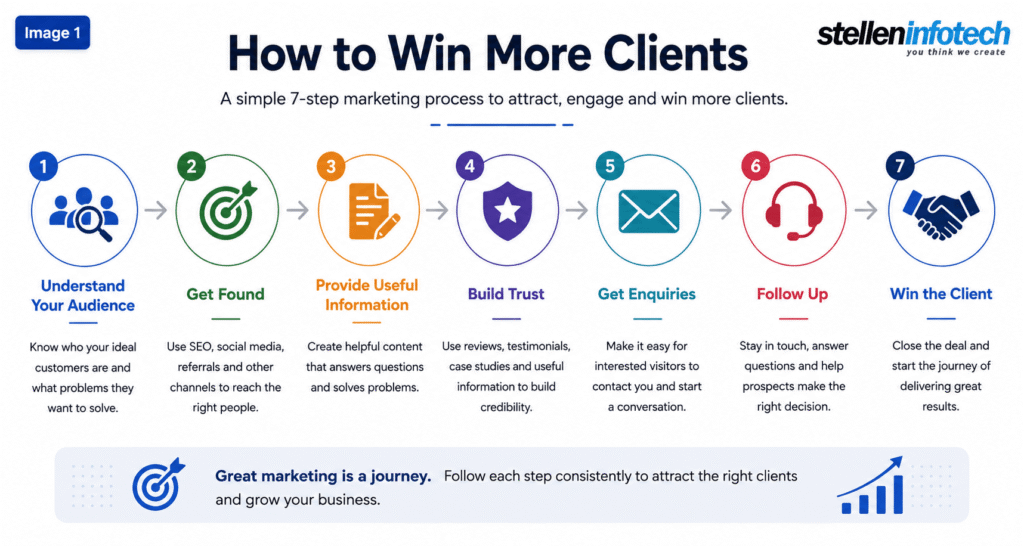
A simple process looks like this:
Your Audience
Information
Client
You do not need to use every marketing channel. Focus on the channels your potential customers already use and measure what brings results.
1. Know Who You Want to Reach
One of the biggest marketing mistakes is trying to sell to everyone.
Before you start a campaign, define the type of customer you want to reach. Think about their needs, problems, industry, location, and buying habits.
For a business-to-business company, you may also need to know who makes the final buying decision.
Start by asking:
- What type of business needs our service?
- What problems are they trying to solve?
- What services are they looking for?
- What questions do they ask before buying?
- What makes them choose one provider over another?
- What concerns could stop them from buying?
You can find useful answers through customer conversations, reviews, sales calls, website data, keyword research, and competitor research.
The more you understand your customers, the easier it becomes to create useful marketing messages.
2. Explain Clearly Why Customers Should Choose You
Once you know your audience, explain what makes your business useful to them.
Your website and marketing should make three things clear:
- Who do you help?
- What problem do you solve?
- Why should customers consider your business?
Avoid vague statements such as:
We provide high-quality digital solutions.
Instead, explain what you actually provide and who it is for.
For example, if you provide web development services, explain the types of websites or applications you build, the businesses you serve, and the problems your services can solve.
Your customers should understand your offer without having to search through several pages.
3. Build a Website That Helps You Get Clients
Your website is often one of the first places a potential customer visits after finding your business.
It should do more than list your services.
A good business website should answer questions such as:
- What does the company do?
- Who does it serve?
- What services are available?
- How can the company help?
- Why should a customer trust the company?
- Are there examples of previous work?
- How can someone get in touch?
Your website should also make it easy to take the next step.
Depending on your business, that could be:
- Requesting a quote
- Booking a consultation
- Calling the business
- Sending an enquiry
- Booking a product demo
- Downloading a useful guide
If visitors cannot easily find what they need, some of them may leave before contacting you.
4. Use SEO to Reach People Looking for Your Services
SEO can help your business appear when potential customers search for products, services, and answers online.
But SEO is not only about ranking for service keywords.
People search at different stages of the buying process.
When people are learning
They may search for:
- How does enterprise mobility work?
- How can I improve website performance?
- What is a custom web application?
At this stage, helpful guides and blog posts can answer their questions.
When people are comparing options
They may search for:
- Native vs hybrid app development
- Best web development technologies
- Custom vs off-the-shelf software
Comparison and detailed guide content can help here.
When people are ready to buy
They may search for:
- Web development company
- SEO services
- Hire Shopify developer
- Mobile app development company
Service pages are usually more useful for these searches.
A good SEO strategy connects these different types of content.
For example:
Blog post → Service page → Contact or enquiry
This gives visitors a clear path from learning about a problem to finding a solution.
If you want to improve your website’s search visibility, SEO services can help with areas such as keyword research, content optimization, technical SEO, and internal linking.
5. Create Content That Answers Customer Questions
Blogging should not be about publishing as many articles as possible.
Your content should help potential customers understand a problem, compare their options, or make a better decision.
Useful content can include:
- How-to guides
- Comparison articles
- Industry guides
- Case studies
- FAQs
- Checklists
- Videos
- Research reports
- Templates
- Expert guides
For example, someone looking for a custom web application may first want to understand the difference between custom software and an off-the-shelf solution.
A useful article can answer that question and explain when each option makes sense.
This type of content can bring visitors to your website before they are ready to contact a company.
Create content for different stages
A simple content plan can look like this:
| Customer Stage | Useful Content |
|---|---|
| Learning about a problem | Blog posts and guides |
| Looking at solutions | Comparisons and explainers |
| Comparing providers | Service pages and case studies |
| Ready to buy | Contact pages, demos and consultations |
This makes your content more useful and gives visitors a clear next step.
6. Build Trust Before Asking for the Sale
People want to know that they are making the right choice before hiring a company.
This is especially true when the service is expensive, complex, or important to their business.
Your website can build trust through:
- Customer reviews
- Testimonials
- Case studies
- Portfolio examples
- Useful content
- Clear service information
- Transparent communication
- Relevant experience
- Answers to common questions
Do not simply add testimonials to a page and leave them without context.
When possible, explain:
What was the problem? What solution was provided? What was the result?
This gives potential customers more useful information when they are comparing providers.
7. Use Happy Customers to Get Referrals
Your existing customers can help you find new clients.
A satisfied customer may recommend your business to a colleague, business partner, friend, or another company.
But referrals usually start with a good customer experience.
Make it easy for customers to:
- Leave a review
- Recommend your business
- Share a testimonial
- Refer a colleague
- Take part in a case study
- Share your content
You can also ask satisfied customers for referrals when the timing is right.
For example, after completing a successful project, you could ask:
“If you know another business that could benefit from this service, we would be happy to speak with them.”
A simple request can create new opportunities without adding another paid marketing channel.
8. Use Social Media to Build Relationships
Social media can help businesses reach new people, stay visible, and show their expertise.
But you do not need to be active on every platform.
Start with the channels your customers actually use.
For example, a B2B company may get more value from LinkedIn than from a platform where its target decision-makers rarely spend time.
Good social media content can include:
- Practical tips
- Short guides
- Customer stories
- Industry news
- Product demonstrations
- Videos
- Answers to common questions
- Research and data
- Behind-the-scenes content
Avoid making every post a sales pitch.
People are more likely to engage with a business that regularly gives them something useful.
9. Offer Useful Free Resources
Free resources can help you attract people who are interested in your services.
The key is to offer something that solves a real problem.
Examples include:
- Checklists
- Ebooks
- Templates
- Guides
- Reports
- Calculators
- Assessments
- Webinars
- Product demos
- Free consultations
For example, an SEO company could offer a technical SEO checklist.
Someone who downloads the checklist may not be ready to hire an SEO company immediately. But they have already shown interest in SEO.
You can then provide more useful information and stay in touch when appropriate.
10. Make It Easy for People to Contact You
Getting visitors to your website is only part of the job.
You also need to make it easy for interested visitors to contact you.
Look at your website and ask:
“If someone wants to contact us right now, can they easily find out how?”
Depending on your business, your main calls to action could include:
- Get a quote
- Contact us
- Book a consultation
- Request a demo
- Call now
- Send an enquiry
The call to action should match the page.
Someone reading a beginner’s guide may not be ready to request a quote.
But someone reading a service page may be much closer to making contact.
11. Follow Up With Potential Clients
Getting an enquiry does not always mean getting a client.
Some people are ready to buy. Others need more time to compare options, discuss the project internally, or get approval.
A simple follow-up process can help.
First, understand the enquiry
Find out:
- What does the prospect need?
- What problem are they trying to solve?
- What is their timeline?
- Who is involved in the decision?
- What information do they need?
Then provide useful information
You might share:
- A relevant service page
- A case study
- A guide
- A product demo
- Answers to their questions
Finally, agree on the next step
This could be:
- A call
- A consultation
- A technical discussion
- A proposal
- A product demonstration
Good follow-up is not about sending repeated sales messages. It is about helping the prospect make a decision.
12. Use AI and Automation Where It Makes Sense
AI and automation can help with some parts of marketing and lead generation.
For example, businesses can use them to:
- Sort and qualify enquiries
- Answer common website questions
- Personalize email messages
- Organize customer information
- Research content ideas
- Create reports
- Automate routine tasks
A chatbot, for example, can answer basic questions and direct visitors to the right service or contact page.
But automation should not replace human communication when a prospect has a complex requirement.
For larger projects, customers may still want to speak directly with someone who understands their needs.
13. Measure Which Marketing Activities Bring Clients
Do not judge your marketing only by website traffic or social media likes.
The more important question is:
Which activities are helping us get qualified leads and clients?
Here are some useful metrics to track:
| Marketing Activity | What to Measure |
|---|---|
| SEO | Organic traffic, leads and conversions |
| Content marketing | Traffic, engagement and enquiries |
| Social media | Engagement, traffic and leads |
| Email marketing | Clicks, replies and conversions |
| Paid advertising | Cost per lead and conversions |
| Referrals | Referral leads and new clients |
| Website | Enquiries and conversion rate |
The right metrics depend on your business.
For example, a B2B company may have a long sales process. Someone could read a blog post today and become a customer several weeks later.
That is why it is useful to look at the full customer journey instead of only the last interaction.
A Simple Process to Get More Clients
If you are not sure where to start, use this simple process:
| Step | What to Do |
|---|---|
| 1. Understand | Identify your ideal customers and their problems. |
| 2. Attract | Use SEO, social media, referrals and other relevant channels. |
| 3. Educate | Create useful content that answers customer questions. |
| 4. Build Trust | Use reviews, testimonials, case studies and useful information. |
| 5. Convert | Give interested visitors a clear way to contact you. |
| 6. Follow Up | Stay in touch and answer questions. |
| 7. Retain | Continue providing a good customer experience. |
| 8. Grow | Encourage reviews, referrals and repeat business. |
You do not need to perfect all eight steps at once.
Start with the part of your marketing process that needs the most improvement.
Common Mistakes Businesses Make When Trying to Get Clients
Trying to reach everyone
A broad audience can make your marketing message unclear.
Focus on the customers who are most likely to need your services.
Focusing only on traffic
More website visitors do not always mean more clients.
Look at qualified leads and enquiries as well.
Making every piece of content a sales pitch
People visit your content because they want information.
Answer their questions first. Talk about your services when they are relevant.
Ignoring existing customers
Your current customers can provide reviews, referrals, repeat business, and useful feedback.
Making claims you cannot support
Avoid promises about guaranteed rankings, leads, sales, or revenue.
Clear and honest marketing helps build trust.
Making it difficult to contact you
If people cannot quickly find your contact details or next step, you may lose potential clients.
How Long Does It Take to Get New Clients From Marketing?
There is no fixed timeline.
The time it takes depends on your industry, competition, marketing channel, budget, sales process, and target audience.
Some methods can produce enquiries quickly. Others, such as SEO and content marketing, often take longer to build.
Instead of expecting every channel to produce immediate sales, track progress through stages:
This can help you understand where your marketing needs improvement.
For example, if your website receives visitors but very few people contact you, the problem may be your messaging or calls to action.
If you get many enquiries but very few become clients, you may need to review your sales and follow-up process.
Frequently Asked Questions
How can I get more clients for my business?
Start by identifying your ideal customers and the problems they need to solve. Then use the channels where they are most likely to find you, such as SEO, content marketing, social media, referrals, partnerships, or paid advertising. Make sure your website clearly explains your services and makes it easy to contact you.
What are the best marketing tips to win clients?
Start with a clear target audience, a strong message, useful content, good search visibility, customer reviews, referrals, and regular follow-up. The best combination depends on your industry and customers, so measure which activities bring qualified leads and new business.
How does SEO help businesses get more clients?
SEO helps your business appear when people search for information, products, or services related to your business. Useful content can attract people while they are researching, while well-optimized service pages can help people who are ready to contact a provider.
How can content marketing attract new clients?
Content marketing helps answer questions that potential customers have before they buy. Blog posts, guides, comparisons, case studies, videos, and FAQs can help people understand their options and build trust in your business.
Do referrals help businesses get new clients?
Yes. Referrals can introduce your business to potential customers through people they already know and trust. A good customer experience, strong service, and an easy review or referral process can help generate more recommendations.
Should a small business use every marketing channel?
No. It is usually better to focus on a few channels that your customers actually use. Once you know which channels bring useful results, you can decide whether to expand your marketing efforts.
How do I know if my marketing is working?
Track more than website traffic. Look at qualified leads, enquiries, conversion rates, sales opportunities, new customers, and the cost of getting those customers. These numbers give you a better view of your marketing results.
Can AI help businesses get more leads?
AI can help with tasks such as answering common questions, sorting enquiries, researching content, and automating routine work. It can support your marketing process, but human communication is still important for complex sales and customer needs.
Final Thoughts
Getting more clients does not require one perfect marketing trick.
Start with the basics.
Know your customers. Explain your value clearly. Get found online. Create useful content. Build trust. Make it easy to contact you. Follow up with interested prospects.
Then measure what works.
Improve your website pages and call to actions to convert your website traffic into leads,
The goal is not to market your business everywhere.
The goal is to reach the right people with the right message and make it easy for them to choose your business.