Across sturdy options available in the market, WordPress ranks as a powerful platform for a stellar and technologically advanced CMS. Having Intuitive and interactive interfaces allowing the easy creation, modification, and management of website content have significantly raised its popularity. According to a report, the number of websites developed using WordPress was a staggering 835 million in the year 2022. With the constantly increasing number of stellar websites developed using WordPress, responsive and excellent website development is mandatory. It allows you to mark a prominent position in the market and stand strong at a higher position across the competition.
Regardless of your knowledge level, you should look out to hire excellent and leading WordPress experts for optimal website performance. Brainstorming on how to make the ultimate choice for an excellent hire and avail a superior level of satisfaction?
In this segment you’ll get a better understanding and knowledge of factors acquiring consideration to hire the best developers available in the market. We’ve listed a detailed list of qualities to look out for while making the selective choice. You can get the maximum and the desired output from the potential WordPress developers by making the right and decisive choice.
Valuable And Adequate Technical Experience:
Look at the attributes that should be considered when hiring WordPress experts and outline the development project’s desired needs and requirements. Write down your project needs to understand forthcoming development requirements better and with precision. Generally, basic WordPress website development is done in PHP- a critical programming language. An optimal performance website development requires scripting language skills like HTML/XHTML, MySQL, CSS, and more as per the project requirements.
Your project developer should be equipped with the critical technical languages listed above and not just PHP. Research and look out for a sufficient experience holder with valuable knowledge and skills in technical languages.
Effective And Spectacular Communication:
Effective and Spectacular Communication is the bridge between confusion and clarity. An effective flow of communication is required everywhere and this is a must-have quality in a WordPress developer. Individuals from different cultures and geographies use WordPress and other website development platforms to develop their own websites. The development experts should do justice to their job by providing excellent communication skills across various channels.
Doing so allows for a WordPress website development to match the expectations and actual output across clients.
Understand And Work Within Development Budget:
Individuals set budgets to guide the developers about their operating means and to avoid the space for unexpected financial challenges. Developers should understand the project requirements and work as per their capabilities within the development budget.
Responsive & appealing themes and highly functional website features are some elements individuals foresee at the time of development budget preparation. While appealing themes are excellent to attract website visitors, creative and best-functioning features are great for lead conversions.
Share your concerns with an expert and look to hire WordPress theme developers that understand and work according to your expectations. Also, make sure they can accomplish and deliver WordPress website development within deadlines with a perfect blend of advanced features.
Robust Search Engine Optimization Knowledge:
Along with the incredible qualities listed above, looking out for WordPress developers with robust SEO knowledge is much needed. Generally, WordPress website design and development come with search engine optimization-friendly features. However, you can maximise the efforts of getting your website ranked in the high search results with competitive search terms. Thinking about how?
You can improve your website’s visibility and traffic by hiring experienced developers that have specialisation in stellar website optimization. Accomplishing so lays the foundation for enhancing the credibility and reputation of your website.
With a higher website placement on the search engine, you can reach out to more potential customers. Also, provide them with the products and services or other valuable elements through this enhanced reach.
Superior Website Security Knowledge:
Cybersecurity threats are not new in the digital market. Thus, prioritising website security is critical to reducing the likeness by all means. WordPress as a development platform is regularly updated to eliminate security vulnerabilities significantly. You can share the alarming cyber threats concerns with experienced developers and integrate security features into your website.
Simply, look out and hire WordPress programmers with superior security knowledge and reduce the chances of incurring huge data theft. Experienced developers are experts at integrating stellar security features by using SSL and unique combinations of passwords.
Post-Development Maintenance Support:
Hiring WordPress developers to provide post-development maintenance support is the cherry on the cake. Websites are not just to be developed and left forever. Instead, regular updates need to be made to the content and design required to stay competitive over years.
Before you head towards making a decisive choice towards hiring an experienced WordPress developer, ask for post-development maintenance support services. Aim to hire one providing post-development and deployment of the website services.
Doing so ensures that incredible themes, plugins, and other critical website elements are up-to-date and not outdated.
Conclusion
This in-depth guide must have provided you with all the WordPress developers’ factors that need consideration. From taking care of the nuts and bolts of publishing incredible content to SEO capabilities, WordPress offers wonderful features. These compelling features and capabilities make it an excellent stepping-stone website-building platform choice.
There is no doubt that WordPress for programmers is an advanced and powerful content management system. Generally, it allows developers to create websites by writing a few lines of unique code. Put an end to your WordPress developers’ search by hiring experts from a reputable and leading website development company.
Why wander across the long list available on the internet when Stellen Infotech is here? Take assistance from our excellent team of developers and extend your website functionalities and capabilities. Our experts are among the best at integrating highly functioning features, plugins, appealing and responsive themes, and all required.
Book a consultation with our team of experts to get started with your WordPress website development.
Selecting the best technology for web development and applications is relatively easy. However, looking out to hire the Best Team Of Developers can be a difficult task. Saying yes to React JS technology is a great choice for excellent web development. Hiring Reliable React Js Service should be a top priority to ensure technologically advanced web development.
A React developer is an expert at determining the best course of action for implementing user-friendly, interactive, and intuitive interfaces. They develop unique courses of action for different development projects according to the client’s requirements and expectations. There are plenty of factors that need consideration when hiring a ReactJS developer.
In this article, we’ll cover these factors to help you look for a reliable React developer.
Factors To Consider When Looking Out For A React JS Developer
There are a number of important factors that need consideration when hiring React js Development Services. Understanding these factors will help to make the right selective decision. So, without wasting further time, let us start with the list.
1. Technical Skills Analysis: Sound Knowledge And Expertise
First on the list of hiring factors is an analysis of technical skills. Before you head towards the road to hiring React developers, determine the skills your ideal development expert should possess. List down the required programming languages developers should have sound knowledge and expertise in.
The five primary technical skills one should look out for in a developer are listed below.
JavaScript
React technology is an open-source JavaScript library. JavaScript is a common language that a React developer should be familiar with for successful web development. Make sure to Hire React Developer with a solid knowledge of JavaScript. Also, foresee that the expert holds adequate years of experience. Look out for a proven track development record to make sure that your project is in the right hands.
React Core Concepts
A React developer should have a solid understanding of React’s most essential core concepts. Hooks, functional and class components, lifecycle methods, JSX, and props are the most critical programming concepts a reliable developer should hold.
HTML/CSS
A developer should possess proficiency in HTML and CSS, the basic skills required for front-end development. This programming skill is critical to building an enticing user interface to maximize engagement by providing an excellent user experience.
2. Spectacular Interpersonal Skills:
Every project development is prone to challenges. So a developer should have spectacular interpersonal skills to handle a team and get the work done. Standing strong in times of difficulty is a trait of a leader that you should look for in your potential React developer.
Look at the skills detailed below to hire an excellent developer.
Stellar Communication Skills:
Effective communication is an important factor that development experts should possess. Web development is a process that needs stellar communication with developers to get the desired output as per expectations. Verbal and written communication needs to be encouraged for regular development updates.
Critical Thinking:
The next skill set that a React developer should have is checking the ability to think out of the box. In a nutshell, a developer should be able to analyze and interpret the problem. Look for an expert that can think of possible solutions to problems and come up with unique and creative solutions.
3. Development Knowledge: React Styling Strategies And Fundamentals & Frameworks:
As far as React styling is concerned, a developer should have strong knowledge of popular styling strategies. Adequate knowledge in inline and external styling, React components, and CSS strategies is critical for appealing development styling. Moreover, these styling components are responsible for constructing interactive and feature-rich user interfaces. For React fundamentals and frameworks, see that the development expert is well-versed in third-party tools to commend React libraries. Look out for this checklist factor and Hire React Js Developers with versatile development knowledge and experience.
4. React js Development Services Provider Portfolio:
Take a glance at the portfolio of the React js Development Services provider and check their past projects’ development data. See that the developers have a genuine interest in providing their services and they have a track record of successful projects.
5. Performance Optimization:
Before signing the contract, check that the developer is well-versed in website elements optimization techniques for a best-performing website. Optimization should not just be limited to programming skills. Before signing the contract, check that the developer is well-versed in website elements optimization techniques for a best-performing website. Additionally, Instead of just relying on programming skills, developers should prioritize other critical website elements to maximize performance.
Conclusion
Excellent website designs and applications have become a necessity and moreover a crucial part of our everyday lives. A wide range of audiences is making a transformational shift by accessing stellar websites to ease their daily tasks. With a large audience choosing technologically advanced websites, business owners should be cautious with selecting web development technology and developers.
Furthermore, ReactJS is an imperative choice for excellent web development. Additionally, user-friendly and interactive interfaces and pre-built frameworks comprising buttons and navigation menus have made ReactJS popular in this technologically advanced world.
Consequently, you can take the best route by marking ReactJS as a web development technology and hiring an ultimate developer.
Moreover, the React JS developers of Stellen Infotech are well-equipped with the factors listed above. In addition, our experts guarantee to provide you with agile services 24/7 with high standards and advanced technologies.
Fortunately, the React JS developers of Stellen Infotech are well-equipped with the factors listed above. Our experts guarantee to provide you with agile services 24/7 with high standards and advanced technologies.
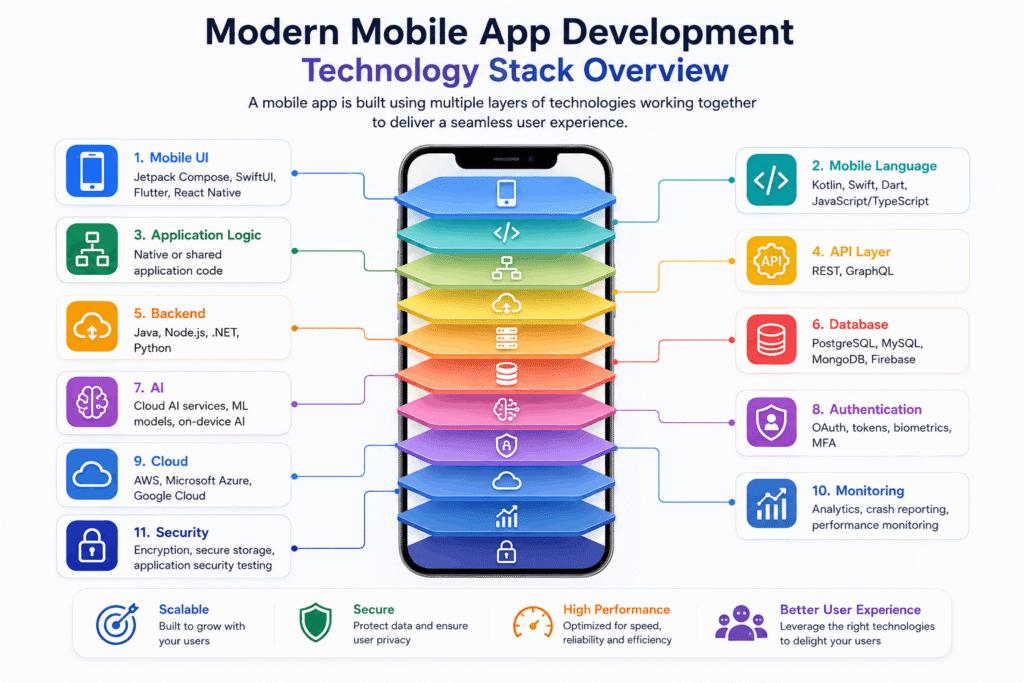
Mobile apps have evolved far beyond simple screens, forms, and notifications. Modern applications can use artificial intelligence, cloud services, real-time data, connected devices, biometrics, advanced graphics, and platform-specific capabilities to deliver highly personalized experiences.
At the same time, development teams have more choices than ever when selecting a technology stack. A business can build separate native applications for Android and iOS, use a cross-platform framework, share selected code through a multiplatform approach, or combine mobile technologies with cloud and AI services.
The answer depends on the type of application, target platforms, performance requirements, features, budget, development team, and long-term maintenance plans.
This guide covers the major technologies used today and explains where each approach can make sense.
What Technologies Are Used in Mobile App Development?
Modern mobile applications usually combine several technologies rather than relying on a single programming language or framework.
Development Area
Common Technologies
Android Development
Kotlin, Android SDK, Jetpack Compose
iOS Development
Swift, SwiftUI, Xcode
Cross-Platform Development
Flutter, React Native
Multiplatform Development
Kotlin Multiplatform, Compose Multiplatform
Backend Development
Java, Node.js, .NET, Python
APIs
REST, GraphQL
Cloud Services
AWS, Microsoft Azure, Google Cloud
Databases
PostgreSQL, MySQL, MongoDB, Firebase and others
Artificial Intelligence
AI APIs, machine learning frameworks, on-device AI
The right combination depends on the application. A banking app, social platform, e-commerce application, IoT solution, and enterprise mobility app can all require very different technology stacks.
1. Native Mobile App Development
Native development means building an application specifically for a particular operating system using its preferred development tools and technologies.
The two dominant mobile platforms are Android and iOS.
Android Development
Kotlin is the primary language used for modern Android development.
Android development also commonly involves the Android SDK and Jetpack libraries. Jetpack Compose provides a modern declarative approach to building Android user interfaces.
Native Android development can be a strong choice when an application needs deep access to Android features, platform-specific functionality, or highly optimized performance.
iOS Development
Swift is Apple’s modern programming language for application development.
For the user interface, SwiftUI provides a declarative framework for building applications across Apple platforms. Apple continues to expand SwiftUI with new capabilities as its platform ecosystem evolves.
Native iOS development is often appropriate when an application needs precise control over the Apple ecosystem, platform-specific features, or a highly customized iOS experience.
When should you choose native development?
Native development can make sense when you need:
Maximum platform-specific control
High-performance applications
Advanced device capabilities
Specialized hardware integrations
Complex animations or graphics
Platform-specific user experiences
Early access to new operating-system capabilities
The trade-off is that building separate Android and iOS applications usually means maintaining separate codebases and development workflows.
2. Cross-Platform Mobile App Development
Cross-platform development allows teams to build applications for multiple operating systems while sharing a significant amount of code.
Instead of maintaining completely separate implementations for Android and iOS, developers can share application logic and, depending on the framework, parts or most of the user interface.
Flutter
Flutter uses Dart and provides a framework for building applications from a shared codebase.
It can be useful when a team wants consistent UI behavior across platforms and needs to move quickly while maintaining a single development environment.
React Native
React Native uses JavaScript or TypeScript and is particularly familiar to teams that already work with React.
Its modern architecture has continued to evolve, with the New Architecture becoming the default for React Native projects from version 0.76 onward.
When should you choose cross-platform development?
Cross-platform development can be a good option when:
You need both Android and iOS applications
A large portion of functionality can be shared
Development speed is important
You want to reduce duplicated development work
Your team already has relevant cross-platform expertise
The application does not depend heavily on platform-specific functionality
However, cross-platform does not automatically mean better or cheaper. The decision should consider performance, integrations, native APIs, team skills, testing, and long-term maintenance.
3. Kotlin Multiplatform
Kotlin Multiplatform takes a different approach to cross-platform development.
Instead of requiring an application to be completely shared, teams can decide which parts of the application should be shared and which should remain platform-specific.
For example, a development team might share:
Business logic
Data models
Networking
Authentication
Validation
Data access
while keeping the user interface native on Android and iOS.
Kotlin Multiplatform can also be combined with Compose Multiplatform when teams want to share UI code. The technology supports gradual adoption, meaning an existing application does not necessarily have to be rewritten from scratch.
This flexibility makes multiplatform development particularly interesting for teams that want code reuse without giving up access to native platform capabilities.
4. AI and Machine Learning in Mobile Apps
Artificial intelligence has become one of the most significant developments in mobile application technology.
However, AI in mobile apps is no longer limited to simple chatbots.
Modern applications can use AI for:
Personalized recommendations
Intelligent search
Voice interactions
Image and document analysis
Content generation
Predictive features
Customer support
Fraud detection
Smart notifications
AI assistants
Workflow automation
Generative AI
Generative AI can allow mobile applications to create or transform content based on user input.
For example, an application could help users:
Summarize documents
Generate product descriptions
Draft messages
Analyze information
Ask questions about their data
Interact with an AI assistant
The implementation can involve cloud-based AI models, application APIs, or a combination of both.
On-Device AI
Another important direction is running some AI capabilities directly on the device.
On-device processing can provide advantages such as:
Lower latency
Better offline functionality
Reduced data transmission
Greater privacy for certain use cases
More responsive interactions
This does not mean every AI workload should run on a smartphone. Larger models and complex tasks may still be better suited to cloud infrastructure.
The practical approach is often to decide which processing belongs on the device and which belongs in the cloud.
AI Agents in Mobile Applications
AI is also moving toward more action-oriented experiences.
Instead of simply answering a question, an AI system can potentially help users complete multi-step tasks by interacting with tools, data, and application functionality.
This is an emerging area, so businesses should evaluate security, permissions, reliability, privacy, and human oversight carefully before allowing AI systems to perform actions on behalf of users.
5. Cloud and Backend Technologies
A mobile application rarely operates by itself.
Most feature-rich apps communicate with backend systems that handle authentication, business logic, databases, payments, notifications, analytics, and other services.
A simplified architecture might look like this:
Mobile App → API → Backend → Database → Cloud Services
Common technologies include:
REST APIs
GraphQL
Java
Node.js
.NET
Python
PostgreSQL
MySQL
MongoDB
Cloud databases
Serverless services
Cloud infrastructure can also help applications scale as usage increases.
For example, an e-commerce app may use mobile technologies for the customer experience while its backend manages products, orders, payments, customer accounts, inventory, and notifications.
This is why mobile app development increasingly involves both mobile engineering and backend architecture.
6. IoT Integration
Mobile applications can also act as interfaces for connected devices.
In an IoT-based solution, the mobile application may communicate with sensors, appliances, vehicles, wearables, or industrial equipment.
A typical architecture could look like:
Connected Device → Network → Cloud/Backend → Mobile App
Examples include:
Smart home applications
Fitness and wearable applications
Connected vehicle platforms
Industrial monitoring systems
Smart appliances
Healthcare devices
Asset tracking systems
The mobile application becomes the user’s interface for viewing data, receiving alerts, controlling devices, or managing connected services.
7. AR, VR and Immersive Mobile Experiences
Augmented and virtual reality can add another layer of interaction to mobile applications.
Augmented Reality
AR can overlay digital information onto the physical environment.
Potential applications include:
Furniture visualization
Retail product previews
Navigation
Education
Tourism
Training
Product demonstrations
For example, a furniture retailer could allow customers to see how a product might look inside their room before purchasing it.
Virtual Reality
VR provides a more immersive environment and can be useful for:
Gaming
Training
Education
Simulations
Virtual experiences
Not every application needs AR or VR. These technologies are most valuable when immersive interaction solves a genuine user problem.
8. Mobile App Security and Privacy
Security should not be treated as a temporary mobile development trend. It should be part of the application architecture from the beginning.
Mobile applications often handle sensitive information such as personal data, payment information, location, authentication credentials, and business information.
Important security technologies and practices include:
Biometric authentication
Multi-factor authentication
Encryption
Secure API communication
Secure data storage
Access controls
Token-based authentication
Application security testing
Dependency management
Secure coding practices
Privacy also needs to be considered when applications collect location, contacts, images, microphone data, or other sensitive information.
The right approach is to collect only the information the application actually needs and clearly communicate how that information is used.
9. Adaptive Interfaces and Foldable Devices
Mobile applications no longer need to be designed around a single screen size.
Users may access applications on:
Traditional smartphones
Foldable phones
Tablets
Large-screen devices
Different orientations
Devices with multiple window configurations
This makes responsive and adaptive UI design increasingly important.
Instead of building an interface for one fixed screen, developers should consider how layouts behave when the available space changes.
This can improve usability across different devices without requiring an entirely separate interface for every screen configuration.
The broader lesson is that modern mobile apps need to be flexible rather than tied to one device format.
10. Mobile App Testing and Performance Technologies
A mobile application can look excellent and still fail if it crashes, loads slowly, drains the battery, or behaves differently across devices.
Testing therefore needs to happen throughout development.
Common approaches include:
Unit testing
Integration testing
UI testing
Automated testing
Performance testing
Security testing
Device compatibility testing
Network testing
Regression testing
Performance monitoring can also help teams identify crashes, slow screens, memory issues, and other problems after an application is released.
Testing is particularly important for applications that need to support multiple operating systems and a wide range of devices.
11. APIs and Third-Party Integrations
Modern mobile applications rarely exist in isolation.
They often need to connect with external systems such as:
Payment gateways
CRM platforms
Maps
Social platforms
Analytics tools
Marketing platforms
Identity providers
Enterprise software
AI services
APIs provide the connection between the mobile application and these external systems.
REST remains widely used, while GraphQL can be useful when applications need more flexible control over the data requested from backend services.
The important consideration is not simply which API technology is used, but whether the overall integration architecture is secure, reliable, scalable, and easy to maintain.
How Do You Choose the Right Mobile App Development Technology?
There is no single technology that is best for every mobile application.
The right choice depends on the project’s requirements.
Requirement
Possible Approach
Maximum platform-specific control
Native development
Android application
Kotlin
iOS application
Swift
Android and iOS with shared code
Flutter / React Native
Shared business logic with native UI
Kotlin Multiplatform
AI-powered application
Native or cross-platform + AI services
IoT application
Mobile + backend + IoT infrastructure
Enterprise mobile application
Architecture based on business requirements
Highly specialized device features
Native development
Before choosing a technology, consider:
Target platforms
Do you need Android, iOS, or both?
Application complexity
Is the app a relatively simple consumer application or a complex enterprise platform with multiple integrations?
Performance requirements
Does the application involve intensive graphics, real-time processing, or specialized hardware?
Device capabilities
Will you need cameras, GPS, Bluetooth, biometrics, sensors, NFC, or other device features?
Development resources
What technologies does your existing team already know?
Time to market
Do you need to release Android and iOS applications simultaneously?
Long-term maintenance
Who will maintain the application after launch, and how easy will it be to update?
Scalability
Will the application need to support a growing number of users, transactions, devices, or integrations?
These questions are more useful than simply choosing the technology that is currently receiving the most attention.
Native vs Cross-Platform: Which Approach Is Better?
The answer depends on the project.
Native development provides maximum control over each platform and can be ideal for performance-intensive or highly specialized applications.
Cross-platform development can reduce duplicated development work when an application needs to support multiple platforms and much of its functionality can be shared.
Kotlin Multiplatform provides another option by allowing teams to share selected application logic while retaining native code where it matters.
The best approach is therefore the one that balances performance, development speed, platform requirements, budget, and long-term maintenance.
What Does a Modern Mobile App Technology Stack Look Like?
A small consumer application might need only a few of these components, while an enterprise application could require nearly all of them.
The Future of Mobile App Development
Mobile development is moving toward applications that are more intelligent, connected, adaptive, and personalized.
AI will continue to influence how users interact with applications, while on-device processing can make some experiences faster and more private.
Cross-platform and multiplatform approaches will continue to give teams more choices for sharing code across Android and iOS. At the same time, native development will remain important when applications require precise platform control.
Cloud services, APIs, connected devices, adaptive interfaces, and stronger security practices will also remain important parts of the mobile development ecosystem.
Rather than following every new technology trend, businesses should focus on building a technology stack that supports their users and business objectives.
Frequently Asked Questions
What technologies are used in mobile app development?
Mobile applications can use a combination of native languages such as Kotlin and Swift, cross-platform frameworks such as Flutter and React Native, multiplatform technologies such as Kotlin Multiplatform, backend technologies, APIs, databases, cloud services, AI tools, and security technologies.
Which technology is best for mobile app development?
There is no universally best technology. Native development can be suitable when platform-specific performance and functionality are important, while cross-platform or multiplatform development can be useful when businesses need to support Android and iOS with shared code.
Which language is used for Android app development?
Kotlin is the primary language for modern Android development. Android applications can also use Java, particularly in existing projects and legacy codebases.
Which language is used for iOS app development?
Swift is Apple’s primary modern programming language for iOS and other Apple-platform applications. SwiftUI can be used to create user interfaces across Apple’s platforms.
Is Flutter good for mobile app development?
Flutter can be a good option for teams that want to build applications for multiple platforms from a shared codebase. The right choice still depends on the application’s requirements, native integrations, team expertise, and long-term maintenance needs.
Is React Native still used for mobile app development?
Yes. React Native remains an established cross-platform option. Its modern architecture has continued to evolve and is now enabled by default in React Native projects.
What is Kotlin Multiplatform used for?
Kotlin Multiplatform allows developers to share code across platforms such as Android and iOS while retaining the ability to use platform-specific code when necessary. Teams can share business logic, data layers, or other components without necessarily rebuilding the entire application.
Can AI be integrated into mobile apps?
Yes. AI can be integrated into mobile applications through cloud-based APIs, backend services, machine learning models, and in some cases on-device AI. Common applications include intelligent search, recommendations, assistants, content generation, image analysis, and automation.
What backend technologies are used for mobile applications?
Mobile applications can connect to backend systems built with technologies such as Java, Node.js, .NET, or Python. These backend systems typically manage APIs, authentication, business logic, databases, integrations, and other server-side functions.
How do I choose the right mobile app development technology?
Start with the application’s requirements rather than the technology. Consider target platforms, features, performance, device capabilities, integrations, development resources, budget, time to market, scalability, and long-term maintenance before choosing the technology stack.
Build a Mobile App With the Right Technology Stack
Choosing the right technology is an important part of mobile application development, but it is only one part of the process.
The application’s architecture, UX, backend, integrations, security, testing, deployment, and ongoing maintenance all contribute to its success.
Stellen Infotech provides mobile application solutions for businesses looking to build custom mobile experiences for their customers, employees, and business operations. The company also provides enterprise mobility solutions, including mobile application development, mobile UX/UI, testing, security, and integration services.
Whether you are starting a new mobile application or modernizing an existing one, the right approach is to evaluate the business requirements first and then select the technologies that support them.
The digital landscape is constantly evolving and the demand of users for content providing personalized experiences is dramatically increasing. With digital transformation, businesses should have an excellent content management system to deliver users with highly-personalized and interactive digital experiences. Drupal is the clear winner as an open-source content management platform overshadowing its competitors by providing personalized experiences to users. The popularity of Drupal CMS development in delivering innovative buying experiences is constantly growing because of its plethora of spectacular features.
Robust security, user-friendly and intuitive interface, excellent performance, personalized market automation, and, most importantly, flexibility are its most staggering features. If you’re entering into web development, then Drupal website development is an excellent choice to provide your users’ interactive digital experience.
This guide demonstrates the incredible practices of a spectacular Drupal CMS Development for your business.
10 Incredible Practices For Spectacular Drupal CMS Development
Let us take a stroll across the list of practices for modern web development using Drupal.
1. Forthcoming Planning:
Planning for your project takes you closer to winning half the battle. The other half is achieved when you make strategic steps toward transforming them into reality. To simplify, start with Drupal website development by setting goals and writing them down in your checklist.
Doing so will allow you to understand what you want to achieve. Also, different ways you can go for stellar web development for your business. Remember to create a development budget to adhere to financial stability. In addition, move further with the next step to take a pursuit accomplishing your business goals.
2. Get Prepared For Drupal Website Development:
After defining your project requirements in a detailed action plan, it is time to start with actual web development. For that, you should have technical knowledge. Drupal, in particular, needs excellent technical skills and critical thinking, and problem-solving skills. You should have high knowledge of PHP and Drupal frameworks and front-end languages like HTML and CSS. You need to be fully advanced in all the listed aspects. An excellent team of Drupal website developerscan make web development easy, smooth, and quick. You can reach out to the leading one across your place and discuss your requirements.
3. Technology Installation and Configuration:
Now, it is time to decide on technology installation and configuration. You need to choose a suitable version for Drupal website development. Unlike different versions, Drupal 10 is a spectacular version of the open-source platform with excellent features. The core modules of Drupal provide functionalities comprising navigation menus, syndicated website structure, managing users, regular content updates, and more.
You can extend your website features and functionalities by configuring and installing additional core modules per the need and requirement. Doing so will take your Drupal website development beyond its capabilities.
4. Theming:
The first step in laying the foundation for Drupal website development is selecting a suitable base theme for your website. Drupal comes with base themes designed with unique styles to get you started with theme development. Generally, the base themes come with advanced features and are easier and faster to implement to predetermine the layout of a website. There are no limits to deciding on a theme for your web development. You can utilize the potential of a leading Drupal website company and leverage excellent core themes. Drupal has an amazing subset of responsive themes capable of CSS and Javascript- fruitful in providing users with unforgettable experiences.
5. Stellar Content Creation:
Drupal is an excellent content management system that allows for stellar content creation of various types with great flexibility. Texts such as articles or blogs, media comprising images and videos, and audio are some content forms created using Drupal. Its content creation tools are designed to facilitate users to create and manage content easily with no hassle.
Users can get quality content curated in numerous types, from educational blog posts to appealing visuals. You can also customize the modules to extend the content creation capabilities and create authentic content. Additionally, post across marketing platforms to tailor it to the needs of your targeted audience.
6. Robust Security:
Security is the utmost priority in building a digital presence in the era of unexpected malicious attacks. Drupal has a more robust security system than any other CMS. Talking about Drupal CMS disadvantages, an inherent concern to cyberattack is significantly more as it is an open-source platform. Although, you can maximize your web development security by following the practices outlined below:
Set secure passwords to file permissions and limit access.
Harden the server by enabling security protocols.
Implement security modules and use up-to-date hosting.
7. Excellent Performance:
It is no secret that a CDN (content delivery network) is best for an excellent-performing website. Further, best-performing websites provide the customer immense satisfaction, more conversions, and pronounced revenue. A CDN in Drupal website development, caching your pages, and optimizing your website elements needs prioritization. All three are crucial components to increase your website performance. You can hire the finest drupal website development company and optimize your site elements to speed up website performance. The experts will compress your website elements with maintaining quality to make your site run smoother and faster.
8. Search Engine Optimization:
A sophisticated Drupal website development is great, but solid SEO is critical to increasing your website visibility on search engines. Like other CMS platforms, Drupal has specific SEO strategies to follow for optimum results.
Drupal SEO is all about optimizing your URLs with precise words to increase the chances of that page ranking higher. Integrating relevant keywords into meta tags and widespread content is great to get your website easily crawled by search engines. Doing so increases the chances of large visitors from search engines watching for your content and answering their search queries.
9. Testing and Debugging:
Website testing and debugging are critical to ensure the website performs as per your expectations. Testing involves checking the functionalities of a website comprising:
URLs to ensure they are working rightly.
Website content forms like educational text, images, and videos, to ensure they are appropriately displayed.
Checking the website on different screen sizes like desktops, laptops, tablets, and smartphones.
Running a website on browsers and platforms, including Google Chrome, Safari, and Internet Explorer.
The website Debugging involves reviewing the following checklist:
Website code for errors or problems.
Modules and themes for compatibility issues.
Website settings to ensure they are configured.
Website performance to ensure it is running efficiently.
After testing and debugging, the errors or problems discovered need to be fixed to ensure an error-free Drupal website development.
10. Maintenance and Upkeep:
Testing and debugging does not end the Drupal website development guide. Drupal maintenance and upkeep are critical to ensure your website is secure, up-to-date, and runs optimally. As user expectations are constantly evolving, making regular updates to the website components is crucial to upkeep with user demand. Core software, modules, themes, and other elementary components are critical components that need regular upgradation.
Also, keep up with all security updates. Test the functionality of modules and themes and ensure that all content is up-to-date. Additionally, back up your website regularly to ensure that if any forthcoming issues arise, you can quickly restore it and avoid downtime.
Conclusion
In conclusion, Drupal website development is essential for modern web development. Empower your digital presence with the ultimate features of Drupal and deliver your users’ ambitious digital experiences. Contact us today at Stellen Infotech, a spectacular drupal website development services provider, and get your modern website development started. Our enthusiastic and highly-skilled experts will incorporate advanced features and get you a fully functional website developed.
The world seems to run usingexcellent-performing mobile apps today. The number of smartphone users across the globe using applications to get things done is constantly increasing. Regardless of the business or industry type, a well-designed with cost-effective robust and secure mobile application is a must to strengthen your brand connection with customers. A stellar-performing application with extensive functionalities and modern technological features is a great way to skyrocket success.
Certain features make an application great, and this article is all about such features. Integrating cutting-edge and advanced functions like machine learning and artificial intelligence can make your smartphone solution intelligent and intuitive.
You can capture the attention of the maximum number of smartphone users worldwide by creating a user-friendly application. The user-friendly features are cross-platform functionality, excellent performance, offline capabilities, and a robust security system.
10 Must-Have Features For Every Mobile Application
Employing the following features will offer a seamless user experience and set your apps apart from others. So, scroll down to see the ultimate features you should incorporate to enrich your mobile solution.
1. Simple And Intuitive Interface:
An excellent-performing mobile application is great for attracting users, but retaining them for a long time is often a challenging task. Users love applications that are easy to use and have an intuitive interface. A simple application design and intuitive interface allow users to navigate back and forth and collect the information required.
Create a mobile application that can be easily used and accessed by every user with as little effort as possible. Also, make sure the display elements have a clear layout. Doing so will ultimately drive users to an excellent user experience.
2. Emphasize Cross-Platform Compatibility:
Integrating this feature into your mobile application type is critical to stand out from the increasing competition in developing stellar-performing applications. Cross-platform compatibility is the holy grail of excellent application development. This technology allows the app to mark its presence on both Apple App Store and Google Play Store.
Choosing a cross-platform application development helps reach a wider audience as these applications design perform seamlessly across multiple platforms. Businesses can utilize this technology and target their audiences on Android and IOS device platforms. Also, you can use the same codebase for both platforms. For that, you need excellent mobile application developersthat will create a unique codebase.
Additionally, this is a strategy to cut down on unnecessary costs of developing unique applications for different devices.
3. Excellent Mobile Application Performance: Quick And Responsive:
A quick-loading and responsive mobile application is a key characteristic that makes an app excellent. Also, it leads to a seamless user experience and higher user retention. No smartphone application user likes waiting. Every user prefers stable, speedy, and reliable applications that load quickly. Your application should not take a long time to load, as it frustrates the customer to leave your app.
The two most common factors that affect application speed are unoptimized elements and too much information. Use a reliable content delivery system to ensure that your application is quick and responsive. Also, optimize data like visuals, videos, and audio content.
It is also vital to see that your application is an error and bugs free. Doing so helps prevent forthcoming clashes, glitches, crashes, and many app efficiency-affecting issues.
4. Offline Capabilities:
Accessing a smartphone application in times of low or no internet connection feels no less than heaven. Get your application designed in a way that your users will be able to have access to every network type.
An offline mode feature permits the users to collect crucial data and information and access it in times of urgent need. This technological feature will ultimately ensure the maximum usability of your application.
When a user can access information whenever and wherever required, it heavily increases the users’ reliance on the app.
5. Integrate Push Notifications in Mobile Apps:
Push notifications are a must-have communication feature in every application type. Unlike lengthy emails, this is an excellent way to let your customers see content that they may find interesting. Keep the messages short, precise, and to the point.
Also, you can send push notifications in graphics, text, or both, whichever way you find appealing. You can even personalize a message about your forthcoming deals and offers to attract customers and encourage a purchase.
6. Incredible Chat Support System:
Instant solutions to customer queries is a great way to build customer loyalty. Your mobile apps should have an excellent chat support system to answer prospective customer product queries.
You can maximize your customer support team productivity by incorporating a 24/7 AI-powered chatbot with customized query replies. You can contact the finest mobile app developers and get a chatbot integrated into your mobile apps
A virtual customer support system will shorten your prospective customers’ wait time and answer queries within a flash.
7. Integrate Machine Learning Attributes:
Integrating ML in mobile applications is crucial to stay ahead of the competition. Machine learning attributes can understand and provide your targeted users with accurate information results.
You can even analyze your targeted mobile application users’ behaviour patterns and make product recommendations automated based on their past purchase history.
8. A Robust Security System:
Your mobile application should be excellent when it comes to security. Cyber attacks are not new news in the times of the internet. As your application will store your users’ sensitive information like personal data and bank details, implementing a robust security system is highly required.
Biometric authentication, iris scan, voice and signature recognition, and facial mapping are some of the excellent security features you should implement.
9. Add Search Option:
As you move towards providing your mobile apps users with an excellent experience, do not miss out on adding a search option. A search feature in your application will allow users to look for required product information and similar products.
It significantly eliminates users’ application navigation hustle, adding an advantage to maximize user engagement. When placed strategically, it reduces or can completely eliminate the bounce rate.
10. Integrate Social Media:
Integrating features that allow users to share content with their loved ones on social media platforms is a great traffic-boosting technique. Social media integration is a whole new marketing strategy as it helps to extend your reach to a larger number of people worldwide and engage new users.
Conclusion:
Make sure that your application is fully packed in all aspects with these incredible features. Each feature is critical to the success of a mobile application. You need to hire an excellent mobile app development servicesprovider and imbibe these attributes to enrich the user experience. The robust smartphone application developers of Stellen Infotech will transform your idea and needs into a feature-rich solution.
Headless content management system (CMS) is more than just a phrase in the fields of web development and digital marketing in recent years. It has had a significant effect on developers and content publishers, simplifying the distribution of content. No longer must content creators rely on complicated, coding-intensive methods to distribute content to their audience.
From 2022 to 2032, the headless CMS market is predicted to expand at a compound annual growth rate of around 22.1%. The global Headless CMS software market is expanding due in large part to the inherent advantages of Headless CMS.
With headless CMS, it is easier to manage content in a single location and made available across all channels and devices. CMS developers no longer need to code, making content creation and distribution easier. Using a Headless CMS also benefits content authors, who can develop material more efficiently and effectively. Businesses can now create better, more interesting content without platform constraints.
Nevertheless, will headless content management systems (CMS) remain a fad or the wave of the future, let’s check it out.
Defining Headless Content Management System
A headless CMS is a content management system that allows for the creation, administration, and delivery of information without requiring a standard online or mobile application. It can easily manage content without a web or mobile app via an API. Content can be created and managed without a web developer. As a result, content management is simplified, performed faster, and less expensive.
Why a Headless CMS Might be the Future of Content Management
Overall, the purpose of a headless content management system (CMS) is to facilitate the management of multichannel digital experiences. The following are some advantages of headless content management systems:
More Secured than traditional CMS:
If you’re seeking for a really secure CMS, you must investigate headless CMS. It is more secure than a standard CMS and will provide you with greater piece of mind. It protects content from SQL injection and cross-site scripting vulnerabilities by giving it straight to the client.
This means that your website is no longer vulnerable to malicious cyber attacks. It is very easy to set up and use, thus no programming languages are needed. To secure your website, consider headless CMS.
Easily Adaptable for Developers:
A headless CMS lets developers build anything, while a traditional CMS is bound to a programming language and framework. This allows user experience customisation and content generation for your business needs. In addition, the absence of any additional programme installation requirements reduces CMS-based website development time. Due to authentication and encryption, It keeps your website’s content secure. It gives the freedom to developers what they want to create the best web experience.
Provide User’s A Single Hub to Control all Content
Are you a business in need of revising a product description? In that case, a Head less CMS is an ideal answer for you! It centralises content updates and ensures every system receives them. No longer will you have to manually update each system or worry about inconsistencies between different versions of the description.
By utilising a headless CMS, you can rest confident that the most recent version of the product description will be accessible on all systems. This makes it much simpler to keep your clients informed and involved, and also ensures that your products remain competitive in the market. The headless CMS is an excellent approach to streamline your content management process and keep your business at the top of its game.
Enhance User Experience
User experience (UX) plays a crucial role in terms of digital presence and brand performance. In fact, research indicates that for every dollar invested in UX, the return might range from two to one hundred dollars. We are all aware that a headless CMS facilitates a content-first approach, but what about the digital experience of users?
As the foundation of a successful digital presence, it’s important to create a positive user experience. This entails adopting every conceivable measure to ensure a seamless and effortless user experience. It could involve investing in the appropriate technologies to ensure an intuitive and responsive user experience.
Generate Content without the Help of Coders
If you’ve ever worked with a conventional Web Content Management (WCM) system, you know that publishing content for authors can be a genuine nuisance. Before any content can be published, engineers must implement the website’s original design, making it difficult for authors to move rapidly. Conventional WCM systems tightly couple the content model to the website’s appearance, leaving authors at the mercy of developers.
Thankfully, there is a better approach! Headless CMS solutions allow content creation to commence as soon as content architects complete their work on the content model. This means that authors do not have to wait for developers to complete the website’s design before creating content. This makes it much simpler to get content up and running rapidly, allowing authors to move much more swiftly and maintain fresh content.
Key Takeaways
Transitioning to a headless CMS is not an instantaneous process. Companies must take the time to establish a structured content model that reflects the interconnectedness of their information. This is critical for any CMS deployment, but even more so for its deployments, as the content model of a headless CMS will be focused on the organization’s content, not its website or mobile design.
It is essential to take the time to consider the content model and how it should be structured in order to ensure that everything is properly integrated and organised. This is the cornerstone of a successful headless CMS deployment, so it is important to take the time to do it correctly.
In short, the headless CMS based website development will be in demand for a long period of time. However, if you have any doubt, kindly consider all listed factors in this article when thinking about the question, “Will headless CMS become the norm in the future?”
Statistics suggest that Google is the most popular search engine, with 360 billion searches each month from internet users. It accounts for a staggering 70% of desktop searches worldwide. Attempting to compete with such a behemoth may be scary, but there are techniques to reach the top of search engine rankings. Using an Effective SEO Strategy is a terrific approach to boost your online visibility. This tutorial will assist you in optimizing your search engine marketing. Are you just beginning to learn about Search engine optimization (SEO) services?
If so, you have arrived at the proper location! In this article, we will provide an introduction to SEO services and then explore the various SEO-related concepts you should be familiar with.
After reading this guide to the foundations of SEO, you will have a thorough understanding of what SEO is, how helpful and necessary it is, and how to get exceptional outcomes in the ever-changing SEO landscape.
What is Search Engine Optimization and why is it so important?
Search engine optimization (SEO) is an umbrella term for a collection of strategies and procedures used to boost a website’s exposure in search engine results. It is a means for businesses to boost their internet visibility and make it easier for prospective customers to locate them. SEO comprises optimising the content, structure, and coding of a website to make it easier for search engines to read and index the website.
SEO is significant since it can boost your website’s exposure in search engine results and, consequently, its number of visitors. It can also increase your organic search rankings and help you reach a larger audience. SEO also helps you establish a reputation and trust with your target audience. It is essential to stay abreast of the newest trends and tactics to guarantee that your website remains visible and relevant as search engine algorithms are continuously changing and evolving.
How Does Search Engine Optimization Play a role?
Search engines are essential for obtaining information on the Internet. But how do they operate? To establish the type of data available on the pages they crawl, search engines conduct a number of interconnected basic activities. The three essential mechanisms underlying these activities are crawling, indexing, and ranking.
Crawling is the process through which search engine robots study the Internet. The crawlers traverse the book, collecting data to add to the index as they travel. This index is a large compilation of all the websites that robots have accessed.
Indexing is the process of organising the information collected by robots. This is accomplished by assigning keywords and phrases to every page. This helps the search engine classify and prioritize the content, making it easier to locate during a search.
Ranking is the process of determining which websites are most relevant to a given search query. This is also achieved by evaluating and sorting the keywords and phrases assigned to each page according to their relevance. In the search engine results, the most relevant pages are displayed first.
Top SEO Methods for Novices
If you’re new to search engine optimization (SEO), you should adhere to a number of guidelines. Search engine optimization (SEO) is also vital if you want to boost your website’s visibility in search engine results and attract more users. Using search engine optimization (SEO) techniques can also increase your ability to acquire new customers. Consider the following suggestions if you’re just starting off with SEO:
Ensure that search engine spiders can easily explore your website before anything else. Two critical stages in this direction are the creation of meta descriptions and the use of relevant keywords in the content. Create a sitemap if you want search engine crawlers to have an easy time discovering and indexing your website.
As content is king in search engine optimization, it makes sense to concentrate on producing material that will pique the attention of and deliver useful information to your target audience. You should also regularly add new content, such as blog articles.
Consider including search terms that your target audience actually uses. You should use popular keywords and phrases in your work. Spread the word about your website on numerous social media networks, as a fourth recommendation. Using social media to reach out to new individuals and build relationships may be highly advantageous. Posting your content on social media and acquiring backlinks to your website are excellent methods for increasing traffic.
Use metrics tracking tools for SEO. There are numerous resources available to assist you to monitor the performance of your SEO. Monitoring your SEO results enables you to determine where you are succeeding and where you need to make adjustments.
By adhering to these recommendations, you can begin your journey to SEO success. Getting more visitors to visit your website requires minimal effort to improve your search engine rankings.
Using SEO to Its Full Potential
After optimising your website for SEO, you can maximise SEO services by monitoring your website’s performance and making adjustments as necessary. This includes monitoring your website’s search engine rankings and modifying your content and structure as necessary.
To create a customised SEO strategy, you must comprehend your target demographic and the type of material they seek. Also, you should discover any technological concerns that may be impeding SEO performance, such as sluggish loading times or duplicate material. After identifying your target audience and technical challenges, you can begin to design a customised SEO plan for your website and its objectives.
In addition, you may employ SEO services to discover parts of your website that could be enhanced, allowing you to make the required modifications to boost your website’s visibility in search engine results.
Final Remarks
This introductory guide has provided an introduction to SEO and how to develop customised SEO strategies and campaigns. By knowing the fundamentals of SEO and how to develop a successful SEO plan, you can also begin to see results and enhance the visibility and ranking of your website.
Today, it’s easier and more economical than ever before to launch an internet business! With the rise of e-commerce sales, it’s not surprising that more and more entrepreneurs are embracing the benefits of owning a digital retail site. Recent data indicates that worldwide e-commerce sales have surpassed $4 trillion and continue to climb annually. That’s why e-commerce websites are in a great race, here is the reason e-commerce designing has become a crucial part of the website. To increase the sales from an e-commerce website, designing is a major part to attract more audience and make them navigate through the website.
The design of an e-commerce web design is crucial to its success. The proper Custom web design may attract clients, boost sales, and provide a pleasant user experience. But, designing for e-commerce can be challenging. Which components should be included? How can you verify your design is effective? This article includes an overview of the basic features of e-commerce site design, as well as sales-boosting advice.
Factors Crucial to E-commerce Website Design
Navigation is an essential element of any e-commerce website because it can make or break the user experience. Customers must have access to an intuitive and user-friendly navigation system in order to find what they need quickly and simply. Websites should have a search bar and organised menus to improve user experience. Customers will be able to quickly locate the products or services they require without having to spend time navigating convoluted menus.
Visual Design
Graphic design is as essential as the products or services you provide. Customers will find your website more engaging and alluring if it contains high-quality pictures, which can help to establish a favourable impression. Using high-definition photographs and videos can aid in displaying products in a manner that compels customers to investigate deeper. Also, try using vibrant hues and a unified layout to create a uniform appearance and feel for your website. Doing so will assist to create a more professional appearance and guarantee that visitors to your website have a favourable experience. Effective custom web design can serve to attract customers and urge them to explore everything your website has to offer.
Merchandise Descriptions
Customers must have a thorough understanding of what they are acquiring while shopping online. Product descriptions are essential for ensuring that buyers know precisely what they are purchasing when they make a transaction. To ensure that buyers are aware of exactly what they are purchasing, it is also essential to provide thorough descriptions and specifications of each product. In addition, additional photographs and videos can be included to provide clients a greater visual grasp of the product. This is especially useful for customers who are unfamiliar with a product or are seeking additional information.
By giving thorough descriptions, specs, and images, consumers can be certain that they will receive precisely what they require.
Including Add to Cart Button
A crucial aspect of web design for e-commerce websites is the conspicuous placement of a shopping cart symbol on every page. It not only provides customers with an easy way to view the things they have put in their shopping cart but it has also been shown to enhance conversion rates. This is why it is one of the most crucial aspects of the best website design. If the cart is visible, customers are also more likely to buy items in it.
Procedure of Checkout
The checkout procedure is an essential aspect of any online business, and it should be straightforward. Credit cards and PayPal should be the very minimum payment options for customers. It is also crucial to prioritise security during the checkout procedure so that clients can have confidence in the safety of their financial details. To make the process as simple as possible, it is essential to have a clean, uncomplicated e-commerce web design and give customers clear directions.
This enables customers to complete the checkout process efficiently and reduces the possibility of annoyance or confusion. With a secure checkout system in place, customers may definitely feel confident in their purchases, and the business can reap the benefits of increased sales and greater customer satisfaction.
Sales Boosting Strategies and Techniques
Accentuate User Experience
User experience should be prioritised while designing for ecommerce. Your website should be intuitive and pleasant to navigate. Ensure that all aspects of your website are user-friendly and intuitive, from the navigation through the checkout procedure.
Use Social Evidence
Social evidence can be a potent sales booster. Add client evaluations and ratings, as well as customer testimonials, on your website. This can assist create client trust and persuade them to purchase.
Optimize for Mobile
Online shopping is increasingly conducted on mobile devices. Make sure your website is mobile-friendly so customers can shop easily. This includes ensuring the design is responsive and the checkout procedure is easy and quick.
Use A/B Tests
A/B testing can be an effective technique to improve an ecommerce website for maximum sales. Employ A/B testing to evaluate the performance of your website’s design, navigation, and checkout process, among other features. This can also assist you to identify what works and what doesn’t, allowing you to optimise your website’s effectiveness.
Conclusion
In conclusion, designing an ecommerce website that drives sales requires careful consideration of both the website’s design and sales strategies. By paying attention to factors such as website speed, usability, and mobile responsiveness, you can create a website that engages your customers and increases your conversion rates.
Additionally, by implementing sales-boosting strategies such as product recommendations, customer reviews, and email marketing, you can build customer loyalty and increase revenue.
At Stellen Infotech, we specialize in e-commerce designing, creating custom web designs that are designed to drive sales and engage customers. Our team of experienced developers and designers can work with you to create a website that reflects your brand identity and meets your unique business needs.
By partnering with Stellen Infotech for your ecommerce designing needs, you can take your ecommerce website to the next level and achieve business growth through increased sales and customer loyalty. Contact us today to learn more about how we can help you achieve ecommerce success.
The field of internet marketing is at a boom. Specifically, the introduction of various digital marketing channels has completely revolutionized the ways to market offerings for businesses. In fact, digital marketing channels, known as online or internet marketing channels, provide the opportunity to reach a broad target audience globally and sell products and services. Some famous internet marketing channels include SEO, social media, email, influencer, PPC, affiliate marketing, and on and on.
Every business desires to accomplish success by marking the winning position in the route of competition among potential contenders. Specifically, every businessperson can attain a long list of wished goals by using advanced SEO services with spectacular and cost-effective marketing channels. By utilizing these platforms, businesses have an opportunity to expand reach. Also, they can drive organic traffic, and generate leads and conversions for their business.
Read this quick guide to get yourself educated about how these can positively contribute to the overall growth of your business.
7 Spectacular And Popular Channels Of Digital Marketing:
1. Social Media Marketing:
Social Media Marketing is a thrilling and well-known online marketing channel. It can be best used to promote and market brand offerings comprising products and services on various social media platforms. Some popular and highly used social networking platforms are Instagram, Facebook, Twitter, LinkedIn, and on and on. Utilizing these networks effectively, is best for businesses to expand their reach across the internet.
Today, a technological-driven group audience spends time scrolling their smart gadgets in this era of social networks, which is visible in our daily lives. To make the most of this trend, getting active on social media and utilizing the following virtual networks can be helpful. It can significantly contribute towards achieving wanted goals. Specifically, engagement with a wider audience can be best accomplished through social networks. Furthermore, building engagement with a wider audience across the globe encourages lead generation for converting them into prospective customers or buyers.
2. Affiliate Marketing:
Affiliate marketing is a spectacular digital marketing channel that involves working with an individual or leading companies in exchange for a commission. Specifically, promoting your products or services through third-party publishers is a cost-effective option. These third parties include influencers, entrepreneurs, publishers, bloggers, and other successful website owners.
With affiliate marketing, affiliates promote and market your business offerings- products and services with affiliate links. Specifically, these affiliate marketing experts integrate affiliate links within educational blogs, websites, emails, and social media. All this contributes to expanding the reach and encourage organic traffic to a website. As a result, for businesses looking to generate revenue by converting more leads, seeking assistance from affiliate marketing companies providing affordable SEO services is highly suggested.
3. Video Marketing:
Video marketing is the most common and widely used form of digital marketing. It is easy to understand and highly considered by the maximum audience. It is cost-effective for building brand awareness across the internet. Businesses can post videos in the widest types and formats to educate their target audience about their products and services. The most common and leading video marketing formats are:
-Educational videos about how to use them
-Customer Testimonials
-Personalized messages
-Product demos and services results
-Webinars and event videos
-Documentary-style videos
Posting videos in the leading formats is a great way to target the maximum audience and encourage engagement. A website and famous social media platforms is highly suggested for video marketing.
4. Email Marketing:
This powerful marketing channel is great for promoting business offerings through emails. It is one of the easiest ways to connect with your target audiences across the globe and nurture them with educational information. Communicating via email can help make prospective customers aware of the existing business offerings and the latest offers added to the existing ones. Businesses can tailor messages to a specific target audience to increase the brand’s visibility. Furthermore, sending customized newsletters to a targeted group of customers based on their past shopping experiences is a great way to retain customers.
5. Influencer Marketing:
Getting unique products and services market with the help of famous influencers having spectacular acting skills is best for digital marketing. The young generation of all times follows their role models, be it for fashion, diet, culture, or anything else. Influencer marketing is about building brand trust and loyalty by utilizing the massive reach across the internet. Businesses should ensure that they get their product or service marketed by using the hands of a successful influencer. Selecting the one that has already built trust among a targeted community for unique products and services can provide wanted results.
6. PPC Marketing:
Pay Per Click marketing is a type of digital advertising that helps to obtain visibility on SERPs. This marketing form allows modern businesspersons to place ads on their websites or search engines and get them displayed for particular keywords. As a result, these ads often appear when a user searches for a particular phrase of keyword or a specific product or service. By aligning the PPC marketing strategy with content marketing, businesses can best drive customers. Furthermore, encouraging them to purchase a product or service.
7. Search Engine Optimization:
SEO is the process of using potent strategies to increase website ranking organically on search engines. Specifically, businesses can use techniques such as using specific keywords to get a website or some web pages ranked higher to generate leads. When done correctly, SEO is the most powerful form of digital marketing. In fact, businesses can even use SEO services of an E-commerce SEO Agency to optimize their website for search engines and build more awareness. Ultimately, winning at organic search can drive more qualified traffic and leads to your website.
Conclusion:
In conclusion, every business type can succeed in acquiring its wished goals by using the potent digital marketing channels listed above. Understanding what’s best for your business’s overall growth and making a decisive choice can provide enormous benefits in today’s digital world. Every marketing channel is effective in achieving maximum reach and driving engagement among the audience.
Businesses can even utilize every digital marketing channel to get their trade offerings highly marketed across the internet. Constantly monitoring and making alterations or upgrades is required to achieve success in the long run. In Addition, doing constant upgrades can get a time and effort-consuming task. Taking the assistance of professional SEO Servicescan make it easier. Stellen Infotech is a leading provider of professional SEO services catering to positive results for businesses desiring to expand their brand reach.
Establishing a long-term relationship with customers by providing them with a robust platform, by all means, to connect with, definitely sounds fascinating. The year 2023 and the forthcoming years are alarming for businesses aiming to provide a seamless user experience. Usually, with advanced IT security features in web development. Watching out to defend your users’ internet-connected devices, comprising smartphones and desktops, by malicious attacks from cyber criminals, hackers, and spammers, are highly needed. Following the result-oriented practices and tools proposed by experts from Web Development Company can keep potential hackers away from breaching crucial website data resulting in financial losses.
Read this informative blog post until the last, to get educated about the powerful cyber security tools and practices in web development.
5 Powerful Tools For Cyber Security In Web Development:
1. WP Scan:
The first cyber security tool in the list is WPScan. A great and highly suggested powerful tool for businesses having a decisive approach towards building WordPress-powered websites. Its appealing range of features comprising excellent themes and plugins. Also, it has a vast database for known vulnerabilities and deformities makes it potent against cyber threats.
Primarily, the WPScan tool is free and can get easily downloaded on every server from GitHub. Along WPScan being considered fantastic for checking security issues on WordPress, it can even combine with other security checker tools. Ultimately, to accomplish the goal of targeting vulnerabilities on every website of general interest.
2. Sucuri Site Check:
Another effective and powerful scanner that automatically scans the website, ensures that malware and suspicious redirects are spotless is Sucuri Site Check. It is one of the most popular and eases available security tools on the internet. It offers a range of safety features. It allows individuals, entrepreneurs, and businesspersons to scan their websites for viruses and malware activity.
Various companies operating at different scales have found this tool is of use to make potential improvements in website safety features. In addition, its WordPress plugin and specific appealing security functions are free for users with an add-on paid service. Ultimately, to accomplish the niche of offering more robust website security checking.
3. Virus Total:
Virus Total is the most potent URL scanner tool that analyzes and effectively checks how secure a website is. To do so, it provides an online service that analyzes suspicious files and URLs that detects malware and malicious content types.
Broadly, it uses antivirus engines and website scanners to present a detailed security check report comprising detailed information about malicious files and external URLs within the website. Further, this tool utilizes anti-malware software smartly to identify possible potent viruses, trojan threats, or worms.
4. Detectify:
A free trial for 14 days is available on detecify, followed by a paid security check service for extensive vulnerabilities suspicion. Integrating this software tool within your website’s security system performs a scan extensively for over 1,500 vulnerabilities. Additionally, this scanner uses crowd sourcing with support from over 150 ethical hackers to build and automate security check tests.
5. Mozilla Observatory:
Another absolutely free tool for website owners looking for a web development solutionthat checks for website security with third-party platforms is Mozilla Observatory. In addition, this powerful tool ensures and provides results broken into four sections. These sections comprise:
SSH Observatory
-TLS Observatory
-HTTP Observatory
-Third-Party Tests
Mozilla Observatory is a tool that is 100% free and does not require additional payment or charges for security services. Additionally, this tool accelerates towards informing about the best practices to secure websites from cyber threats.
4 Result-Oriented Practices For Cyber Security In Web Development:
1. Conduct Regular Assessment Of Security Threats:
Every business is unique, special and different. So, do its business website’s offerings comprising products and services. The same goes for the benefits web development provides. Each website impacts its foundation that is business differently and uniquely. Likewise, effectively analyzing the malicious threats before actually developing and launching a website for your business needs to be prioritized. Furthermore, conducting regular assessments to identify security threats can reduce the chances of malicious threats at a high rate. Thus, encompassing within your robust business’s website.
2. Use Proper Encryption For Confidential Information Protection:
Data encryption is the most effective security method and commonly used for protecting the confidential information of the data transmitted using the internet. Properly implementing encryption is a sound choice for providing a protection mechanism against crucial data breaches. Generally, it constitutes stealing or extracting the whole database of a business’s unique and essential information enlisted on its website.
Converting the easily readable plain text by humans into an incomprehensive text, ultimately known as ciphertext, is the best way to ensure safety against cyber threats. Further, effective data encryption guarantees that no individual other than the data owner or legitimate data recipient can read or avail access to the critical information.
3. Always Have A Plan For Backup And Recovery:
Web development is certainly a time and consistent effort-consuming project. Understanding the seriousness of developing and implementing a backup and recovery strategy is central to recovering primarily crucial data in case of any malicious attacks (malware or virus). It is evitable that cybercrime is on the rise, and the adverse impact is constantly increasing with advancements in growing technologies and techniques for hacking.
Data backups come in handy and allow for recovery against data corruption. Strategically, making a decisive choice against data recovery at the time of web development from a web developers company can help. For businesses to stand still and strong against cyber crimes, creating and storing copies of data listed on the website is highly necessary.
4. Update Vulnerabilities In Your Web Application Security Checklist:
Analyzing the forthcoming expected security risks and planning is vital. It helps to make decisive action based on adverse and impactful results and reduce the likeliness of cyber threats. Businesses can strengthen their web development security in current internet-based threats by making an action-driven approach.
Taking preventive measures towards discovering, updating, and managing vulnerabilities during the web development security process are highly essential. Businesspersons can use intelligent scanners consistently to spot and settle vulnerabilities during web development.
Conclusion:
In conclusion, cyber crime is rising, and businesses should integrate powerful tools and follow result-oriented practices to be immune. So, take the checklist factors on board during developing a web development solution for your business to ensure safety against cyber attacks.
Now that you are aware of the practices and powerful tools, it is time to take action by implementing them all in your website development. Also, by implementing the best within your website, you can customize it according to your requirements by integrating advanced security features. As you know custom web development is important for business growth. Whatever you want can be best done by selecting the rightcustom web development company. Luckily, Stellen Infotech is at your convenience. A leading company in the market catering to developing websites prioritizing security to avoid loopholes hindering the overall growth of your business.
Client stories
What our clients say
Trusted by 2,000+ businesses across 80 countries since 2011.
“
Stellen Infotech and its highly professional team of developers did a great job with my website. Thanks a ton for doing such a marvellous job!
Seth PhillipsBusiness Owner, USA“
I couldn't be any happier with my website. Stellen Infotech has pleased me with its services and customer support. I highly recommend their developers and will surely hire them again.
Tim ConnellFounder, Australia“
Stellen Infotech gave real value to my business website. I highly recommend them as a web development company that is professional, talented and competent.
Peter MeedDirector, UK
Our Clients, Our Pride
Ready to build software that ships and AI that works?
Tell us what is slowing your business down. Our team will map the right mix of custom software, mobile apps and AI automation — and show you a working prototype within weeks.